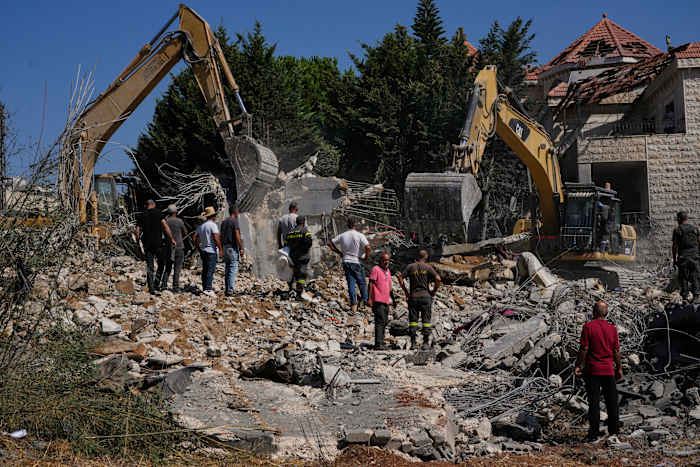
Dust settles differently when it belongs to a home. It is not the grey, polite accumulation of abandoned attics or forgotten bookshelves. It is heavy, jagged, and smells faintly of burnt mortar and torn copper wire. It settles into the folds of sweaters left on chairs, into the grain of family photographs sitting face down on linoleum, and into the hair of men who have spent their entire lives digging through the wreckage of their own histories with their bare hands.
History in this part of the world is rarely written with ink. It is scratched into limestone, poured into concrete foundations, and measured in the decades it takes an olive tree to grow thick enough to bear heavy fruit. Then, an afternoon arrives that can erase forty years of careful pruning and sun-drenched harvests in less than four seconds.
Nine bodies. That is the cold architecture of the report filed across wire services and read aloud by anchors in air-conditioned studios thousands of miles away. Nine lives reduced to a digit, sandwiched between reports of currency fluctuations and diplomatic handshakes. But numbers do not bleed. Numbers do not have mothers who remember the exact weight of them as infants, or neighbors who can point to a shattered corner of a courtyard and recall the precise afternoon laughter echoed off those exact stones.
Consider what happens when the sky decides to fall.
It does not announce itself with thunder. It arrives with a sharp, tearing rip, like heavy canvas splitting down the middle, followed instantly by a concussive thump that rattles the teacups in cupboards three villages over. For a fraction of a second, time stretches. People look up from kitchen tables, from schoolbooks, from the simple, mundane act of peeling cucumbers for lunch. They search the faces of their children for an answer. And then the walls come inward.
We talk about geopolitics as if it were a game of chess played on a polished wooden board by men in tailored suits. We use words like escalation, strategic asset, retaliatory strike, and collateral damage. These are linguistic shields designed to protect the speaker from the horror of the reality they describe. Collateral damage is a clinical term for a grandmother sitting on her front porch with a green plastic watering can by her feet. It is a cousin who was fixing the alternator on an old Renault. It is a nine-year-old girl whose biggest worry that morning was whether she remembered to bring her blue notebook to math class.
I have walked through these ruins after the smoke clears. The silence that follows an airstrike is unlike any other silence on earth. It is not peaceful. It is a stunned, suffocating void. The birds do not sing for hours. The wind seems afraid to rustle the remaining leaves on the battered olive branches. In that silence, the survivors move like ghosts. They do not scream immediately. Scream comes later, after the shock wears thin and the realization sets in that the kitchen they shared breakfast in three hours ago no longer exists. They sift through the grey rubble, turning over shards of blue-glazed plates and twisted iron rebar, looking for a ring, a shoe, a fragment of something familiar that proves their yesterday was real.
A strike in a Lebanese village is never an isolated event. It is a tremor along a fault line that runs deep beneath the collective psyche of a people who have learned to live with one ear perpetually tuned to the horizon. Every family here keeps a bag packed near the door, not out of panic, but out of a weary, generational pragmatism. They know the geography of fear. They know which hills afford shelter and which valleys funnel the sound of incoming fire. Yet knowledge is no armor against gravity and high explosives.
The reports will fade by tomorrow. Another headline will shove this village off the top of the screen. The analysts will move on to dissecting the next strategic maneuver, measuring success in tonnage and tactical advantage. But in the village, the empty chairs remain. The smell of dust lingers in the curtains of the houses that managed to stay standing.
The world looks away because the alternative is too demanding. To truly understand what happened under that shattered roof requires abandoning the comfort of abstraction. It requires looking past the sanitized maps and the arrows pointing north and south, straight into the eyes of a father holding a small, dust-covered schoolbag, wondering how to explain to the empty air that the world kept spinning anyway.