The concrete does not warn you. It does not cry out under the pressure of ten thousand tons of shifting weight, nor does it signal that the welds deep within its iron skeleton are beginning to part like frayed thread. To the commuters driving beneath the overpass that rainy Tuesday afternoon, the massive structure was just part of the background noise of modern life. It was a grey canopy cutting through the heavy South Korean sky, a monument to efficiency.
Then, it became a guillotine.
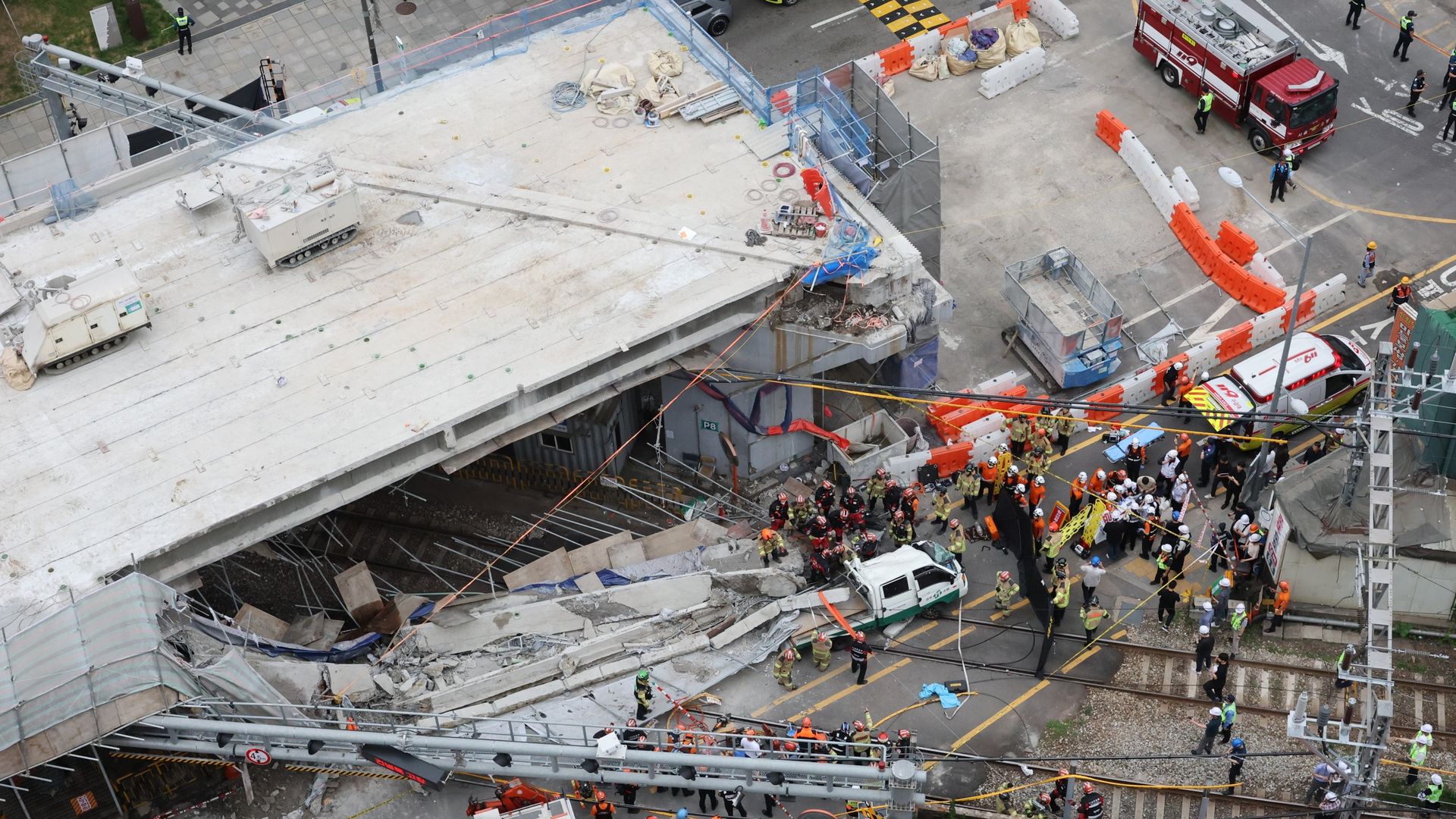
When the overpass collapsed, it did not happen with the slow, cinematic groan we expect from movies. It was instantaneous. A sudden, thunderous crack shattered the air, followed by the terrifying sound of thousands of tons of reinforced concrete slamming into the asphalt below. In a fraction of a second, three lives were extinguished. Just like that. No time to react. No time to swerve. The mundane routine of a daily commute was permanently erased by a catastrophic failure of engineering and oversight.
We look at these tragedies through the cold lens of a news ticker. Three dead. Traffic delayed. Investigation launched. We consume the facts, shake our heads at the horror, and move on to the next headline. But those three numbers represent a profound fracture in the unspoken contract of modern society. Every single day, we place our lives in the hands of invisible engineers, anonymous inspectors, and municipal budgets. We trust that the bridge will hold. We trust that the ground will remain firm.
When that trust breaks, the world splits open.
The Illusion of Solidity
Consider a hypothetical commuter named Ji-hoon. He is thirty-four, running slightly late for a meeting in Seoul, sipping a lukewarm coffee, and listening to a podcast about finance. He passes under the overpass every day at exactly 4:15 PM. To Ji-hoon, and to all of us, infrastructure is invisible. We only notice it when it breaks. We view a bridge as a permanent fixture of the earth, as solid and unyielding as a mountain range.
But engineers view it differently. They know that every structure is alive. It breathes. It expands in the suffocating heat of summer and contracts in the bitter bite of winter. It vibrates with every passing semi-truck. A bridge is a constant, violent war between gravity and human ingenuity.
The problem is that gravity never sleeps. It does not take vacations, it does not suffer from budget cuts, and it never cuts corners. It waits for the slightest hint of human error. A single pocket of rust inside a steel girder. A slight miscalculation in load distribution. A rushed concrete pour to meet a political deadline.
Initial reports from the South Korean ministry point toward a combination of structural fatigue and inadequate drainage that allowed water to pool within the internal supports, accelerating corrosion. It is a story as old as civilization itself. The disaster did not begin when the bridge fell. It began years ago, in quiet rooms where warning signs were ignored, or in maintenance logs where checks were checked off without a second glance.
The Real Cost of Cutting Corners
We live in an era obsessed with the new. We celebrate the groundbreaking ceremonies, the ribbon-cuttings of glistening new smart cities, and the architectural marvels that dominate our social media feeds. Maintenance, however, is deeply unsexy. No politician ever won an election by promising to thoroughly inspect old expansion joints or replace aging bolts deep within a subterranean support pillar.
This creates a dangerous imbalance. We are building a world faster than we can maintain it.
When a nation experiences a meteoric economic rise—as South Korea did during its miraculous post-war development—infrastructure is thrown up at breakneck speed. It is a testament to human will. But those structures, built during the boom years, are all reaching retirement age at the exact same time. The bill is coming due. The three souls lost on that rainy afternoon paid a price for a debt they did not owe.
Imagine the sheer force required to crush a modern vehicle flat. It requires a failure so absolute that the safety cages designed by automotive geniuses become entirely useless. Crumple zones mean nothing when the sky falls. The physical reality of the scene was a grim tableau of twisted metal, shattered glass, and the eerie, rhythmic honking of a car horn trapped beneath the debris, echoing through the pouring rain until its battery finally died.
The Human Element in a World of Metrics
But the real problem lies elsewhere. It sits in our collective psychology. We have become comfortable with a certain baseline of systemic failure. We accept that a certain percentage of things will go wrong because we view society as a massive machine where some friction is inevitable.
Try explaining that friction to a family waiting at a dinner table for someone who will never walk through the door.
The three victims were not statistics. One was a mother returning from a grocery run. Another was a young man on his way to a job interview. The third was a veteran truck driver who had spent thirty years navigating those very roads, surviving countless close calls only to be taken out by the road itself. Their deaths were entirely preventable. That is what sharpens the grief into something jagged and unmanageable. If the inspection had occurred a week earlier, if the warning signs of concrete spalling had been taken seriously, they would be alive today.
Consider what happens next: the inevitable cycle of public outrage and bureaucratic maneuvering. The television cameras arrive, beaming live footage of cranes lifting massive chunks of grey rubble. Officials line up in dark suits, bowing deeply before the cameras in a traditional display of public apology. They promise a thorough investigation. They vow to punish those responsible. They announce an immediate inspection of every similar overpass in the province.
But why does it require blood on the asphalt to trigger a clipboard in the field?
The Friction of Progress
This is not a uniquely South Korean crisis; it is a global one. From the crumbling overpasses of the American rust belt to the rapidly constructed highway systems of developing Asia, we are playing a high-stakes game of jenga with our daily commutes. We patch over cracks with asphalt sealant and hope the core holds. We extend the lifespan of bridges via executive decrees rather than structural reinforcement.
It is easy to blame corrupt contractors or lazy inspectors, but the truth is more uncomfortable. The responsibility is systemic. We demand low taxes and high-speed infrastructure simultaneously. We want the benefits of a hyper-connected world without wanting to look at the staggering cost of keeping that world from falling apart. We treat infrastructure like a software update—something that can be patched on the fly, seamlessly, without interrupting our user experience.
But concrete does not have a digital backup. There is no Ctrl+Z when a structural weld snaps.
The technology to prevent this exists. We have fiber-optic sensors that can detect micro-fissures deep within concrete before they are visible to the human eye. We have acoustic monitoring systems that can hear the microscopic ping of a snapping steel cable inside a pre-stressed girder. We have the data. What we lack is the collective will to prioritize the invisible over the spectacular.
The Echoes in the Rain
The site of the collapse will eventually be cleared. The twisted metal will be hauled off to a scrapyard, the shattered concrete will be ground into aggregate for new roads, and a new, stronger span will be built in its place. Commuters will eventually pass over and under it again, their hearts beating at a normal rhythm, the memory of the three who died fading into a local trivia question.
But for those who understand the true stakes, every bridge becomes a question mark.
You find yourself looking up when you stop at a red light beneath an overpass. You notice the rust stains weeping down the concrete pillars like dark tears. You notice the exposed rebar, rusted to a dull orange, peeking through the chipped facade. You realize just how thin the line is between a normal Tuesday and a catastrophic headline.
The rain continues to fall on the shattered asphalt of the highway, washing away the dust and the fluids of the vehicles caught in the collapse. The blue flashing lights of the emergency vehicles cast long, rhythmic shadows against the raw, broken face of the concrete structure. It stands as a silent accusation. A reminder that our cities are only as strong as the things we choose not to look at, and that the true cost of neglect is never measured in currency, but in the sudden, violent silence of a life cut short.