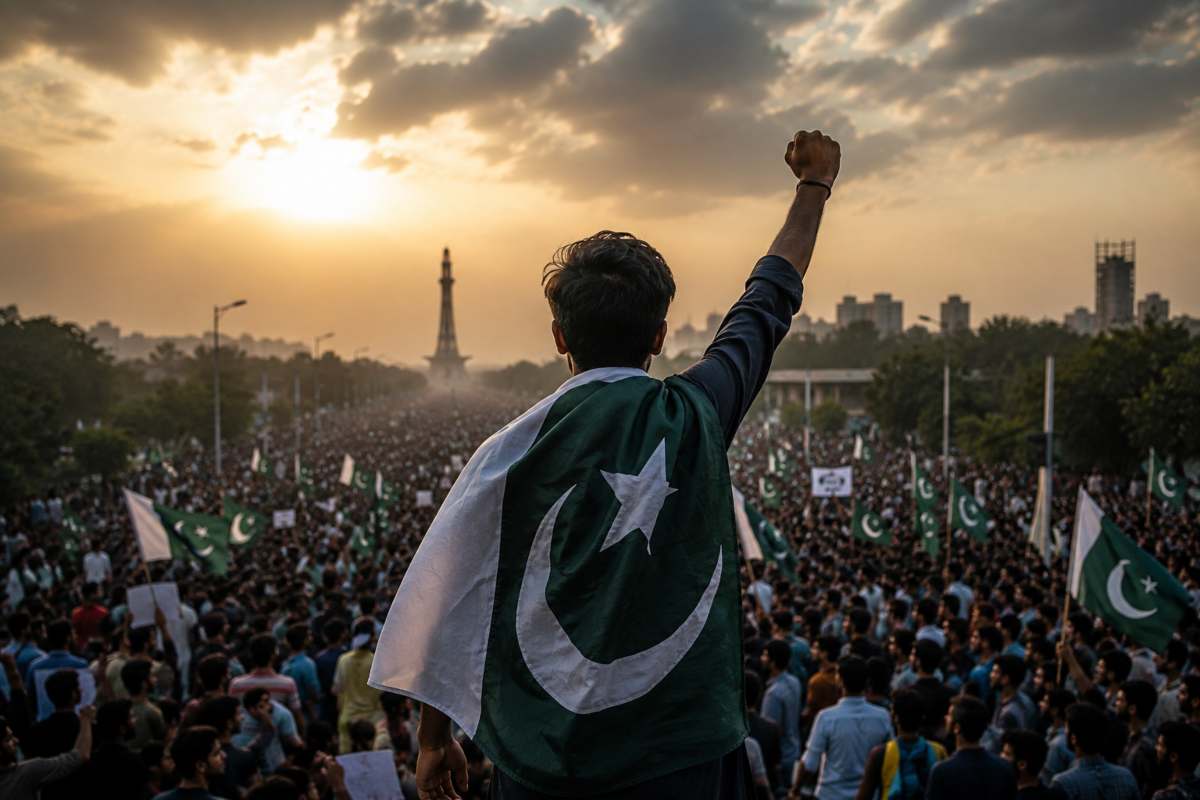
The tea is always hot in the corner stalls of Islamabad, poured back and forth between stained glass cups until a thick froth crowns the rim. Men gather around these tables when the heat of the afternoon breaks, radios crackling with updates on inflation, political wrangling, and court rulings. They argue about power. They argue about who stole what, who signed which decree under pressure, and whose turn it is to rule.
Yet, beneath the noise of these daily debates, a heavy, suffocating quiet settles over the room whenever someone mentions the judiciary, civic activism, or the kind of sustained public movements that reshape a nation. Someone stirs their tea too hard. Someone looks down at their phone. For another perspective, read: this related article.
Silence.
It is a familiar reflex. To understand why massive, sustained civil movements demanding structural judicial independence—similar to the historic lawyers' movement that once galvanized Pakistan—do not easily replicate themselves today, you have to look past the surface of political apathy. You have to look at the geometry of fear, the exhaustion of daily survival, and the structural walls built to contain dissent before it can even draw breath. Further coverage on this matter has been shared by Associated Press.
Consider Tariq. He is a hypothetical shopkeeper in Lahore, though he represents thousands of real faces. Tariq owns a small spare-parts shop. His electricity bill arrived last week, and it was higher than his monthly rent. His margins are razor-thin. When news flashes across television screens about a constitutional amendment or a controversial judicial appointment, Tariq feels a knot in his stomach. Not because he doesn't care about justice—he cares deeply. He knows what it feels like when a local official demands a bribe just to clear a commercial permit. But Tariq has two daughters in college and an elderly mother needing insulin.
For Tariq, taking to the streets isn't a romantic act of civic duty. It is a calculated risk with catastrophic downside.
If he joins a protest march, his shop stays closed. If his shop stays closed, he misses daily revenue. If he gets caught in a police baton charge or detained under maintenance of public order laws, his business could collapse entirely within a week. Survival is a full-time occupation. When every waking hour is consumed by the sheer physics of staying afloat, long-term systemic reform becomes a luxury item reserved for those who do not have to worry about tomorrow's dinner.
This is the first invisible wall. Economic precarity.
When a population is economically exhausted, rebellion is an expensive hobby. Contrast this with the historic lawyers' movement of 2007 to 2009. Back then, the spark was ignited by the direct suspension of a sitting Chief Justice of Pakistan, Iftikhar Muhammad Chaudhry. The legal fraternity—armed with professional standing, organizational networks, a degree of financial cushion, and physical access to courtrooms—led the charge. They had robes, bar associations, and a corporate identity that gave them a shield, however fragile, against total marginalization.
Ordinary citizens rallied behind them, fueled by a collective frustration with military rule. But even then, sustaining that momentum required an extraordinary alignment of political opposition parties, media conglomerates discovering their newfound editorial freedom, and civil society organizations channeling funds and coordination.
That alignment was an anomaly, not a template.
Today, the media landscape is fragmented, heavily monitored, and economically strangled. Digital spaces, once hailed as the great equalizers where grassroots movements could organize without centralized leadership, are heavily policed. Cybercrime laws, surveillance infrastructure, and targeted intimidation mean that a digital spark can be extinguished before it ever hits dry tinder.
People have learned the cost of a viral post. A single video clip recorded at a rally can result in a midnight knock on the door, a sudden disappearance from social media feeds, or formal charges that drag through courts for years. The state's apparatus for managing dissent has evolved from blunt-force suppression to precise, chilling deterrence.
Fear works. It is efficient. It settles into the bones of a society like a chronic ache.
There is another element, too. Disillusionment.
Movements require a shared narrative of hope—the belief that if we stand together under the hot sun, chant the slogans, and face the tear gas, something on the other side will actually change. But Pakistan's political history is a revolving door of dashed expectations. Citizens have marched before. They have voted out prime ministers, welcomed saviors in uniform, cheered for populist reformers, and watched every single one of them compromise with the very system they promised to dismantle.
When every political hero eventually turns out to be mortal, flawed, or deeply invested in personal survival, the public develops a profound cynicism.
Why risk your livelihood for a court system that feels distant, elite, and disconnected from the price of wheat? Why march for judicial independence when the average person's immediate justice crisis is getting a corrupt police officer to register a simple theft report at the local station?
The disconnect between high constitutional debates in Islamabad and the gritty, immediate miseries of daily life is vast. To bridge that gap requires an organizing force that speaks the language of the working class, addresses their immediate material needs, and offers a credible, unshakeable alternative. That force does not currently exist.
Instead, resistance takes quieter, micro-level forms. It happens in private living rooms where people mock the nightly news broadcasts. It happens in remittances sent home from brothers working construction sites in Dubai, keeping families afloat while the national economy stutters. It happens in the quiet resilience of ordinary people solving their own problems entirely outside the state's purview because they have stopped expecting the state to help them.
This is not a lack of courage. Courage is not absent in Pakistan; it is simply rationed. People use it up just to survive the morning commute, to pay the bribes without losing their dignity, to keep their children in school while inflation eats their savings.
To expect massive, sweeping movements for institutional overhaul from a population fighting a daily war of attrition is to misunderstand the human cost of systemic failure.
The tea gets cold in the glass. The men at the table finish their discussion, fold their newspapers, and pay their bills. They walk back out into the dust and the exhaust fumes, heading home to calculate how they will stretch next month's salary. The constitutional crisis remains unsolved, hovering in the upper echelons of power like distant lightning over the mountains, while down in the streets, the quiet, heavy work of enduring continues.


