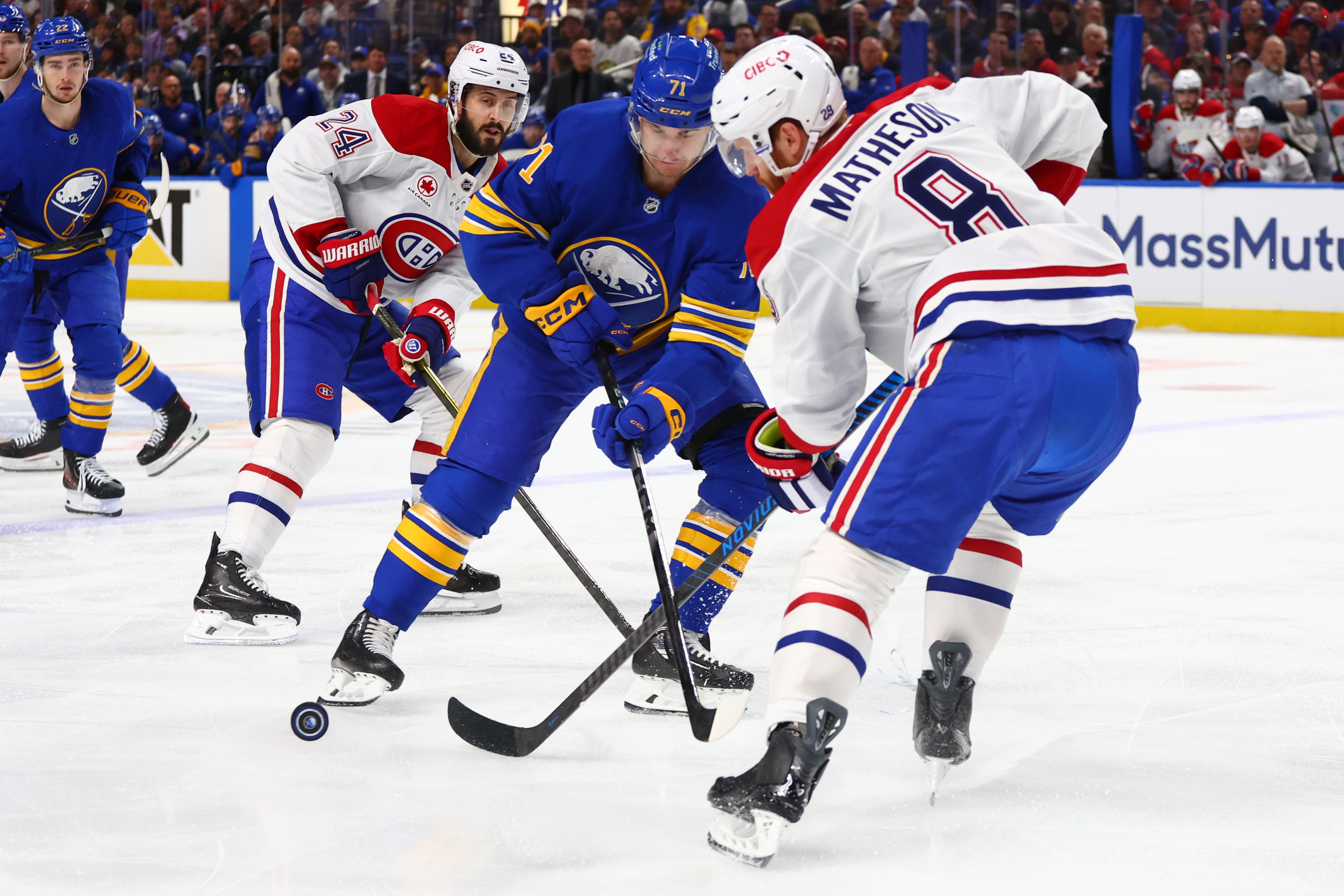
The air inside the Bell Centre doesn't just circulate; it breathes. On opening night, that breath is heavy with the scent of overpriced drafts, expensive cologne, and the collective anxiety of several million people who view a hockey team not as a hobby, but as a primary character trait.
For the Montreal Canadiens, the beginning of a season isn't a fresh start. It is a debt collection. Every player who pulls that storied red jersey over his head is suddenly a custodian of twenty-four Stanley Cup banners and the ghost of Maurice Richard. It is a heavy garment. Sometimes, it looks like it weighs a hundred pounds.
Against the Buffalo Sabres, that weight was visible.
The Mirage of Momentum
The game began with the kind of frantic energy that suggests a team is trying to win the season in the first ten minutes. Montreal came out with a snarl. They were fast, aggressive, and for a fleeting moment, they looked like the juggernaut the city demands them to be. The puck moved with a sharp, rhythmic snap. The crowd was a roar that felt physical.
Then, the first crack appeared.
Hockey is a game of mistakes disguised as a game of skill. You can do ninety-nine things right, but if the hundredth thing involves a missed assignment in the defensive zone, the scoreboard doesn't care about your effort. Buffalo, a team often dismissed as being in a perpetual state of "rebuilding," didn't panic. They waited. They watched the Canadiens exhaust themselves in a flurry of unproductive motion.
When the Sabres finally struck, it wasn't a masterpiece of technical brilliance. It was a cold, clinical exploitation of a Montreal defense that had wandered too far from home. One-nil. The roar in the arena didn't vanish; it curdled. It turned into that specific, low-frequency murmur that happens when twenty thousand people simultaneously remember that they’ve seen this movie before.
The Loneliest Man in the Building
To understand a 4-2 loss, you have to look at the goalie.
In Montreal, the goaltender is a sacrificial lamb in pads. When the score was tied, and then when it slipped away, the camera kept finding the man in the crease. You could see it in the set of his shoulders. Every time a Buffalo forward broke through the neutral zone, the goaltender wasn't just facing a shooter; he was facing the mounting realization that his margin for error had evaporated.
Buffalo’s second goal was a heartbreaker. It was a scramble, a chaos of limbs and composite sticks, the kind of play where the puck seems to have a mind of its own. It trickled past the line with a sickening slow-motion inevitability.
The goaltender stood up and stared at the rafters. In that moment, he wasn't an elite athlete. He was a guy having a very bad day at the office, except his office has no walls and his mistakes are broadcast in high definition to a province of amateur critics. He looked small. The net behind him looked cavernous.
The Invisible Stakes
Why does a random loss in the first series of the year matter?
Logic says it doesn't. There are eighty-one games left. The math is on their side. But hockey in Montreal doesn't run on logic. It runs on narrative. A loss to Buffalo isn't just two points dropped; it’s a seed of doubt planted in the frozen soil of October.
The players know this. You could see it in the way the veterans started over-handling the puck in the second period. They were trying to manufacture a miracle. Instead of taking the simple pass, they looked for the highlight-reel play, the one that would silence the doubters and restore the natural order of things.
But the more you squeeze a handful of sand, the faster it slips through your fingers.
Buffalo played a "boring" game. They stayed in their lanes. They didn't chase the big hit. They were content to let Montreal beat Montreal. By the time the third period rolled around, the Canadiens looked like a team running uphill in deep snow. They were tired, not in their legs, but in their heads.
The Anatomy of the Collapse
The fourth goal was the finality.
It came after a brief surge where Montreal managed to claw back within one. For three minutes, the building was alive again. The "Ole, Ole, Ole" chant started to build, a fragile hope rising from the concrete. Then, a turnover at the blue line. A breakaway. A clinical finish.
4-2.
The sound that followed wasn't a boo. It was the sound of seats flipping up. It was the sound of thousands of people deciding that beating the traffic was more important than watching the final three minutes of a foregone conclusion.
There is a specific kind of silence that descends on a losing locker room. It’s not a quiet peace; it’s a ringing, heavy void. The players strip off their gear, their breath still coming in ragged gasps, and they look at the floor. They know the headlines are already being written. They know the radio shows will be filled with callers demanding trades, line changes, and divine intervention.
The Human Cost of the Game
We talk about stats. We talk about Corsi and Fenwick and expected goals. We analyze power play percentages until our eyes bleed. But none of those numbers capture the feeling of a young defenseman who just realized his missed block led to the game-winner.
The human element of the 4-2 loss is the part we ignore because it's uncomfortable. We want these men to be gladiators, immune to the pressure, unaffected by the weight of the city. But they aren't. They are twenty-somethings who are acutely aware that they are failing to live up to a legend they didn't create.
The Sabres walked out of the Bell Centre with two points and a quiet confidence. They did their job. They played the spoiler. For them, it was a successful business trip.
For the Montreal Canadiens, it was a reminder that the jersey is heavy.
As the lights dimmed and the ice scrapers began their lonely work, the banners stayed where they were, hanging in the darkness. They didn't care about the 4-2 score. They’ve seen it all before. They know that the season isn't won or lost in a single night in October, but they also know that every loss adds another ounce of lead to that red sweater.
The players walked out to their cars, through the tunnels, past the fans waiting in the cold for an autograph or a glimpse of a hero. The heroics would have to wait for another night. For now, there was only the long drive home and the knowledge that tomorrow, the weight would still be there, waiting for them in the locker room.
The ghosts of the Forum are patient, but they are never silent.