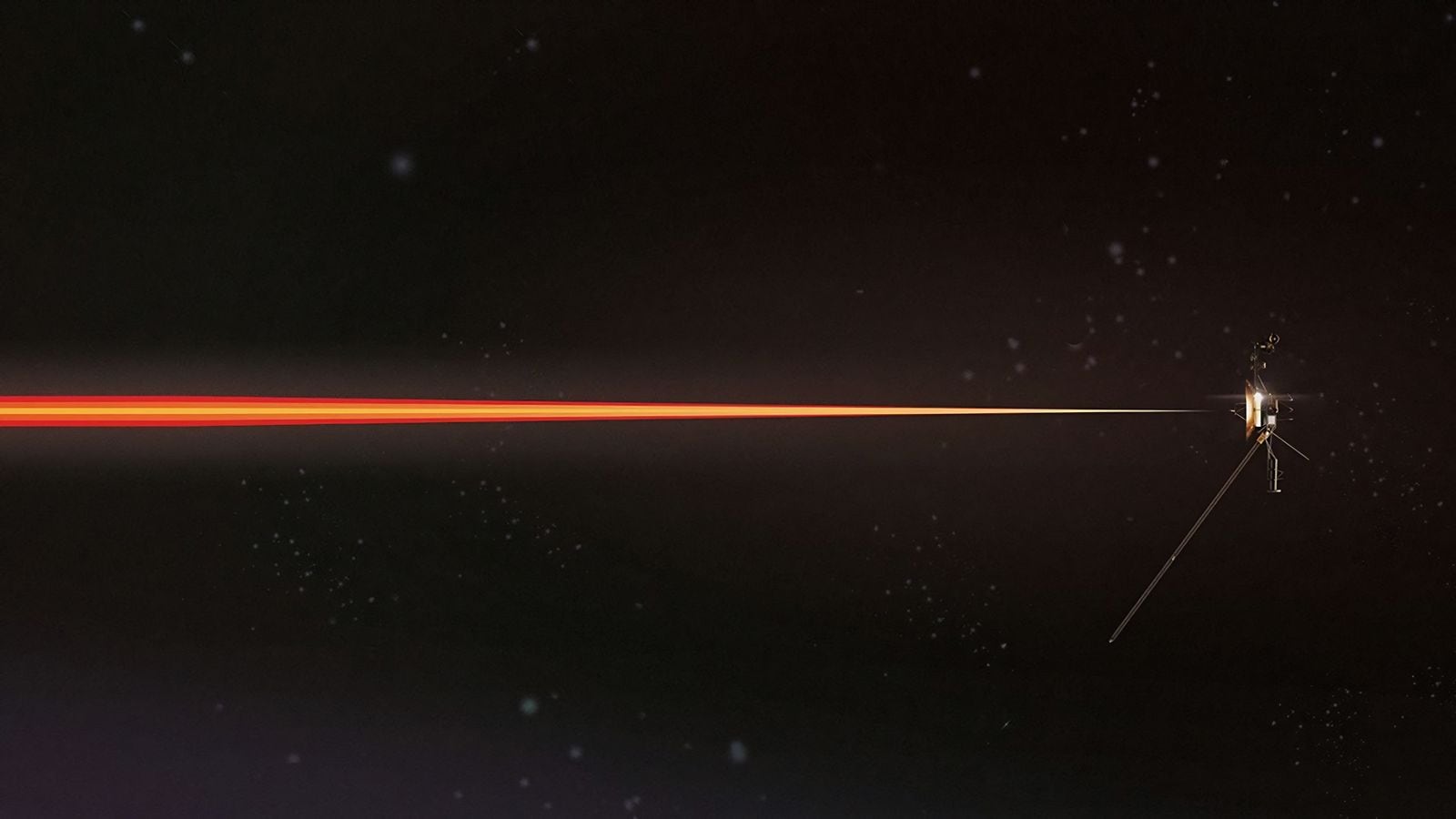
Every space blog on the internet is throwing a digital parade because NASA’s Voyager 1 just crossed the one light-day threshold—roughly 16 billion miles from Earth—nearly fifty years after launching in 1977.
Pop the champagne. Write the tear-jerking op-eds about human ingenuity. Marvel at the Golden Record floating through the dark.
Now stop and look at the actual numbers.
Taking half a century to travel twenty-four hours at the speed of light isn't a triumphant leap into the cosmos. It is the aerospace equivalent of spending five decades trying to crawl across a single-lane highway while Ferrari engines sit rusting in the garage. Celebrating Voyager 1’s distance milestone as proof of our interstellar readiness is the laziest consensus in modern science journalism, and it actively blinds us to how stagnant human propulsion technology has become.
The Illusion of Interstellar Speed
When mainstream outlets report that Voyager 1 is screaming through space at roughly 38,000 miles per hour, your brain registers that as incomprehensibly fast. Compared to a Boeing 737, it is. Compared to the geometry of the universe, Voyager 1 is practically parked.
To understand why the "one light-day" headline is a psychological trick, you have to strip away the romanticism and look at the math of cosmic scales:
- One light-day is approximately 16.08 billion miles (25.88 billion kilometers).
- One light-year is roughly 5.88 trillion miles.
- The nearest star system, Alpha Centauri, sits 4.37 light-years away.
Do the division. If Voyager 1 were pointed directly at Proxima Centauri—which it isn't—it would take more than 73,000 years to get there.
Let that sink in. Seventy-three millennia. That is longer than the entire recorded history of human civilization multiplied by twelve. When writers frame 16 billion miles as humanity "touching the stars," they are selling a comforting fiction. Voyager 1 hasn't conquered interstellar space; it has barely stepped off the front porch. It crossed the heliopause—the boundary where the Sun’s solar wind gives way to the interstellar medium—back in 2012, yet it remains firmly trapped inside the Sun's gravitational well. It won't even reach the inner edge of the Oort Cloud, the spherical shell of icy debris surrounding our solar system, for another 300 years. Passing through that cloud will take another 30,000.
I’ve spent years watching aerospace contractors and public relations teams spin legacy hardware milestones into distraction campaigns. Whenever an agency lacks a funded, high-impulse deep-space architecture on the launchpad, the press releases pivot hard to nostalgia. Voyager 1 is a magnificent piece of 1970s engineering—nobody disputes the brilliance of the Jet Propulsion Laboratory (JPL) engineers who built a spacecraft that outlived its warranty by forty-five years. But worshiping a 49-year-old relic while our current deep-space probes still rely on the exact same chemical combustion and planetary gravity assists is a symptom of technological stagnation, not progress.
The Physics Trap of Chemical Propulsion
Why is Voyager 1 moving so slowly? Because it is a victim of the Tsiolkovsky rocket equation, the unforgiving mathematical tyrant that governs every mission we launch.
Chemical rockets work by burning propellants to throw mass out the back of a nozzle. To go faster, you need more fuel. To carry more fuel, you need a bigger rocket, which requires even more fuel just to lift the extra weight off the launchpad. You hit an exponential wall almost immediately.
Voyager 1 only achieved its current velocity because of a rare, once-every-175-years planetary alignment known as the Grand Tour. JPL trajectory designers like Gary Flandro realized in the 1960s that Jupiter, Saturn, Uranus, and Neptune would align in a way that allowed a single spacecraft to steal orbital momentum from each giant planet via gravity assists. Without those planetary slingshots, chemical rockets couldn't have pushed Voyager 1 out of the solar system at all.
Here is the uncomfortable truth the celebratory articles leave out: if we launched a chemical rocket toward interstellar space today without a lucky planetary alignment, it would actually travel slower than Voyager 1.
The Radioisotope Bottleneck
Even if Voyager 1 were moving ten times faster, it would still be flying blind and deaf before it ever reached another star. The spacecraft runs on three Multi-Hundred-Watt Radioisotope Thermoelectric Generators (MHW-RTGs), which convert heat from decaying plutonium-238 into electricity.
Plutonium-238 has a half-life of 87.7 years. Combined with degrading thermocouples, Voyager 1 loses roughly 4 watts of electrical power every single year. At launch in 1977, it had about 470 watts to work with—less than a standard microwave oven. Today, it is operating on barely more than 200 watts.
Every few months, flight controllers in Pasadena have to make agonizing triage decisions, shutting off heaters and turning off instruments just to keep the main transmitter alive. Within the next decade, Voyager 1 will go completely dark. It will become a silent, freezing aluminum corpse drifting through the void, completely useless for science long before it covers even a fraction of a percent of the distance to the nearest star.
Dismantling the "People Also Ask" Myths
When headlines about Voyager 1 trend, millions of readers type the same three questions into search engines. Every single one of those questions is built on a flawed premise pushed by pop-science coverage.
1. "Has Voyager 1 officially left the solar system?"
No. And claiming it has is an insult to basic orbital mechanics.
Media outlets conflate leaving the heliosphere with leaving the solar system. The heliosphere is a magnetic bubble inflated by the Sun’s solar wind. Crossing its boundary (the heliopause) means Voyager 1 is now swimming in interstellar plasma rather than solar plasma. That is a fascinating meteorological shift, not a gravitational escape. The solar system ends where the Sun’s gravity stops dominating other stars—roughly halfway to Alpha Centauri, around two light-years out. Voyager 1 has traveled 0.0027 light-years. It is still a prisoner of the Sun.
2. "Could aliens find the Golden Record?"
Only if they are already sitting in our cosmic backyard looking for scrap metal.
Carl Sagan’s Golden Record was a brilliant piece of public diplomacy and human storytelling, but as an actual communication protocol, it is a lottery ticket with odds worse than zero. Space is overwhelmingly empty. Unless Voyager 1 passes directly through a dense planetary system—which its current trajectory does not do for at least 40,000 years, when it will pass within 1.6 light-years of the star Gliese 445—no solid object will ever come near it. Even if an alien civilization somehow detected a cold, dead, 1,600-pound piece of metal moving at 17 kilometers per second in the pitch black between stars, catching it would require an energy expenditure so massive that any species capable of doing it would already know we exist from our radio leakage.
3. "Is Voyager 1 still the fastest man-made object?"
Not even close.
Voyager 1 holds the record for the most distant human-made object, not the fastest. NASA’s Parker Solar Probe obliterated Voyager’s speed record years ago, hitting speeds exceeding 394,000 miles per hour—more than ten times faster than Voyager 1—by diving straight into the Sun's steep gravity well. The distinction matters because it exposes how misleading raw velocity stats are when divorced from orbital trajectory. Falling toward a massive gravity well is easy; climbing out of one against the Sun’s pull is brutally hard.
The Nuclear Engine We Abandoned
The real tragedy behind the Voyager 1 headlines isn't that the probe is slow. It is that we already knew how to build something radically faster before Voyager 1 even left the drawing board, and we walked away from it.
In the 1960s and early 1970s, NASA and the Atomic Energy Commission ran Project NERVA (Nuclear Engine for Rocket Vehicle Application). Instead of burning chemical fuel, NERVA used a compact nuclear fission reactor to superheat liquid hydrogen and blast it out of a nozzle.
The tests worked. NERVA engines achieved a specific impulse (the aerospace metric for fuel efficiency) roughly double that of the best chemical rockets ever built. A nuclear thermal propulsion stage could cut transit times to the outer planets in half and push interstellar precursor probes out of the solar system at velocities that would make Voyager 1 look like it was moving in reverse.
We killed the program in 1973 due to shifting political priorities, budget cuts after the Apollo wind-down, and cold-feet regulatory paranoia over launching fissile material.
If you want to go even further back into the history of abandoned brilliance, look at Project Orion—the brainchild of physicist Freeman Dyson and mathematician Stanislaw Ulam in the late 1950s. Orion proposed propelling a massive spacecraft using a series of small, shaped nuclear pulse units detonated behind a heavy pusher plate. The physics was sound. The math checked out. An Orion-class starship could theoretically reach 3% to 5% of the speed of light, turning a 73,000-year slog to Alpha Centauri into a single human lifetime.
We signed the Partial Test Ban Treaty in 1963, effectively outlawing the concept, and settled for chemical firecrackers instead.
What Real Interstellar Engineering Looks Like
If we want to stop celebrating 50-year crawls to one light-day and actually become an interstellar species, we have to abandon the paradigm of carrying our fuel with us.
There is an obvious caveat here, and intellectual honesty requires admitting it upfront: high-energy deep-space propulsion is terrifyingly expensive, politically toxic, and carries catastrophic failure risks. Launching a nuclear reactor or firing a gigawatt-scale laser array in Earth orbit isn't something you iterate on with the "move fast and break things" Silicon Valley playbook. One launchpad explosion with a dirty reactor core sets spaceflight back three decades.
However, accepting zero risk guarantees zero progress. Right now, there are only three architectures capable of breaking the chemical tyranny that trapped Voyager 1:
- Beamed-Energy Propulsion (Laser Sails): Pioneered conceptually by physicist Robert Forward and modernized by initiatives like Breakthrough Starshot, this approach leaves the heavy engine on Earth or in lunar orbit. A phased array of ground-based lasers fires a concentrated 100-gigawatt beam at a wafer-thin, gram-scale spacecraft attached to a light sail. Radiation pressure accelerates the probe to 20% of the speed of light within minutes. At that velocity, a probe passes Voyager 1’s current 16-billion-mile mark in less than five days, and reaches Alpha Centauri in twenty years.
- Nuclear Electric Propulsion (NEP) with Magnetoplasmadynamic Thrusters: Instead of using a nuclear reactor to heat gas directly, an NEP system uses a fission reactor to generate megawatts of electricity, powering high-thrust plasma engines. Unlike chemical rockets that burn for minutes and coast for decades, plasma thrusters fire continuously for years, compounding acceleration until the spacecraft reaches staggering velocities.
- Fusion-Driven Rockets: Magneto-inertial fusion engines—currently being researched by teams like Helicity Space and Pulsar Fusion—aim to fuse deuterium and helium-3 to create exhaust velocities orders of magnitude higher than fission. If controlled fusion achieves net energy gain in a compact form factor, the solar system shrinks from decades to months.
Stop Worshiping the Rearview Mirror
Voyager 1 is a monument to what human beings could achieve with slide rules, 69 kilobytes of computer memory, and audacious trajectory math in the 1970s. Respect the engineers who built it. Honor the technicians at NASA’s Deep Space Network who still manage to pull a whisper-quiet 23-watt radio signal out of the cosmic background noise across 16 billion miles of emptiness—a signal weaker than the energy generated by a single snowflake hitting the ground.
Just stop pretending that crawling one light-day in half a century is a victory lap for modern spaceflight.
Every time we treat a 1977 probe's odometer reading as breaking technological news, we lower the bar for what our aerospace institutions should be building right now. You don't win a cross-country race by bragging about how far your grandfather’s bicycle rolled down a hill fifty years ago.
Turn off the nostalgia machine, fund high-impulse nuclear and beamed-energy propulsion, and build something that can actually pass Voyager 1 before the people reading this article die of old age.