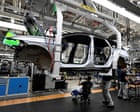
The financial press is currently treating the standoff at Volkswagen’s Wolfsburg headquarters like an unexpected tragedy. On one side, CEO Oliver Blume and CFO Arno Antlitz are trying to push through a massive restructuring package: 100,000 job cuts worldwide and the closure of four major German manufacturing plants, including Zwickau and Audi’s Neckarsulm site. On the other side, Christiane Benner of the IG Metall union and works council head Daniela Cavallo are leading mass protests, screaming that management is passing the buck for leadership failures onto the workforce.
The media’s consensus is painfully lazy. The narrative says that VW is a victim of external shocks—sudden Chinese EV competition, slowing demand in Europe, and shifting trade tariffs. The prescription from politicians in Berlin and Lower Saxony is always the same: compromise, preserve the factories, and protect German domestic manufacturing at all costs.
That consensus is entirely wrong.
The planned factory closures and massive layoffs are not a tragedy; they are a decade overdue. The real crisis isn't that VW is shrinking. The crisis is that the German auto giant has spent the last twenty years operating as a state-subsidized employment agency disguised as a car manufacturer. Trimming the edges through natural attrition or voluntary buyouts will not fix this. If Volkswagen wants a future, it needs to break the power of its labor unions, stop treating its domestic factories like holy shrines, and completely dismantle its current corporate structure.
The Myth of the Structural Underdog
Mainstream analysts love to blame the current crisis on external market forces. They point to Chinese EV brands undercutting European prices, or the sudden cooling of the electric vehicle market. This completely misdiagnoses the disease. High labor and energy costs are merely a symptom. The root cause is a fundamental lack of capital efficiency engineered by the company's own governance structure.
I have spent years watching legacy corporations burn billions trying to optimize broken, legacy operational setups because they lack the political courage to kill them. Look at the hard numbers. Mobility Global data shows that Volkswagen’s domestic car factories are on track to operate at an abysmal 81% capacity this year. By 2030, that utilization rate is projected to collapse to 73%. Zwickau—the supposed poster child of VW's electric transition—is looking at a capacity utilization cliff, dropping from 88% down to an unmitigated disaster of 42% by the end of the decade.
No industrial business can survive when its primary manufacturing assets sit idle more than half the time.
The standard union line is that management messed up the EV product pipeline. But the truth is much uglier: VW cannot build an affordable EV because its German labor costs make it mathematically impossible. The company's operating margin has been hovering around a pathetic 4.3%. For context, to fund the massive capital expenditures required for next-generation software architectures and autonomous platforms, a mass-market automaker needs a consistent return on sales of at least 8% to 10%.
You cannot reach an 8% margin when you are paying premium Western European manufacturing wages to assemble legacy sheet metal that the global market no longer wants. The labor unions aren’t defending the future of automotive technology; they are defending an unsustainable 20th-century welfare model.
The Stranglehold of Lower Saxony and IG Metall
To understand why Volkswagen is uniquely unequipped to handle the realities of modern manufacturing, you have to look at the Volkswagen Act of 1960. The state of Lower Saxony owns a 20% voting stake in the company. Under the law, any major strategic decision—like, say, closing a factory—requires a 80% supermajority.
This means the local government and the labor unions, who together control half the seats on the supervisory board, have a functional veto over basic economic reality.
Imagine running a global business where your board’s primary incentive is not profitability, return on equity, or technological supremacy, but winning the next regional political election. Every time a VW executive tries to adjust the workforce numbers to match market demand, the politicians and union bosses lock arms to block it.
We saw this exact script play out at the end of 2024. Management wanted structural cuts. The union threw a tantrum, threw up blockades, and forced a compromise that guaranteed no German plant closures until 2030. What happened? Less than two years later, the company is bleeding cash, shares are sitting at 16-year lows, and they are back at the negotiating table asking for double the layoffs because the 2024 deal was completely detached from commercial reality.
The contrarian truth that nobody in Wolfsburg wants to admit is that the union's protectionism is the very thing destroying the company's long-term viability. By forcing VW to maintain bloated, underutilized factories like Hanover and Emden, IG Metall has starved the company of the capital needed to invest in software and battery chemistry.
The Cost of the Counter-Intuitive Fix
Let's look at the actual mechanics of what Oliver Blume is trying to do. The leaked restructuring plan goes far beyond firing assembly line workers. Management is quietly preparing to spin off the core VW brand and its massive components business into completely separate legal entities. They are even putting crown jewels like Lamborghini and Ducati back on the auction block, fresh off the heels of the Everllence divestment.
This is exactly the right move, and it highlights the hidden downside of the contrarian path: to save the enterprise, you have to kill the legacy brand identity.
The core "VW" badge is an economic anchor dragging down the profitable segments of the business like Porsche and Audi. For decades, the high margins of the luxury brands have been siphoned off to subsidize the inefficient, union-protected mass-market assembly lines in Germany. By carving out the core brand and the components division, Blume is effectively trying to isolate the toxic asset.
If the core VW brand cannot survive on its own merits without being propped up by luxury SUV sales, it deserves to downsize.
Is there a risk to this aggressive, scorched-earth strategy? Absolutely. A full-scale corporate divorce and a head-on collision with IG Metall will result in rolling strikes, massive production disruptions, and political fallout that could paralyze the company for twelve to eighteen months. The reputational hit in Germany will be severe. But the alternative is slow, agonizing liquidation via market irrelevance.
Dismantling the Premise of the Corporate Defense
When looking at the public debate around this corporate showdown, the questions being asked by the public and politicians are fundamentally flawed.
Why can't Volkswagen just retrain its factory workers for software roles?
This is a fantasy pushed by politicians who don't understand tech or manufacturing. Assembly line manufacturing and software engineering require completely distinct skill sets. You cannot take 45,000 workers trained in mechanical assembly, put them through a twelve-week coding bootcamp, and expect them to compete with software engineers in Silicon Valley or Shenzhen. The architecture of a modern vehicle requires a complete top-down rewrite of the software stack, not a legacy workforce trying to learn how to write basic script. VW doesn't need to retrain its domestic workforce; it needs to replace the legacy roles with pure-play software talent, most of which will not be based in Germany.
Can the German government step in with subsidies to save the factories?
They can try, but it will only accelerate the collapse. Government bailouts and subsidies create a moral hazard that rewards inefficiency. Look at the history of British Leyland or Detroit in the 2000s. Taxpayer-funded life support allows management and unions to avoid making the brutal structural changes required to compete. Every euro Berlin spends to keep an underutilized line running in Zwickau is a euro taken away from real, competitive R&D.
The Actionable Mandate for Legacy Industry
If you are an executive, investor, or board member sitting in a legacy industrial company watching the Volkswagen drama unfold, you cannot afford to treat this as an isolated automotive problem. This is a case study in structural inertia.
The mandate is clear: stop indexing your business strategy to political goodwill or historical sentiment. If your asset utilization is dropping below 80%, you close the asset. If your corporate governance allows non-commercial actors to veto operational decisions, you restructure the governance or move your capital elsewhere.
Volkswagen’s management must not blink this time. They must ignore the protests outside the gates, override the regional politicians of Lower Saxony, and push through the full 100,000 headcount reduction and the four factory closures. The era of the German industrial welfare state is dead, and the sooner Wolfsburg buries it, the sooner it can start building a viable company.