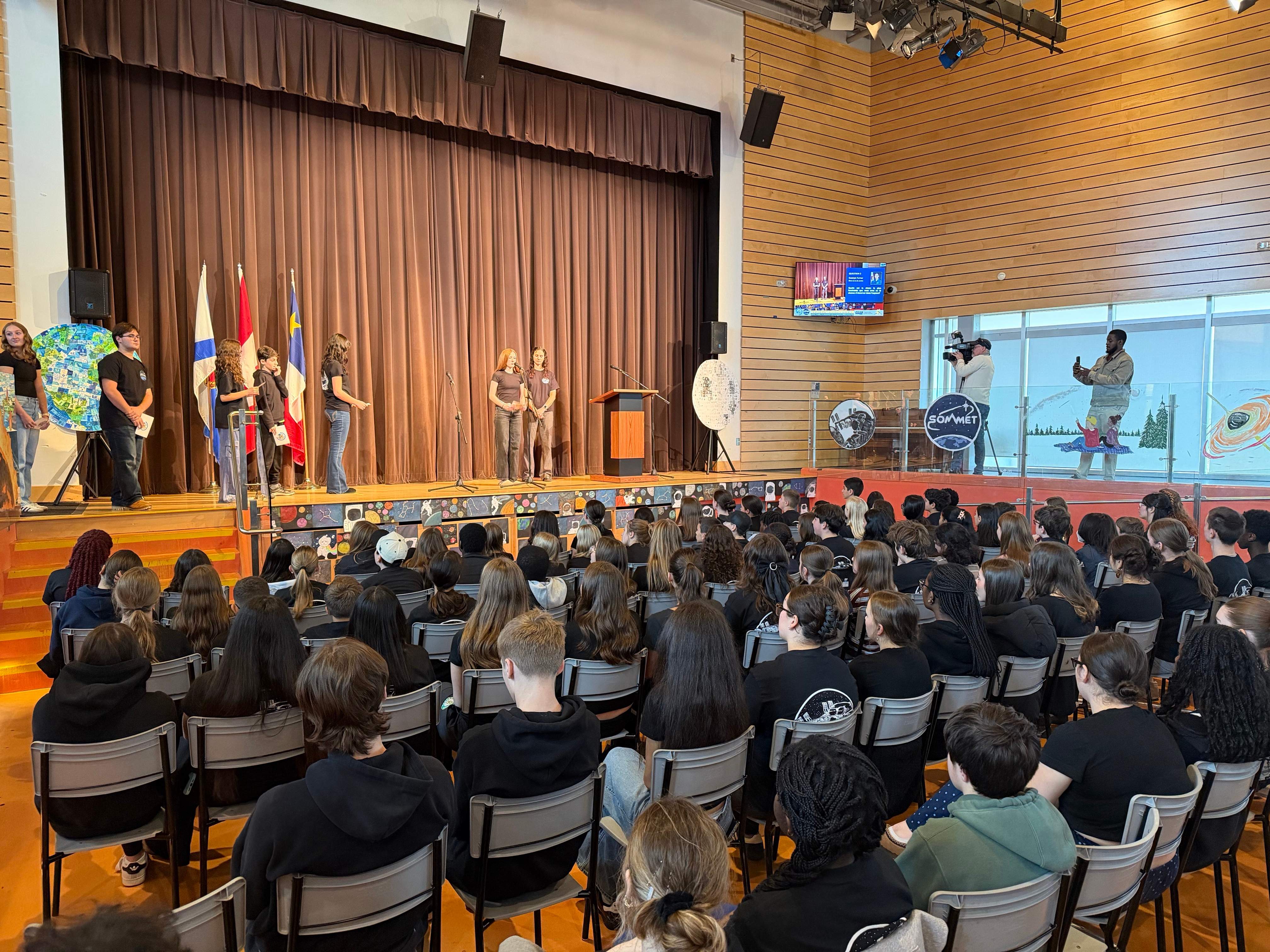
Silence has a weight in a gymnasium full of twelve-year-olds.
Usually, a school assembly in Halifax sounds like sneakers squeaking on varnished maple, the low rumble of restless knees, and the crinkle of smuggled granola bar wrappers. But on a Tuesday morning when a radio frequency connects a coastal Canadian classroom to a metal tube hurtling 400 kilometers above the Atlantic Ocean at 28,000 kilometers per hour, the air changes. Every breath stops. A hundred pairs of eyes lock onto a single screen, waiting for a voice to drop out of the static. Building on this topic, you can also read: The Operational Architecture of SpaceX Starship Flight 15.
They are not asking about orbital mechanics. They do not care about microgravity fluid dynamics or the political treaties governing low-Earth orbit.
A kid steps up to the microphone, clears his throat, and asks the only question that truly matters to a human being staring at the stars. Experts at The Next Web have shared their thoughts on this situation.
"How does space smell?"
It is a disarmingly simple query. Yet it pierces right through decades of sanitized aerospace engineering, revealing the raw, sensory reality of leaving our planet behind. When a Canadian astronaut floating aboard the International Space Station smiles and answers that question, he is doing far more than satisfying classroom curiosity. He is bridging the most terrifying distance humanity has ever engineered.
The Invisible Distance Between a Desk and the Stars
To understand why a ten-minute radio call between Nova Scotia and the International Space Station carries such emotional voltage, you have to strip away the sci-fi glamour. Spaceflight is largely reduced to sterile press releases and telemetry graphs. We see astronauts smiling in crisp blue flight suits, floating effortlessly past camera lenses, making the impossible look like a casual afternoon swim.
That illusion hides a brutal truth.
Space is violently hostile to human biology. Outside the thin aluminum skin of the station—a shell barely thicker than a soda can in certain structural zones—lies a hard vacuum where unprotected blood boils and temperatures swing wildly from 121 degrees Celsius in direct sunlight to minus 157 degrees in the Earth's shadow. Getting a human voice from that lethal void down to a microphone in Halifax requires a ballet of orbital physics, amateur radio relays, and split-second timing.
Picture a hypothetical twelve-year-old named Maya sitting in the third row of that Halifax gymnasium. To illustrate what happens during these connections, consider how fragile the link actually is. The International Space Station completes an orbit around Earth every ninety minutes. It does not hover over Nova Scotia; it screams past the coastline like a rifle bullet. From the moment the station rises above the local horizon to the moment it dips below the curve of the Earth on the opposite side, the ground antenna has roughly ten minutes of line-of-sight contact.
Ten minutes.
If a cable loosens, if atmospheric interference spikes, or if a student freezes at the podium, the window slams shut. The station vanishes over the horizon at nearly eight kilometers per second, leaving the room staring at a blank screen. That ticking clock transforms an ordinary school day into a high-stakes mission. Every second has to count. Every question has to earn its place in the queue.
Why the Vacuum Has a Scent
When the signal locks in and the audio clears, the astronaut aboard the ISS does not give a textbook definition of a vacuum. Technically, space has no air, which means a human cannot sniff the cosmos directly without fatal consequences. If you took off your helmet outside the airlock, you wouldn't smell anything before losing consciousness in roughly fifteen seconds.
Instead, the astronaut describes what happens when you come back inside.
After a spacewalk, astronauts re-enter the airlock, repressurize the chamber, and pull off their helmets. That is when the smell hits them. It clings to the fabric of their spacesuits, the metallic surfaces of their tools, and the seams of their gloves. Astronauts across generations—from Apollo moonwalkers to modern ISS crews—describe an unmistakable, jarring aroma.
Seared steak. Hot metal. Welding fumes. Burnt almond cookies. Gunpowder.
The chemistry behind this phenomenon is as fascinating as the sensory shock. Atomic oxygen—single oxygen atoms split apart by fierce ultraviolet radiation from the sun—clings to the exterior of spacesuits and spacecraft hulls while in low-Earth orbit. When the astronaut returns inside the airlock and repressurizes the cabin with normal air, those hyper-reactive single oxygen atoms combine with standard molecular oxygen to form ozone, while triggering rapid oxidation reactions on the suit materials.
The result is the sharp, acrid tang of a welding torch mixed with charred meat.
Think about what that revelation does to a child in a Halifax school gym. For their entire lives, space has been an abstraction—black velvet dotted with cold white pinpricks on a classroom poster. Suddenly, space has a texture. It smells like a summer barbecue gone slightly wrong and a mechanic's garage after a long shift. The abstract void collapses into something visceral, messy, and real.
I remember the first time I stood beside a decommissioned thermal vacuum chamber at a space testing facility, catching a faint whiff of baked Kapton tape and scorched metal after a pressure cycle. That smell stays in the back of your throat for hours. It strips away the sterile, cinematic polish of space exploration and replaces it with the undeniable scent of heavy industry operating at the edge of survival. You realize immediately that astronauts are not mystical sky-travelers; they are mechanics, plumbers, and electricians working inside a life-support machine that smells like hot wires and ozone.
The Architecture of a Ten-Minute Miracle
Behind that effortless moment at the microphone lies a quiet network of volunteers and engineers who spend months preparing for ten minutes of magic. The program that makes these connections possible—Amateur Radio on the International Space Station, known globally as ARISS—operates on a philosophy that feels almost rebellious in an era of multi-billion-dollar aerospace conglomerates.
They use ham radio.
While space agencies rely on billion-dollar satellite tracking networks to manage telemetry and command data, ARISS equips the space station with comparatively simple amateur radio transceivers. When a school in Halifax wins a coveted slot on the schedule, local amateur radio operators haul antennas onto the school roof, run coaxial cables through ceiling tiles, and test frequencies against coastal weather patterns.
Consider the sheer vulnerability of that setup. There is no massive corporate redundancy backing up a school gymnasium link. There are retirees who spent forty years tinkering with shortwave transmitters in their basements, standing beside teenagers who have never seen an analog dial, all staring at an azimuth-elevation rotator tracking an invisible dot across the Canadian sky.
When the call sign crackles through the speakers—"Charlie Foxtrot One Sierra Sierra, this is..."—the room experiences a collective intake of breath. In an age where instant communication is completely taken for granted, where video calls across continents happen with a careless tap on a glass screen, watching adults and children sweat over a ten-minute radio pass restores a sense of sacredness to human connection.
We have forgotten how hard it is to reach across distance. Because our phones connect us everywhere instantly, we assume proximity is cheap. Watching a classroom wait for the orbital mechanics of the Earth to align just so they can ask a fellow Canadian what his bedroom smells like reminds us that true connection requires effort, patience, and alignment.
What Living in Orbit Actually Feels Like
Once the ice breaks with the smell of seared steak, the Halifax students press deeper into the daily absurdities of orbital life. This is where the human narrative truly catches fire, because children possess an instinct for cutting straight to the vulnerabilities adults are too polite to mention.
They want to know how you sleep when there is no up or down. They want to know what happens when you cry in zero gravity, or how you brush your teeth without spitting water into million-dollar electronics.
The answers strip away the superhero mythos piece by piece.
Sleeping on the ISS means zipping yourself into a sleeping bag tethered to the wall of a phone-booth-sized crew quarter, your arms floating awkwardly in front of your chest like a sleepwalker unless you tuck them inside the straps. There is no soft mattress cradling your spine; there is no pillow taking the weight off your neck. You simply float inside a small fabric cocoon while fans hum continuously around your head—because without constant airflow, exhaled carbon dioxide would form an invisible, suffocating bubble right around your face while you sleep.
Tears do not roll down your cheeks in orbit. Without gravity to pull the liquid downward, tears pool into a stinging, wobbling blob over your eyeball until you wipe them away with a towel.
And brushing your teeth? You wet the bristles from a sealed pouch, scrub, and then swallow the toothpaste foam—or spit it carefully into a washcloth—because droplets of minty water floating loose in the cabin can drift behind instrument panels and short-circuit vital life-support computers.
As the astronaut explains these small, intimate compromises, a subtle shift occurs in the gymnasium. The hero on the screen shrinks to human size, and the students in the bleachers grow taller. They realize that the person floating above them is not a different species endowed with superhuman calm. He is a regular person dealing with weird plumbing, weird smells, and weird sleeping arrangements, driven forward by curiosity and discipline.
The Quiet Courage of Asking Strange Questions
There is a historical pattern to how nations lose their edge in exploration. It rarely happens because budgets dry up overnight or rockets fail on the pad. It happens when we stop allowing young minds to ask unscripted, slightly strange questions about the world around them.
Throughout the history of aviation and spaceflight, the breakthroughs that mattered most almost always began with someone noticing an odd sensory detail that didn't match the equations on the chalkboard. Early test pilots had to describe the buffeting vibrations of transonic flight before wind tunnels could model them accurately. Early astronauts had to report seeing strange flashes of light with their eyes closed—later identified as cosmic rays passing straight through their retinas—before radiation shielding could be properly calibrated.
When a Halifax student asks about the smell of space, they are practicing the exact observational instinct that drives real science. They are refusing to accept a sanitized summary. They are demanding to know what the experience actually feels like inside a human body.
Yet our modern educational and professional cultures often train that instinct right out of us. By the time those twelve-year-olds reach university or enter the workforce, most will have learned to ask safe, predictable questions designed to impress the person holding the microphone rather than uncover the truth. They will ask about career trajectories and five-year roadmaps instead of asking why the airlock smells like burnt gunpowder.
Watching a room full of kids engage directly with an astronaut before that cynicism sets in is a profound corrective. The astronaut doesn't patronize them. He treats a question about the smell of burned steak with the exact same seriousness as a question about robotic arm operations on the Canadarm2. That mutual respect creates an electric current that lingers long after the radio signal fades into static.
The Echo After the Horizon
At nine minutes and forty seconds into the pass, the audio begins to fray.
Static creeps back into the edges of the astronaut's voice, subtle at first, like dry leaves scraping across pavement. The International Space Station is dropping rapidly toward the eastern horizon over the Atlantic, racing toward Europe at nearly eight kilometers every second. The line-of-sight geometry that allowed radio waves to travel cleanly from orbit to a Halifax rooftop is bending out of reach.
The final student steps up to the microphone, hurrying slightly now, aware of the invisible clock running out above the ceiling. A quick question. A rapid, warm reply from orbit. A final wave on the monitor.
Then—hiss.
The white noise rushes back in to fill the room. The connection is gone. Within forty-five minutes, that astronaut will be watching an orbital sunrise over the Indian Ocean, while the students in Halifax file out of the gymnasium toward their afternoon math classes.
Nothing in the physical room has changed. The floorboards are still scuffed. The fluorescent lights still buzz overhead. The coastal wind still rattles the exterior doors.
Yet every single person walking out of those double doors carries a different mental map of the universe than the one they walked in with. Space is no longer a cold wallpaper backdrop behind their daily lives. It is a real place, reachable by radio waves, inhabited by neighbors who eat tortillas out of pouches, sleep strapped to walls, and come back inside from work smelling faintly of ozone and seared steak.
Years from now, most of those students will forget the exact altitude of the International Space Station. They will forget the orbital velocity, the frequency of the amateur radio band, and the technical name of the airlock module.
What they will remember is the sudden, inexplicable silence in a crowded gymnasium, the voice dropping down through the static from a cloudless sky, and the startling realization that the edge of the universe smells just like home after a thunderstorm.