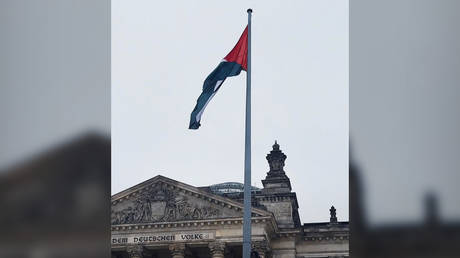
Footage circulating across social media appears to show a Palestinian flag raised at the Reichstag building in Berlin, the seat of the German Bundestag. The short clip, framed to suggest an official or unchallenged breach of Germany’s most symbolically loaded government edifice, rapidly accumulated shares and heated commentary. Yet viral video rarely tells the whole story, especially when it collides with Berlin’s tightly policed security perimeter and Germany’s uniquely fraught domestic politics.
To understand why a single frame of fabric against classical stone ignites an international firestorm, you have to look beyond the camera lens. You have to examine how digital outrage is manufactured, how Germany’s strict legal architecture governs political symbols, and why the Reichstag remains the ultimate prize in the battle for visual legitimacy.
The Anatomy of a Viral Clip
Social media algorithms reward visual shock, not context. When a video surfaces showing a contested national symbol near a landmark like the Reichstag, the platform mechanics immediately favor the most dramatic interpretation. Users share the clip assuming either a daring protest breach or an official diplomatic shift.
In reality, the Platz der Republik—the expansive lawn directly in front of the Reichstag—is one of the most heavily surveilled and frequently permitted protest zones in Europe. Demonstrations occur there almost daily. Raising a flag on a pole within the crowd, or positioning a camera at a low angle so that a banner held by a protester overlaps visually with the Reichstag’s facade or rooftop flagpoles, is an old visual trick. It creates an optical illusion of institutional endorsement or physical occupation without anyone ever crossing a police barricade.
Even when protesters manage to scale a perimeter fence or project images onto the building's exterior—tactics used by groups ranging from climate activists to far-right demonstrators over the past decade—the German Federal Police (Bundespolizei) and the parliamentary police (Polizei beim Deutschen Bundestag) maintain rapid-response units stationed inside the complex. Unauthorized objects on the structure itself are typically removed within minutes. By the time a video goes viral globally, the physical reality on the ground in Berlin has usually been resolved for hours, leaving only the digital afterimage to dictate public perception.
Why the Reichstag Carries Unmatched Symbolic Weight
Few buildings in the Western world carry the historical baggage of the Reichstag. Built in the late nineteenth century, burned in 1933 in an event that helped consolidate Nazi power, stormed by the Red Army in 1945, and wrapped in silver fabric by artists Christo and Jeanne-Claude in 1995 before its Norman Foster-designed glass dome was completed, the structure is a physical timeline of German catastrophe and democratic rebirth.
Because of this history, the German state treats the physical integrity and symbolic neutrality of the building with extreme seriousness.
The Bannmeile Doctrine
Under German law, the area immediately surrounding the Bundestag, the Bundesrat, and the Federal Constitutional Court is designated as a befriedeter Bezirk—commonly referred to as the Bannmeile or restricted security zone. The law exists to ensure that elected representatives can deliberate free from physical intimidation or coercion by crowds outside.
While assemblies are not strictly impossible near the building, they require explicit, advance authorization from the Federal Ministry of the Interior in consultation with the President of the Bundestag. Spontaneous gatherings inside the perimeter are illegal. When activists attempt to bypass these rules to capture a viral moment on the steps of the Reichstag, they are not merely committing a minor infraction; they are triggering a specific legal mechanism designed in the aftermath of the Weimar Republic's collapse to prevent street pressure from overwhelming parliamentary democracy.
Flag Protocol on the Four Towers
The four corner towers of the Reichstag fly specific banners under strict federal decree. Three towers fly the black-red-gold federal flag of Germany (Bundesflagge). The fourth flies the flag of the European Union.
Exceptions are extraordinarily rare and require high-level institutional approval. For instance, the rainbow pride flag was flown for the first time on Christopher Street Day in 2022 only after formal authorization by the Bundestag President. Foreign national flags are almost never raised on the building itself, even during state visits, which are typically handled at the Federal Chancellery or Bellevue Palace. Therefore, any image purporting to show a foreign or contested flag flying from the Reichstag's official masts is either a forced-perspective illusion from the lawn below, a digital manipulation, or the result of a brief, illegal trespass rather than an act of state.
Germany’s Staatsräson and the Policing of Symbols
The sensitivity surrounding the Palestinian flag in Berlin cannot be separated from Germany’s post-Holocaust political doctrine. Since Angela Merkel’s 2008 address to the Israeli Knesset, successive German governments have affirmed that Israel’s security is part of Germany’s Staatsräson—its fundamental reason of state.
This doctrine does not remain abstract. It filters down into municipal policing guidelines, administrative court rulings, and public assembly permits across Berlin.
Following the escalation of the Gaza conflict in late 2023, Berlin authorities repeatedly wrestled with how to balance constitutional rights to free assembly under Article 8 of the Basic Law (Grundgesetz) against public order concerns and laws prohibiting incitement to hatred (Volksverhetzung).
- Blanket Bans vs. Case-by-Case Rulings: Initially, Berlin police issued sweeping preemptive bans on several pro-Palestinian demonstrations, citing imminent risks of antisemitic slogans and public disorder. Administrative courts later pushed back, ruling that blanket bans violated constitutional norms unless authorities could prove specific, unavoidable threats.
- Symbol Restrictions: Even when marches are permitted, police frequently impose strict conditions (Auflagen). Certain chants, maps erasing Israel, and symbols linked to banned organizations like Hamas or Samidoun are strictly prohibited and result in immediate arrests.
- The Status of the Flag Itself: The standard Palestinian national flag is not banned under German federal law. Citizens and protesters have the legal right to carry it in public spaces, including during registered demonstrations near the government quarter. However, in the charged atmosphere of Berlin street politics, police closely scrutinize how and where it is displayed—especially if activists attempt to affix it to state property or breach the Bannmeile.
This legal nuance is almost always lost in cross-border social media coverage. To an international audience unfamiliar with German administrative law, seeing a Palestinian flag near the Bundestag looks like either a triumphant breakthrough or a shocking breakdown of state control. To a Berlin beat reporter, it looks like a routine clash over permit boundaries in the Tiergarten district.
The Mechanics of Cross-Border Disinformation and Framing
When a clip like this circulates without verifiable metadata, it enters an ecosystem where multiple actors have an incentive to distort its meaning.
On one side, activist networks use tight framing and triumphant captions to project momentum, making a localized street action appear as though it captured the seat of European economic power. Perception becomes leverage. If thousands of people believe the Reichstag has been symbolically claimed, the political impact rivals an actual breach.
On the other side, domestic right-wing commentators and foreign disinformation outlets seize on the exact same footage to push a narrative of state collapse. In their framing, the video serves as visual proof that German authorities have lost control of their capital to migrant populations and political radicals. The caption changes, the outrage shifts direction, yet the underlying deception—presenting a fleeting or visually misleading street moment as an institutional takeover—remains identical.
Consider a hypothetical example of how this plays out in real time. Imagine a tourist standing two hundred meters away on the Platz der Republik holds up a small handheld flag while a friend crouches low with a smartphone, aligning the fabric directly over the distant Reichstag pediment. Five seconds of video are uploaded to Telegram with a sensational caption claiming the Bundestag has been stormed. Within an hour, partisan accounts on X strip the audio, crop the edges to hide the surrounding tourists, and repost it as breaking news. By evening, cable commentators in three different countries are debating the security failure of the German government based entirely on a perspective trick.
How to Verify Viral Footage from Government Landmarks
Veteran investigative journalists treat unverified protest footage from high-profile landmarks with immediate skepticism. Before accepting what a viral clip claims to show, three basic verification steps separate reality from manipulation.
- Check the Flagpoles and Lighting: Official flags on the Reichstag sit high on the four corner towers and are illuminated by dedicated architectural spotlights at night. A flag held by a protester or draped over a lower fence will lack the structural scale, wind resistance, and lighting angles of the permanent masts.
- Cross-Reference Live Webcams and Wire Services: Berlin’s government quarter is covered by continuous live feeds, including the Bundestag’s own cameras and international news agency positions. A genuine physical breach of the Reichstag facade triggers an immediate, massive police response that appears on live feeds and wire photos within minutes.
- Inspect the Aspect Ratio and Audio: Heavy cropping—especially vertical crops that eliminate the ground level—is the primary tool used to disguise forced perspective. If you cannot see the base of the flagpole or the feet of the people holding the banner, the framing is hiding critical spatial context.
The battle over symbols in Berlin is real, rooted in deep historical guilt, fierce constitutional debates, and the raw emotions of an ongoing Middle Eastern war. Yet the distance between a permitted protest on a public lawn and the fall of a parliamentary landmark is measured in more than meters; it is measured in the willingness of viewers to look past a cropped screen.