Modern warfare is obsessed with the wrong metrics.
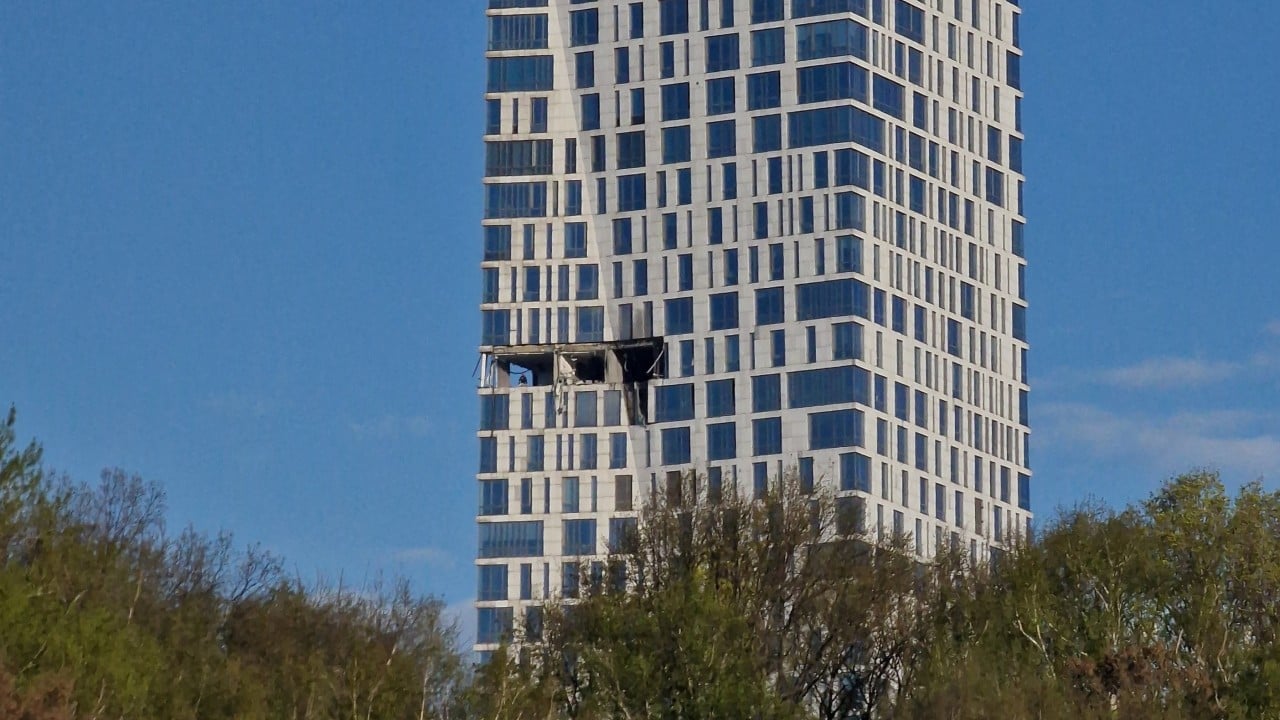
Every time a drone clips a piece of glass in Moscow's financial district, the Western press treats it like a turning point. They focus on the shattered windows and the proximity to the Kremlin. They talk about the psychological blow to the Russian elite. They frame it as a disruption of the May 9th Victory Day parade.
They are missing the point entirely.
The obsession with "symbolic strikes" is a distraction from the brutal reality of kinetic attrition. If you think a single drone hitting an upscale office tower changes the calculus of a major land war, you aren't paying attention to history or physics. You're watching a movie.
The High Cost of Cheap Optics
The narrative currently being sold is that these drone strikes "bring the war home" to the Russian public. The logic suggests that if a few wealthy Muscovites have to work from home for a week, the political pressure will become unbearable.
That is a fundamental misunderstanding of nationalistic resilience.
I’ve analyzed conflict zones for two decades. I’ve seen what happens when you poke a bear with a toothpick. You don’t kill the bear; you just make it angry enough to justify its own aggression to a skeptical populace. Historically, strategic bombing—even at a massive, industrial scale—rarely breaks the will of a civilian population. It almost always hardens it.
When a drone hits the IQ-Quarter building in Moscow City, it provides the Russian state media with exactly the "existential threat" content they need to keep the mobilization gears turning. It transforms a distant "special operation" into a local defense.
The Victory Day Obsession
The media is currently fixated on the Victory Day parade. They want to know if the drones will stop the tanks from rolling through Red Square.
This is the wrong question.
The parade is a choreographed piece of theater. Whether it happens with 100 tanks or one T-34 doesn't change the supply lines in the Donbas. It doesn't fix the logistical failures of the Russian army. It doesn't change the fact that modern electronic warfare (EW) is currently the most significant variable on the battlefield.
Western analysts love to talk about the "humiliation" of a disrupted parade. But humiliation is not a military outcome. You cannot trade "embarrassment" for territory.
The Physics of the Flop
Let's talk about the hardware. The drones reaching Moscow are often light, long-range loitering munitions. They carry a small payload—usually enough to blow out a few floors of a skyscraper, but nowhere near enough to cause structural failure or significant military damage.
From a technical standpoint, sending a $50,000 drone to break $10,000 worth of windows in a business center is a terrible ROI.
If the goal is truly military disruption, these assets should be hitting:
- Refineries: Cripple the fuel supply.
- Rail Nodes: Break the logistics of moving heavy armor.
- Power Substation Transformers: These take years to manufacture and replace.
Instead, we see strikes on "Moscow City." Why? Because it looks good on Twitter. It's a PR-led strategy in a war that requires a resource-led strategy.
The Electronic Warfare Blind Spot
The reason these drones are hitting office buildings and not the Ministry of Defense is often due to the invisible war: GPS spoofing and jamming.
Moscow is currently the most heavily defended EW environment on the planet. High-end Russian systems like the Pole-21 or Krasukha-4 create a "bubble" of interference that makes precision strikes nearly impossible for small, autonomous craft.
When a drone hits a random office tower, it’s rarely the intended target. It’s usually a drone that has lost its signal and drifted until it hit the tallest object in the vicinity. The "upscale tower" wasn't a choice; it was an obstacle.
We are celebrating "precision strikes" that are actually failures of navigation.
The Paradox of Provocation
There is a dangerous assumption that Russia has "run out of ways to escalate." This is a fallacy.
In every conflict, there is a threshold where a state moves from "measured response" to "total mobilization." By focusing on symbolic irritants rather than strategic destruction, the current drone strategy risks crossing that threshold for zero military gain.
If you are going to strike the heart of an enemy capital, you do it to decapitate their command structure or paralyze their economy. You don't do it to ruin a parade.
Stop Asking if the Parade is Safe
People keep asking: "Is Moscow safe for Victory Day?"
They should be asking: "How much longer can both sides sustain the loss of 1,000 men a day for a few hundred meters of mud?"
The drone strikes on Moscow are a symptom of a stalemate, not a solution to one. They are the tactical equivalent of a middle finger. It’s satisfying to show, but it doesn't win the fight.
In the real world, wars are won by the side that can produce more shells, recruit more soldiers, and keep their logistics moving under fire. Everything else is just content for the evening news.
If you want to know who is winning, look at the rail lines and the factories, not the skyline of the capital.
Stop looking at the smoke. Look at the dirt.