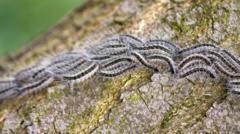
The expansion of the oak processionary moth (Thaumetopoea processionea) across temperate European corridors represents an compounding biological threat that bridges silvicultural degradation with acute public health liabilities. Standard public warnings routinely frame this invasive lepidopteran as a localized nuisance, focusing on superficial cutaneous symptoms. This superficial perspective fails to grasp the underlying mechanics of the pest's expansion and its systemic risks. To accurately evaluate the threat, the problem must be deconstructed through a dual-framework approach: structural forestry degradation and the biochemical mechanics of urticating toxin dissemination.
The Tri-Phase Mechanistic Lifecycle
The operational risk window of Thaumetopoea processionea is dictated by a rigid, temperature-dependent development timeline divided into three specific phases.
[Phase 1: Larval Emergence] ---> [Phase 2: Instar L3 Structural Shift] ---> [Phase 3: Pupation & Residual Threat]
  (Late March - April)              (May - June)                             (July onward)
  • Hatching triggered by temp      • Synthesis of thaumetopoein             • Webbing degrades
  • Defoliation begins              • 62,000 urticating setae/larva          • Hairs remain viable for 5 years
Phase 1: Larval Emergence and Initial Canopy Defoliation
Eclosion occurs between late March and mid-April, matching the budburst of host Quercus (oak) species. Ambient spring temperatures dictate the speed of this stage. Higher early-season baselines accelerate larval growth, causing early damage to tree leaves before the canopy can fully mature.
Phase 2: Instar L3 Structural Shift and Toxin Synthesis
During the first two larval stages (instars L1 and L2), the caterpillars lack defensive structures. The transition to the third instar (L3), occurring from May through June, marks a major functional change. The larvae begin synthesizing thaumetopoein, an irritant protein, and develop a dense covering of micro-setae (urticating hairs). At full development in the L6 stage, a single larva carries approximately 62,000 of these barbed structures.
Phase 3: Pupation and the Residual Threat Reservoir
In July, the larvae retreat into dense, silken webbing nests built on trunks and lower structural branches to pupate. While adult moths emerge within weeks and lack toxic structures, the abandoned nests remain highly dangerous. The silk matrices hold millions of shed urticating hairs, which stay toxic for up to five years.
The Economics of Silvicultural Degradation
The impact on forestry can be quantified by a clear cause-and-effect chain: severe defoliation reduces a tree's capacity to photosynthesize, which weakens its overall health and leaves it vulnerable to secondary environmental stresses.
The primary damage mechanism is the systematic destruction of the tree's leaves during peak growth periods. When infestation levels exceed baseline thresholds, the canopy loss triggers a distinct tree health decline:
$$Canopy\ Loss \longrightarrow Photosynthetic\ Deficit \longrightarrow Carbohydrate\ Depletion$$
This carbohydrate depletion directly reduces the tree's ability to defend itself. Consequently, infected oaks are much less equipped to handle environmental pressures like prolonged drought or poor soil conditions.
This structural weakness leaves the trees highly susceptible to secondary infections and pests. Weakened oaks lack the metabolic resources to resist pathogens like oak decline fungi (Armillaria species) or boring insects such as the two-spotted oak borer (Agrilus aplanatus). Thaumetopoea processionea rarely kills a mature oak tree directly; instead, it dismantles the tree's natural defenses, leading to a slow, systemic decline.
The Biochemical Pathophysiology of Thaumetopoein
The public health risks of Thaumetopoea processionea stem from the physical and chemical properties of its micro-setae. These hairs measure between 100 to 250 micrometers in length, a size and shape optimized for airborne dispersal and tissue penetration.
[Setae Contact with Tissue]
       │
       ▼
[Mechanical Penetration (Barbed Setae Architecture)]
       │
       ▼
[Chemical Envenomation (Release of Thaumetopoein)]
       │
       ▼
[Mast Cell Degranulation (IgE-Independent Histamine Release)]
       │
       ▼
[Clinical Pathology: Contact Dermatitis / Keratoconjunctivitis / Bronchospasm]
The health risk operates through a two-part process:
Mechanical Penetration
The outer surface of each hair features backward-facing barbs. When these hairs make contact with human skin, eyes, or respiratory pathways, the barbs lock into the mucosal or cutaneous tissue. Any physical attempt to brush or wash the hairs away mechanically drives them deeper into the tissue.
Chemical Envenomation
Once embedded, the hair releases its internal payload of thaumetopoein. This protein triggers a direct, non-allergic inflammatory response by degranulating mast cells and releasing histamines independently of IgE antibodies. Because this process does not rely on prior sensitization, any exposed individual will experience symptoms, though repeated exposures will worsen the reaction.
This dual-action mechanism leads to three distinct medical complications:
- Acute Urticaria and Contact Dermatitis: Itchy, painful rashes and localized swelling that can persist for weeks as the embedded hairs continue to release toxins.
- Keratoconjunctivitis: If the hairs drift into the eyes, they lodge in the conjunctiva. Left untreated, this can lead to mechanical trauma, chronic inflammation, and potential visual impairment.
- Upper and Lower Respiratory Tract Bronchospasm: Inhaling airborne hairs brings them into contact with pharyngeal and bronchial linings. This triggers immediate swelling, coughing, and can cause severe, life-threatening airway constriction in individuals with pre-existing conditions like asthma.
For domestic animals, particularly dogs, the risk is even higher due to their investigative behavior. Licking infected bark or picking up fallen nests can cause severe swelling of the tongue, mouth blistering, and tissue necrosis that requires emergency veterinary intervention.
Strategic Risk Mitigation Protocols
Managing Thaumetopoea processionea requires moving away from reactive, ad-hoc spraying toward a structured, proactive containment model.
                       [SURVEY & MONITORING]
                                │
                                ▼
         ┌──────────────────────┴──────────────────────┐
         ▼                                             ▼
[Infestation < Threshold]                     [Infestation ≥ Threshold]
         │                                             │
         ▼                                             ▼
[Targeted Biopesticides]                      [Mechanical Extraction]
(Bacillus thuringiensis / Diflubenzuron)      (HEPA Vacuuming & Thermal Destruction)
Predictive Vector Mapping and Early Surveillance
Containment strategies must begin with regular monitoring before eggs hatch. Utilizing historic sighting data, local canopy density maps, and winter egg-plaque counts allows forestry teams to isolate high-risk zones. This targets interventions precisely where they are needed, rather than deploying broad, inefficient responses after infestations take hold.
Biochemical Containment (Instars L1–L2)
When applied during the first two larval stages, low-toxicity biological treatments are highly effective.
- Bacillus thuringiensis var. kurstaki (Btk): This bacterial agent targets lepidopteran larvae specifically. Once ingested, it disrupts the caterpillar’s midgut membranes, neutralizing the population before they develop toxic hairs.
- Diflubenzuron: An insect growth regulator that disrupts chitin synthesis during molting. This prevents larvae from transitioning into the dangerous L3 stage.
Mechanical Abatement (Instars L3–L6 and Nests)
Once larvae develop toxic hairs and build nests, chemical sprays become counterproductive because they cause dying caterpillars to drop from the canopy, scattering millions of toxic hairs over a wider area. Instead, teams must switch to mechanical removal.
Specialist operators equipped with full personal protective equipment (PPE) use truck-mounted HEPA-filter vacuum systems to extract nests and processions directly from the bark. The recovered material is then sealed and incinerated to completely destroy the toxic proteins.
Environmental Constraints and Long-Term Trends
Current containment efforts face clear operational limits. While biological sprays work well in early spring, their application window is narrow and heavily dependent on predictable weather. Rain or unexpected temperature shifts can disrupt application schedules, allowing larvae to safely reach the toxic L3 stage. Furthermore, aerial or widespread spraying is heavily restricted in urban environments and protected nature reserves to minimize damage to non-target insect species.
Looking at broader climate trends, rising average spring temperatures across northern and western Europe are accelerating larval development and expanding the pest's viable geographic range. Mild winters are increasing egg survival rates, causing infestations to move further northward each season. This changing climate suggests that Thaumetopoea processionea will become a permanent, endemic management challenge across temperate regions, requiring sustained funding and long-term forestry planning rather than temporary emergency responses.