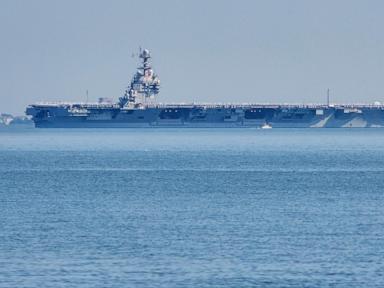
The Navy is taking a victory lap, and the media is handing out the trophies. After 239 days at sea, the USS Gerald R. Ford (CVN 78) is finally steaming back toward Norfolk. The headlines call it a "record-breaking deployment" and a "show of American resolve."
They are wrong.
What the Pentagon markets as a triumph of endurance is actually a flashing red light for American naval strategy. Extending a carrier's deployment three times isn't a strategic masterstroke; it is a desperate patch for a broken scheduling system and a fleet that is stretched to its absolute breaking point. We are celebrating a marathon runner for completing a race they were forced to run because the relief vehicle broke down in the driveway.
The Cost of Staying Out
The Ford didn't stay in the Eastern Mediterranean because it was the best tool for the job. It stayed because the Navy lacked a viable alternative to maintain a "continuous presence."
When we keep a carrier at sea for nearly eight months, we aren't just tiring out the crew. We are eating the "service life" of the most expensive machine ever built. Every extra day at sea is a day stolen from future readiness.
Think of it like this:
- Maintenance Debt: For every month a carrier is over-deployed, you add months of unplanned repairs to its next dry-dock cycle.
- The Human Tax: Retention is already in the gutter. When sailors are told three times that they aren't going home for Christmas, they don't re-enlist. They leave.
- The Tech Trap: The Ford is the first of its class. It is a floating laboratory. It needs time at the pier to integrate the lessons learned from its Electromagnetic Aircraft Launch System (EMALS). Keeping it at sea for "presence" prevents us from fixing the very bugs that made the ship late in the first place.
The Presence Fallacy
The "Lazy Consensus" among defense analysts is that "Presence equals Deterrence." The logic suggests that if a carrier is visible on a map, our adversaries will behave.
This is a 20th-century mindset applied to a 21st-century problem.
In a world of long-range anti-ship ballistic missiles and cheap, swarming suicide drones, a carrier's greatest asset is its mobility and its ability to strike from over the horizon. By parking the Ford in a fixed geographic box for months on end, we turned a $13 billion asset into a static target. We didn't deter the regional actors; we gave them eight months of free data on how we operate our newest flight deck in a high-tension environment.
True deterrence isn't being there; it’s being able to arrive unexpectedly.
The Broken Math of the Carrier Force
The Navy claims it needs 11 carriers to meet global demands. Currently, it has 11. On paper, everything looks fine. In reality, the math is a lie.
At any given time, a significant portion of the fleet is in a "Refueling and Complex Overhaul" (RCOH) or stuck in long-term maintenance. When one ship—like the Ford—is forced to stay out for a "record-breaking" stint, it creates a "bow wave" of delays for the rest of the fleet.
The ship that was supposed to replace the Ford is now behind schedule. The crew that was supposed to train is now waiting. The yards that are supposed to fix the ships are already backed up for years. We are cannibalizing the 2030s to pay for the headlines of 2024.
The Dual-Carrier Trap
During this deployment, the Ford was joined by the USS Dwight D. Eisenhower. This "dual-carrier" operations flex is a favorite of politicians because it looks great on a poster.
But look at the hardware. The Eisenhower is one of the oldest ships in the fleet, commissioned in 1977. We are pairing a ship with "new car smell" with a ship that belongs in a museum, and we are asking them both to do the work of three vessels. This isn't a strategy; it's an admission that our high-end fleet is too small to handle the current geopolitical reality without burning out our assets.
EMALS and the Reality of "Sorting"
The Navy loves to brag about the number of sorties the Ford launched during this deployment. It's a metric that sounds impressive to anyone who hasn't worked on a flight deck.
Yes, the Electromagnetic Aircraft Launch System is theoretically faster than steam catapults. But what the official reports won't tell you is the "reliability gap."
$$MTBCF = \frac{Total,Operating,Hours}{Critical,Failures}$$
During its early trials, the Mean Time Between Critical Failure (MTBCF) for EMALS was far below the requirement. While it has improved, a 239-day deployment is exactly the kind of stress test that exposes these flaws. If we are being honest, the Ford was likely operating under "protective" conditions for much of its stay—maintaining presence while crossing fingers that the brand-new tech wouldn't have a catastrophic hiccup while the world was watching.
Stop Celebrating the 239 Days
If we want a Navy that can actually win a peer-to-peer conflict, we have to stop treating "extended deployments" as a badge of honor. They are an emergency measure that has become a standard operating procedure.
We need to admit a few uncomfortable truths:
- Presence is overrated: We need to rely more on land-based airpower and long-range fires rather than taxing the carrier fleet for every regional flare-up.
- Maintenance is the Mission: A ship in the yard getting upgraded is more valuable than a ship idling in the Mediterranean for the eighth consecutive month.
- The Ford is a Prototype: We should be treating it as such. Pushing a first-in-class vessel to a record-breaking deployment before its systems are fully matured is a risk that outweighs the PR reward.
The Ford is coming home, and the crew deserves every bit of praise for their sacrifice. But the admirals need to stop smiling. This deployment wasn't a success. It was a warning.
Stop asking how long a carrier can stay at sea. Start asking why we are so poorly positioned that we have no choice but to find out.