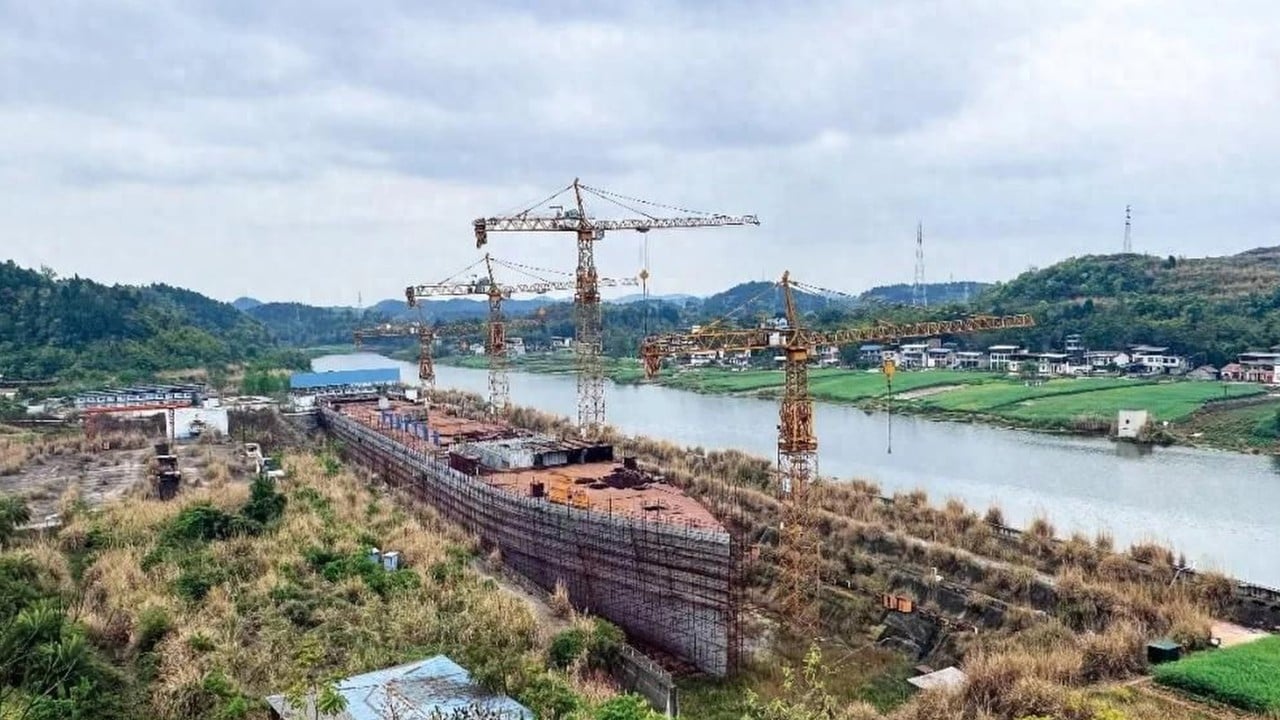
The rust doesn't look like a tragedy yet. It looks like a slow, orange infection spreading across the skeleton of a dream. In the landlocked heart of Sichuan province, more than 600 miles from the nearest salt spray of the ocean, a massive steel ribcage rises out of the Qi River. It is a full-scale replica of the RMS Titanic.
It was supposed to be the centerpiece of the Romandisea Seven Star International Cultural Tourism Resort. It was supposed to feature a high-tech simulation of the iceberg collision, complete with light effects and vibrating floors, allowing tourists to pay for the privilege of experiencing a disaster that claimed 1,500 lives. Today, it is a silent, billion-yuan monument to the specific brand of hubris that defines the early 21st-century Chinese property boom. If you enjoyed this article, you should read: this related article.
Walk along the riverbank and the scale hits you first. This isn't a theme park attraction. It is 269 meters of cold, hard ambition. But look closer. The scaffolding is skeletal. The workers are gone. The "unsinkable" ship has been claimed by something far more effective than an iceberg: the shifting tides of debt and the sudden, chilling wind of a changing national economy.
The Architect of a Mirrored World
Su Shaojun didn't want to build a boat. He wanted to build a legacy. As the CEO of the Seven Star Energy Investment Group, Su represented a class of developers who believed that if you built it large enough, reality would eventually have to bend to accommodate your vision. For another angle on this story, check out the recent coverage from AFAR.
In his mind, Daying County—a relatively obscure spot on the map—would become a global destination. He spent over 100 million USD on this project. He hired Hollywood production designers and specialized British consultants to ensure every door handle and every gold-leafed molding in the Grand Staircase matched the 1912 original.
Why build a replica of a tragedy in a place with no connection to the sea?
The answer lies in a uniquely modern form of madness. In the height of the Chinese "Great Leap" into luxury tourism, local officials and private developers entered a frantic arms race to create "unique selling points." If your neighbor has a replica of the Eiffel Tower, you must build the Sphinx. If they have the Sphinx, you must build the Titanic. It is a game of architectural poker where the stakes are billions of yuan and the losers leave behind ghost cities.
The Ghost Crew of the Qi River
Consider the hypothetical life of a local laborer we’ll call Chen. Chen grew up in a village where the most exciting thing to happen in a decade was the paving of a new road. Suddenly, a billionaire arrives. He promises a "Seven Star" resort. He promises jobs for Chen’s children.
Chen spends three years welding plates of steel onto a hull that will never touch the ocean. He feels the pride of craftsmanship. He hears the rumors that James Cameron himself might visit. For a brief window of time, the future feels as solid as the metal under his torch.
Then, the money stops.
The silence that follows a construction halt is heavier than the noise of the work. First, the high-level consultants leave. Then the foremen. Finally, the cranes stop moving. Chen returns to his village, looking back at the river where a massive, half-finished ship sits like a beached whale. It isn't just a failed business venture to him. It is a broken promise. It is a physical reminder that the "miracle" of local development was actually a fragile bubble.
A Graveyard of Imitations
This Titanic is not an isolated incident. China is littered with these "duplitecture" projects. You can visit a fake Venice in Dalian or a replica of Hallstatt, Austria, in Guangdong. For a long time, these projects worked. They drew crowds. They sold luxury villas.
But the Titanic in Sichuan faced a problem the others didn't: the weight of its own irony.
When the project was announced, the families of the original Titanic victims expressed a understandable cocktail of horror and confusion. To them, the ship was a grave. To the developers in Daying, it was a "universal symbol of love and sacrifice," a narrative sanitized by the 1997 film and repurposed as a marketing hook.
The dissonance was profound. You cannot build a monument to "love and sacrifice" while ignoring the economic reality of the ground you are building on. By 2021, the project was stagnant. The investment group faced mounting legal challenges and debt. The local government, once an enthusiastic partner, found itself tethered to a rotting metal giant that it couldn't afford to finish and couldn't afford to tear down.
The Physics of the Fall
Gravity always wins. In finance, gravity is interest.
The math behind the fake Titanic was always precarious. It required millions of visitors a year to break even. It required a middle class with endless disposable income and a permanent appetite for kitsch. Most importantly, it required a banking system willing to overlook the absurdity of a landlocked shipwreck.
When the Chinese government began cracking down on "extravagant and wasteful" projects and tightened the "Three Red Lines" on developer debt, the physics changed. The flow of easy credit evaporated. Projects like Romandisea, which relied on the momentum of the next loan to pay for the last one, hit the wall.
It is easy to mock the developers. It is easy to laugh at the sight of a cruise ship in a cornfield. But there is a deeper, more unsettling truth here. We all live in systems that prize growth over sustainability. We all, in some way, have bought tickets for ships that were never meant to sail.
The Invisible Stakes
The real tragedy isn't the wasted steel. It’s the opportunity cost.
Think of the schools that could have been funded with a billion yuan. Think of the local industries that could have been nurtured if that capital hadn't been poured into a replica of a 112-year-old disaster. When a project this large fails, it creates a "debt shadow" that lingers over the local economy for a generation.
The local shops that opened nearby in anticipation of the tourist boom are boarded up. The roads built to accommodate tour buses lead to a gated entrance that no one enters. The rust on the hull isn't just oxidation; it is the visual representation of stalled lives.
We often talk about "excess" as if it’s a moral failing of a few greedy men. It’s more like a weather pattern. Su Shaojun was caught in a storm of his own making, but the rain falls on everyone in Daying County.
The View from the Bridge
If you stand on what was supposed to be the bridge of the Sichuan Titanic today, you don't see the Atlantic. You see the quiet, muddy flow of the Qi River. You see the laundry hanging from the windows of nearby apartments. You see a reality that is stubborn, grounded, and unimpressed by grandiosity.
The ship is a masterpiece of detail. The rivets are in the right places. The dimensions are exact. It is a perfect copy of a ghost.
There is a haunting beauty to it, if you have a dark enough imagination. In the twilight, when the sun hits the orange-red primer of the hull, the ship looks almost alive. For a second, you can imagine the lights turning on, the sound of a string quartet, and the clinking of champagne glasses.
Then a bird lands on a rusted railing. A dog barks in the distance. The illusion shatters.
The fake Titanic didn't sink because of an iceberg. It sank because it was built on the idea that the past could be sold as a theme park and the future could be funded by fantasies. It sits there now, not as a tourist attraction, but as a lighthouse—a warning to anyone who thinks they can build their way out of reality.
The river flows past it, indifferent. The steel waits for a completion that will likely never come. The most famous shipwreck in history has been replicated so perfectly that it managed to find a way to happen twice, once in the freezing water, and once in the dry, unforgiving dirt.