Walk down to the Port of Singapore at three o’clock in the morning. The city-state is asleep, but the docks are screaming. Mega-vessels, stacked high with thousands of steel containers, slice through the dark waters of the Malacca Strait. Cranes tower over the water like robotic giants, swinging massive loads from ship to shore with rhythmic precision.
Every container is a heartbeat. Inside them are microchips bound for assembly lines in Hanoi, lithium-ion batteries headed for automotive factories in Thailand, and processed agricultural goods destined for supermarkets in Jakarta.
For decades, this intricate dance relied on a predictable global rhythm. Washington and Beijing maintained an uneasy but stable economic codependency. One invented; the other manufactured. The rest of the world carved out comfortable niches within that grand design.
That rhythm is gone.
Now, Singapore’s Prime Minister Lawrence Wong looks out at a drastically altered global map. The trade war that began as a skirmish of tariffs has solidified into a permanent structural shift. Washington speaks of "friend-shoring" and tech walls; Beijing emphasizes "dual circulation" and self-reliance. As these two superpowers pull away from one another, they create a dangerous economic undertow.
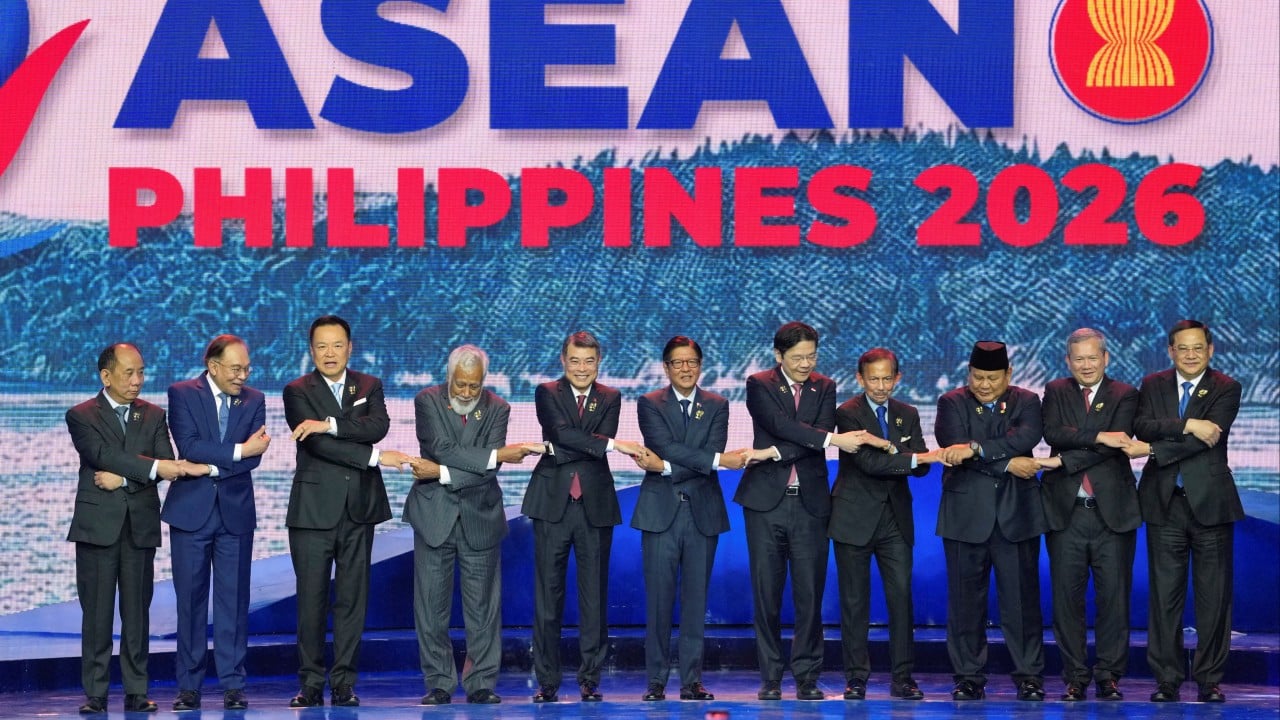
For the Association of Southeast Asian Nations (Asean), a bloc of over 680 million people, this rivalry is not an abstract geopolitical debate. It is a daily negotiation for economic survival.
The Factory on the Border
To understand the pressure building beneath the surface, look at a hypothetical supply chain manager we will call Min-jun.
Min-jun coordinates component sourcing for a multinational electronics firm. Five years ago, his job was straightforward: find the highest quality at the lowest cost. Today, his spreadsheets look like a geopolitical risk assessment.
If his firm sources too many critical components from China, they risk losing access to the American market due to tightening export controls. If they pivot entirely to Western suppliers, costs skyrocket and production timelines double.
Min-jun’s solution—and the solution for hundreds of companies like his—is not to abandon Asia, but to redistribute the weight. They call it the "China Plus One" strategy.
A company might keep its primary design and high-end manufacturing hub in Shenzhen, but they will establish a secondary, crucial facility in Malaysia or Vietnam. This hedge protects them from sudden tariff spikes or political embargoes.
This shift explains why foreign direct investment into Southeast Asia has surged despite global economic headwinds. The region has become a vital economic buffer zone.
But this sudden influx of capital reveals a glaring problem. Southeast Asia is not a monolith. It is a collection of ten distinct nations with varying degrees of infrastructure, regulatory frameworks, and digital maturity.
When a truck carrying microchips leaves a factory in Thailand, it should ideally cross into Cambodia and arrive in Vietnam with minimal friction. In reality, that truck encounters a patchwork of customs declarations, incompatible digital transit systems, and differing logistics standards.
The physical roads exist. The digital and regulatory highways do not.
This is the vulnerability Lawrence Wong is targeting. In an era where Washington and Beijing are erecting walls, Southeast Asia’s only viable defense is to tear down its internal borders.
The Invisible Infrastructure
When politicians speak of "connectivity," the mind naturally drifts to concrete and steel. We think of high-speed rail lines slicing through the jungles of Laos or massive deep-water ports expanding along the coast of Sumatra.
These mega-projects are impressive, but they are incredibly capital-intensive and slow to materialize. The more urgent, albeit invisible, battleground is digital and regulatory integration.
Consider the simple act of sending money across a border. For an Indonesian migrant worker in Singapore trying to send money back to her family in a rural village, the traditional banking system was historically slow, expensive, and opaque.
Today, Singapore’s PayNow and Thailand’s PromptPay are linked. A user can transfer funds instantly using just a mobile phone number.
This is not merely a convenience for travelers or expatriates. It is the foundational plumbing of a unified regional economy.
When small and medium-sized enterprises can transact across borders instantly, without losing significant margins to currency conversion and intermediary bank fees, the economic center of gravity shifts.
The goal is to scale this connectivity across the entire bloc. A seamless digital economy agreement across Asean could unlock billions of dollars in dormant economic activity. It allows a digital entrepreneur in Manila to sell services to a logistics firm in Ho Chi Minh City as easily as if they were in the same neighborhood.
The stakes extend far beyond digital payments. Energy security looms large over the region's long-term growth.
Southeast Asia’s energy grid is currently fragmented. Some nations possess an abundance of renewable energy potential—like Laos with its hydroelectric capability or Indonesia with its geothermal resources—while others face soaring power demands with limited domestic supply.
An interconnected Asean Power Grid would allow countries to trade electricity across borders. It transforms energy from a national vulnerability into a shared regional asset.
If Singapore can import solar energy from Australia via subsea cables while simultaneously tapping into regional hydro power, it stabilizes its own grid while funding green infrastructure across its neighboring states.
The Peril of the Middle Ground
This vision of a highly integrated, frictionless Southeast Asia sounds ideal on paper. Achieving it requires navigating a treacherous political landscape.
The greatest threat to Asean’s prosperity is fragmentation from within.
As the US-China dynamic grows more adversarial, both superpowers are actively trying to pull individual Asean members into their respective orbits.
One nation might rely heavily on Chinese infrastructure loans through the Belt and Road Initiative, making them hesitant to sign regional agreements that could displease Beijing. Another nation might look to Washington for maritime security guarantees, aligning their domestic tech policies with American export standards.
If Asean members begin choosing sides individually, the bloc splits apart.
The region would devolve into a collection of isolated economic islands, easily manipulated and unable to compete on the global stage.
Singapore’s diplomatic strategy hinges on the concept of "Asean centrality." The core idea is simple: the bloc must remain a neutral, open platform where everyone can do business, but no single external power dominates.
This neutrality is not passive sitting on the fence. It is an active, aggressive commitment to multi-alignment.
It means welcoming American tech investments in data centers while simultaneously expanding trade volumes with Chinese manufacturing networks. It means telling both Washington and Beijing that Southeast Asia will not be an arena for their proxy conflicts.
To maintain this leverage, the region must be too integrated to ignore.
A fractured Southeast Asia is a target. An integrated Southeast Asia is an indispensable global partner.
The Real Measure of Success
It is easy to get lost in the vocabulary of international diplomacy—trade pacts, supply chain resilience, multilateral frameworks, macro-economic stability.
But none of these metrics matter if they do not change life on the ground.
The true test of Singapore’s push for Asean connectivity will not be found in joint communiqués issued at regional summits. It will be measured by the choices made by people like Min-jun and the millions of workers across the region.
It will be measured by whether a young software engineer in Jakarta can scale her startup across four neighboring countries without needing four different legal teams.
It will be measured by whether a manufacturing plant in Penang can keep its lights on during a global energy crunch because it drew power from a river thousands of miles away.
The world of the past three decades—defined by frictionless globalization and undisputed American economic hegemony—is gone. It is not coming back.
The new era is fragmented, suspicious, and volatile.
In this environment, small and mid-sized nations cannot afford the luxury of isolation. They cannot rely on the goodwill of superpowers preoccupied with their own domestic anxieties and imperial rivalries.
Back at the Port of Singapore, the pre-dawn mist begins to lift. Another container ship glides past the breakwater, its hull riding low in the water, heavy with the weight of global commerce.
Its crew does not look at the map as a collection of political borders or ideological battle lines. They see the depth of the shipping lanes, the strength of the currents, and the lights of the next harbor waiting on the horizon.