The dust in Abuja has a specific weight. It settles on the windshields of idling black SUVs and the worn sandals of street vendors alike, a fine, ochre powder that smells of parched earth and exhaust. For Yusuf, a fictional but representative father in the capital, this dust is no longer just a nuisance. It is a clock. Every minute his daughter is late coming home from school, the dust seems to thicken in his lungs. He knows the statistics that the official reports don't like to dwell on. He knows that the "degraded security situation" mentioned in press releases translates to a very real, very sharp fear that high-tension wires of instability are snapping across the most populous nation in Africa.
Nigeria is a giant holding its breath.
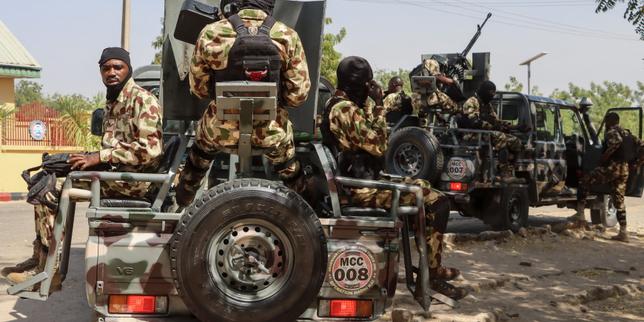
When the Nigerian government recently reached out to international partners—specifically calling upon France and other Western allies—it wasn't just a routine diplomatic gesture. It was a flare sent up from a ship taking on water. The reality on the ground has shifted from isolated pockets of insurgency to a multifaceted hydra of violence. In the north, the old shadows of Boko Haram and ISWAP still linger, but they have been joined by "bandits"—a term that feels far too cinematic for the brutal reality of mass kidnappings and village raids. In the southeast, separatist tensions simmer. In the middle belt, the land itself has become a theater of war between herders and farmers.
Consider the sheer scale of the challenge. Nigeria isn't just another country on a map; it is an economic engine and a cultural heartbeat. If Nigeria stumbles, the vibrations are felt from the Gulf of Guinea to the streets of Paris. This is why the appeal to France carries such heavy historical and strategic weight.
The French Connection and the Sahelian Chessboard
France finds itself in a delicate position. For years, Paris has been the primary Western military actor in the Sahel, the semi-arid strip of land just north of Nigeria. But the French experience in Mali and Burkina Faso has been fraught with complications, leading to a withdrawal that left a power vacuum now being eyed by Russian mercenaries and various insurgent groups.
When Nigeria asks for help, it isn't asking for boots on the ground in the traditional sense. The lessons of the last decade have been learned in blood and shattered glass. Nigeria wants intelligence. It wants high-altitude surveillance. It wants the kind of technical hardware that can see through the thick canopy of the Sambisa Forest or track a convoy of motorcycles across the scrubland before they reach a vulnerable schoolhouse.
The relationship is pragmatic. France needs a stable Nigeria to prevent the total collapse of regional security, which would inevitably trigger a migration crisis and a surge in global terrorism. Nigeria needs French expertise in counter-insurgency and, perhaps more importantly, French influence within the European Union to unlock broader financial and logistical support.
The Human Toll of the "Buffer Zone"
To understand why this matters, look away from the diplomatic halls and toward the highway connecting Abuja to Kaduna. Once a bustling artery of commerce, it became a gauntlet.
Imagine a young professional, let’s call her Amara. She is a tech consultant, the face of the "New Nigeria." Two years ago, she would have driven to see her parents every weekend. Today, she takes a train, and even then, she grips her phone until her knuckles turn white. She remembers the 2022 train attack, where explosives tore through the tracks and lives were changed in an instant. For Amara, "security cooperation" isn't a bullet point in a policy brief. It is the difference between visiting her mother and becoming a headline.
The insecurity has created a silent economic paralysis. When farmers cannot plant because they fear being snatched from their fields, the price of jollof rice in Lagos spikes. When foreign investors see headlines about mass abductions, they move their capital to safer harbors in Nairobi or Johannesburg. The "invisible stakes" are the dreams of a generation being deferred because the basic social contract—the state’s promise to protect its people—is under unprecedented strain.
A Crisis of Sovereignty
There is a quiet, stinging pride in Nigeria. This is a nation that prides itself on being the "Giant of Africa," a peacekeeping force that has historically exported security to its neighbors. Admitting that the internal situation has reached a point where external intervention is necessary is a bitter pill for the leadership in Abuja.
But the math no longer adds up. The Nigerian military is stretched thin, deployed in nearly every state of the federation. They are fighting a ghost war against enemies who don't wear uniforms and who disappear into the local population as easily as smoke into a dark room.
The call to France is an acknowledgment that the borders of modern conflict are porous. The weapons flowing out of Libya after the fall of Gaddafi found their way into the hands of Nigerian bandits. The extremist ideologies brewed in the deserts of the north are fueled by global networks. If the problem is international, the solution cannot be purely domestic.
The Skeptic’s Corner
It is easy to be cynical. We have seen international "partnerships" dissolve into quagmires before. There is a segment of the Nigerian public that views French involvement with deep suspicion, haunted by the ghosts of "Françafrique" and the long shadow of colonial-era interference. They wonder if French help comes with invisible strings—access to oil, preferential trade deals, or a say in Nigeria’s internal politics.
These doubts are valid. They are the friction that makes diplomacy so grueling. But for the person living in a village in Zamfara State, where the local government has effectively vanished and the only law is the law of the gun, the geopolitics of Paris are irrelevant. They want the night to be quiet again. They want to know that if they scream for help, someone—anyone—will hear them.
Beyond the Horizon of Bullets
Hardware alone won't fix this. You can give a soldier the best night-vision goggles in the world, but if he hasn't been paid in three months, or if he doesn't believe in the government he serves, those goggles are just expensive plastic. The Nigerian government's appeal to foreign partners must be matched by a domestic reckoning.
The "degraded security situation" is a symptom of a deeper malady: a lack of opportunity, a judicial system that feels like a lottery, and a sense of abandonment in the rural periphery. France can provide drones, but it cannot provide justice. It can share satellite imagery, but it cannot rebuild the trust between a citizen and a policeman.
The real journey begins when the foreign advisors leave the room. It begins with the difficult work of governance, of ensuring that the wealth of the nation trickles down to the dusty streets where Yusuf waits for his daughter.
As the sun sets over Abuja, the sky turns a bruised purple. The traffic begins to thin out, not because the roads are clear, but because people are rushing to get behind locked doors before the darkness takes hold. In the quiet moments of the evening, the air is thick with more than just dust. It is heavy with the collective prayers of millions of people who are tired of being brave. They are waiting to see if the world’s response will be more than just words on a page, more than just another "strategic partnership" that looks good in a photograph but feels like nothing at all in the dead of night.
The giant is still holding its breath. The question is how much longer it can go without air.