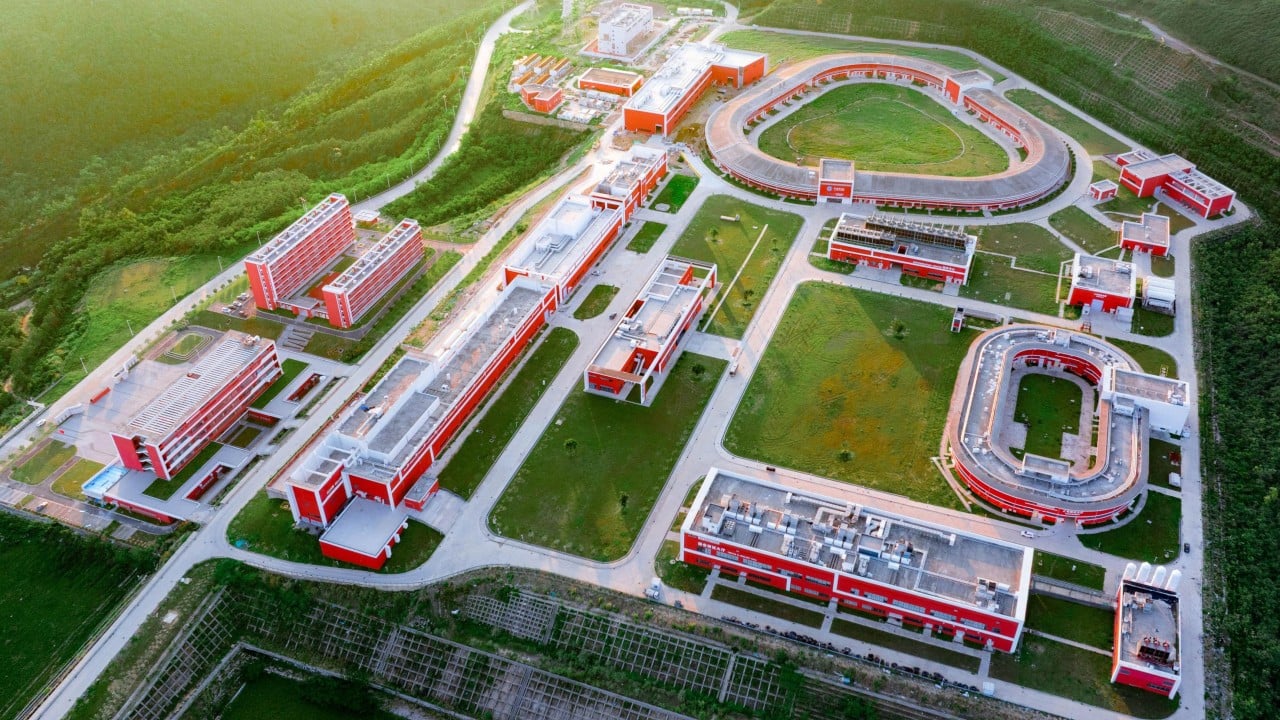
Deep Under the Dust
The soil of South China holds secrets older than the mountains. Millions of years of silence, packed tight into gray clay and subterranean rock.
Then came the drills.
Deep beneath the surface, far removed from the chatter of cities and the hum of ordinary life, a concrete artery now snakes through the dark. It does not carry water. It does not carry oil. It carries speed.
Inside a vacuum sealed tighter than the void between stars, subatomic particles are driven toward an impossible collision. They rush down circular tracks, pinned in place by magnetic fields so strong they tug at the fundamental fabric of space around them.
Engineers in white suits monitor the readouts on quiet screens. Their eyes trace blue and green lines representing beam intensity, magnet temperatures, and vacuum stability. They are waiting for a spark. A flash of energy lasting less than a nanosecond, duplicating conditions that existed only when the universe was milliseconds old.
Humanity built a furnace. And we are throwing atoms into the fire to see what survives.
The Scale of the Invisible
To understand why thousands of researchers spent years burying high-precision instruments beneath the earth, you have to look past the heavy machinery. Forget the giant magnet arrays. Forget the cryogenic cooling towers venting plumes of vapor into the humid air above.
Focus instead on a single atom.
We tend to draw atoms as neat little solar systems in school textbooks. A firm yellow nucleus sitting in the middle, surrounded by tidy rings of orbiting blue electrons.
It is a comforting lie.
The reality is far more terrifying and chaotic. An atom is almost entirely empty space. If you blew up the nucleus of a hydrogen atom to the size of a basketball and placed it on the fifty-yard line of a stadium, the electron would be a tiny grain of sand buzzing around the outer parking lot. Everything in between? Nothing. Pure, cold emptiness.
Yet, that empty space holds the universe together. The nucleus itself—the tiny basketball in our distant stadium—is packed with protons and neutrons, which are themselves jammed full of smaller entities called quarks. Binding them together is the strong force, a phenomenon so fierce that trying to pull two quarks apart only creates more energy, spawning brand-new particles out of thin air.
For decades, physics possessed a clear map of this microscopic wilderness: the Standard Model. It predicted particles with stunning precision. It explained how light travels, how electricity flows, and why your feet do not sink through the floorboards.
Then, the map started running out of ink.
When the Equations Break
Consider a simple puzzle. We can weigh the galaxies. We can calculate the mass of clusters floating through deep space by measuring how their gravity bends the light of distant stars.
The math is simple. Brutal, even.
When you add up all the visible matter in the universe—every star, every planet, every cloud of dust, every human being, every particle ever recorded by every scientific instrument in history—it accounts for roughly five percent of what must be out there.
Five percent.
Imagine walking into a bank account that should hold a million dollars, only to find fifty thousand. You would ask where the rest went. Physicists have been asking that exact question for half a century. The missing mass, which we label "dark matter" simply because we have no better word for our ignorance, is out there. It shapes the cosmos. It holds galaxies together like invisible wire.
Yet no instrument has ever touched it. No sensor has ever caught it red-handed.
To find what is missing, you cannot just look harder through a telescope. You have to create conditions so violent, so concentrated, that the hidden architecture of reality is forced to reveal itself. You need a hammer heavy enough to shatter an atom into its rawest, most primitive components.
That hammer is the particle accelerator.
A Symphony of Magnets and Cold
Building a world-class accelerator is an act of supreme hubris. It demands that humans master extremes that do not exist naturally anywhere on Earth.
First, you need the cold.
The superconducting magnets that steer particle beams require temperatures drifting just above absolute zero. We are talking minus 450 degrees Fahrenheit. At these temperatures, electrical resistance vanishes completely. Current flows through niobium-titanium wires without losing a single watt to heat, creating magnetic fields powerful enough to lift a fleet of battleships.
Second, you need the void.
If a proton traveling at 99.9999% the speed of light hits a single stray molecule of air, it disintegrates instantly. The beam dies. The experiment fails. The stainless steel pipes running through the accelerator tunnel must be pumped down to an ultra-high vacuum, creating an environment sparser than the empty space between the Earth and the Moon.
Finally, you need precision.
Imagine standing on a cliff in New York and firing a needle across the Atlantic Ocean. Now imagine someone standing on a cliff in Ireland firing another needle back at you. To make a high-energy particle collision work, those two needles must hit each other point-to-point in mid-air above the sea.
Do this not once, but billions of times every single second.
This is the daily reality for the team of physicists, computer scientists, and structural engineers operating the facility. A microscopic shift in the Earth's crust, a minor temperature fluctuation in the cooling water, or a fraction-of-a-millimeter misalignment in a quadropole magnet can throw the entire system out of alignment.
When the beam fires, the tunnel must be completely clear of human life. The radiation generated by particles colliding at near-light speeds would be lethal in seconds. The work is done by remote telemetry, monitored from control rooms filled with glowing monitors, half-empty coffee cups, and the low, continuous hum of server racks processing terabytes of collision data per second.
Why Dig in the First Place?
It is easy to look at a multi-billion-dollar machine buried in the earth and ask a fair question: Why?
Why spend vast amounts of capital, engineering talent, and electricity to smash tiny dots of light together underground when there are immediate problems to solve on the surface?
The answer lies in history.
When scientists in the early twentieth century began poking around the weird mechanics of quantum theory, no one was trying to build a smartphone. Nobody was trying to invent MRI machines, fiber-optic internet, or solar panels. They were simply trying to understand why heated metal glowed red instead of blue, or why radium glowed in the dark.
Yet, every major technological leap of the modern era traces its roots back to basic research into the behavior of light and matter. Quantum mechanics gave us the transistor. Without the transistor, there are no microchips, no computers, no modern medicine, no global communications network.
Fundamental physics is not an luxury item. It is the soil from which all future technology grows.
When a nation builds an advanced accelerator, it is not just chasing abstract mathematical theories. It is building an industrial ecosystem capable of pushing human engineering to its absolute absolute limits. The advances made in cryogenic cooling, high-power electronics, supercomputing algorithms, and material science during the construction of these underground rings inevitably spill over into everyday life.
High-brightness light sources produced by particle accelerators are already used to map the molecular structure of dangerous viruses, allowing pharmaceutical researchers to design targeted drugs in months rather than decades. They are used to inspect microchips at the atomic scale, uncovering microscopic defects that would render modern hardware useless.
Smashing atoms is the excuse. Mastering nature is the result.
The Frontier Moves East
For decades, the center of gravity for particle physics rested firmly in the West. Facilities like Fermilab in Illinois and CERN on the border of France and Switzerland set the pace for human discovery. The discovery of the Higgs boson at CERN in 2012 was a triumph of international collaboration, closing a major chapter in our understanding of mass.
But science is a relay race, not a static monument.
As existing machines reach their physical limits, the global physics community faces a crossroads. Upgrading older facilities becomes exponentially more difficult and expensive. Building larger, more ambitious machines requires massive land areas, stable geology, and an immense, long-term financial commitment.
By bringing new, high-power facilities online, China has shifted the geography of fundamental research. The underground ring is more than a concrete tunnel filled with magnets; it is a magnet for global talent. Young researchers, theoretical physicists, and computational experts are drawn to where the data is newest and the energy is highest.
Science flourishes on raw data. Whoever holds the clearest view into the quantum realm holds the pen that writes the next chapter of physics.
What Lies Beyond the Standard Model?
Inside the control room, the monitors paint a picture of invisible chaos.
When two protons collide at maximum energy, they dissolve into a spray of secondary particles. Detectors wrapped around the collision point act like massive, three-dimensional digital cameras, taking billions of snapshots per second of the resulting debris trail.
Physicists are looking for anomalies. Deviations. A tiny bump in a graph where there should be a smooth curve.
Perhaps a particle decays a fraction of a second faster than the Standard Model predicts. Perhaps a rare event occurs slightly more often than the math says it should. These tiny discrepancies are the cracks through which new truth enters.
They might uncover evidence of supersymmetry—the idea that every known particle has a heavier, undiscovered partner. They might detect hint of dark matter candidates, like heavy sterile neutrinos or axions. Or they might find something completely unpredicted, a force or dimension that renders our current physics textbooks obsolete overnight.
The stakes are quiet, but absolute.
We are a species living on a pale dust mote, orbiting a mundane star in an average galaxy. Yet, using copper, iron, code, and sheer stubborn willpower, we have built eyes that can peer into the moment of creation itself.
Deep underground, the magnets hum. The vacuum holds tight. The beam gathers speed, racing around its circular track in the dark, moving closer and closer to the moment of impact.
The soil above remains still. The earth carries on. But down in the tunnel, the universe is about to yield another secret.