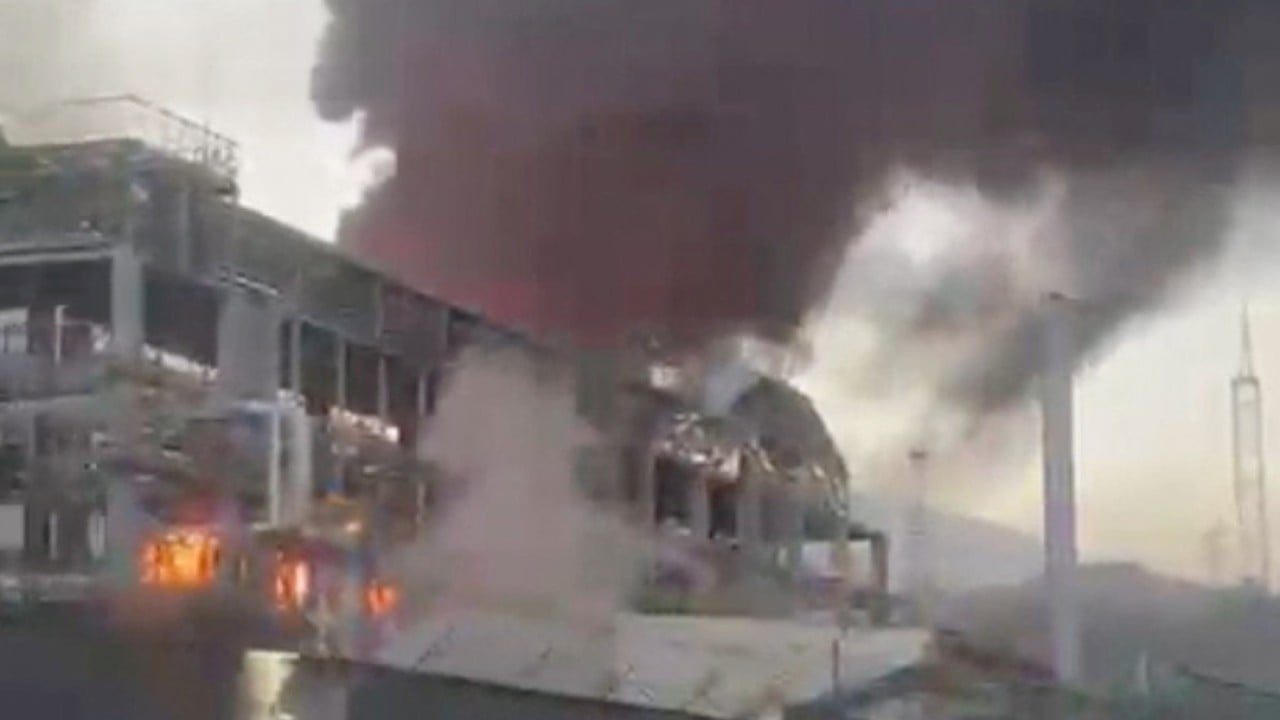
The recent swarm of Ukrainian long-range drones hitting Russian oil refineries marks a fundamental shift in the mechanics of modern attrition. While early reports focused on the dramatic visuals of fireballs over industrial hubs, the strategic reality is far more clinical. Kyiv is no longer just defending territory; it is systematically dismantling the financial and logistical nervous system of the Kremlin’s war effort. By targeting the distillation towers and cracking units of major refineries, Ukraine is exploiting a critical vulnerability in Russia’s internal economy that no amount of frontline fortification can protect.
This isn't about random chaos. It is a targeted economic decapitation. You might also find this related story useful: The Invisible Tax on the Kitchen Table.
Russia’s reliance on oil exports is its greatest strength and its most glaring weakness. The energy sector accounts for roughly a third of the country's federal budget. When a drone strikes a facility like the Ryazan or Slavneft-Yanos refinery, the immediate fire is just the beginning of the problem. The real damage lies in the loss of specialized equipment—much of it sourced from Western engineering firms like Honeywell UOP or Lummus Technology before sanctions took hold. These components are not easily replaced on the black market, and they certainly cannot be manufactured domestically overnight.
The Engineering of Vulnerability
To understand why these attacks are so effective, you have to look at the anatomy of a refinery. These are not just big tanks of fuel. They are massive, interconnected chemical plants where crude oil is heated and separated into various products through a process called fractional distillation. As discussed in latest reports by TIME, the implications are significant.
The primary target is almost always the atmospheric distillation unit. These towers are the "heart" of the plant. If a drone carrying even a modest payload of explosives hits the right valve or heat exchanger, the resulting thermal runaway can destroy the entire unit. Once that tower goes down, the refinery stops producing gasoline, diesel, and aviation fuel.
Ukraine has mastered the art of the "precision swarm." By using low-cost, GPS-guided drones with small radar signatures, they overwhelm local air defense systems. Even if Russian Pantsir or S-400 batteries shoot down 90% of the incoming craft, a single drone reaching the distillation column is enough to cause hundreds of millions of dollars in damage and months of downtime.
Why Air Defenses are Failing
Russia is the largest country on earth by landmass. It is physically impossible to park a surface-to-air missile battery at every single industrial site. The Kremlin faces a brutal choice: protect the high-value refineries deep in the rear or keep those systems on the front lines to shield their advancing troops from HIMARS and Storm Shadow missiles.
Every battery moved to a refinery in Samara or Nizhny Novgorod is a battery that isn't covering a battalion in the Donbas. Ukraine is forcing Moscow into a defensive overstretch that exposes gaps elsewhere. Furthermore, these drones are often made of plywood, carbon fiber, or 3D-printed plastics, making them incredibly difficult for traditional radar to track until they are already diving onto their target.
The Global Price of a Burning Tower
The Biden administration and several European leaders have expressed private concerns about these strikes, fearing a spike in global oil prices. However, there is a nuance here that the markets are starting to realize. Ukraine isn't hitting crude oil terminals that ship raw oil to China or India. They are hitting the refineries that process that oil into usable fuel for the Russian military and Russian citizens.
When a refinery burns, Russia has more crude oil it cannot process. This forces them to export more raw crude to the global market, which can actually keep global prices stable or even drive them down. The pain is felt almost entirely inside Russia.
- Domestic Shortages: Gasoline prices in Russia have seen significant spikes following these campaigns.
- Logistical Friction: Moving fuel to the front lines becomes a nightmare when the nearest refinery is 1,000 miles away rather than 100.
- Budgetary Strain: The cost of repairing these facilities, while simultaneously losing tax revenue from domestic fuel sales, creates a double-edged sword for the Russian Ministry of Finance.
The Sanctions Paradox
The effectiveness of these strikes is amplified by the pre-existing sanctions regime. Before 2022, Russian refineries were undergoing a massive modernization push, largely utilizing European and American technology.
If a distillation unit built with German sensors and American steel is blown apart today, the replacement process is a logistical odyssey. Russia must now turn to Chinese suppliers, whose equipment may not be compatible with the existing Western infrastructure, or attempt to scavenge parts from older, less efficient Soviet-era plants. This creates a "Frankenstein" industrial base that is prone to failure and significantly less productive.
The Rise of the Long Range Drone
We are witnessing the birth of a new class of weaponry. The Ukrainian-made "Lyutyi" drone, for instance, reportedly has a range of over 1,000 kilometers. This puts dozens of Russia's largest industrial assets within striking distance.
These are not the multi-million dollar Reapers or Global Hawks used by the United States. They are "attrition-ware"—cheap, reproducible, and effective. Ukraine is proving that a country without a massive traditional air force can still project power deep into enemy territory. They are using the "silicon valley" approach to warfare: iterate quickly, fail fast, and scale what works.
Military Consequences on the Ground
The Russian war machine runs on diesel. From the T-90 tanks to the supply trucks hauling shells to the artillery lines, everything requires a constant, high-volume flow of refined petroleum.
By hitting the refineries, Ukraine is effectively thinning the blood of the Russian army. It doesn't mean the tanks stop moving today. It means that three months from now, a commander in the Zaporizhzhia region might be told he has to ration his fuel, limiting his ability to launch counter-attacks or rotate tired troops.
It is a slow-motion strangulation.
Internal Political Pressure
For two years, the average resident of Moscow or St. Petersburg could largely ignore the war. The "Special Military Operation" was something happening far away. That changed when the sky started glowing orange.
When a refinery in the heart of Russia is hit, the smoke is visible for miles. It shatters the illusion of safety that the Kremlin has worked so hard to maintain. It forces the Russian public to confront the fact that the state cannot guarantee the security of its most vital assets. This psychological impact is just as important as the physical damage to the distillation columns.
The Technological Arms Race
The Russians are not sitting idle. They are increasingly using electronic warfare (EW) to jam drone signals, creating "bubbles" of interference around major cities and industrial hubs.
In response, Ukrainian engineers are moving toward autonomous terminal guidance. Instead of relying on a continuous GPS or operator signal, these drones use onboard computer vision to recognize the shape of the refinery towers in their final seconds of flight. They "see" their target and steer into it, making jamming irrelevant.
This back-and-forth is happening at a lightning pace. A tactic that works on Monday might be obsolete by Friday. The side that wins isn't the one with the biggest bombs, but the one with the fastest software updates.
The Failure of Traditional Deterrence
For decades, the concept of "escalation" kept the peace between major powers. The fear was that if you hit a nation's core economic infrastructure, they would respond with overwhelming force. Ukraine has called that bluff.
They have realized that the Kremlin is already using every conventional tool at its disposal. There is no higher "gear" for Russia to shift into without resorting to nuclear weapons—a move that would alienate even their closest allies in Beijing and New Delhi. By crossing these red lines, Ukraine has revealed them to be mere sketches in the sand.
The strategy of hitting refineries is a masterclass in asymmetrical warfare. It bypasses the meat-grinder of the front lines and goes straight for the wallet. As long as Ukraine can keep producing these long-range "suicide" drones for a fraction of the cost of a Russian missile, the math remains firmly in their favor.
The fire at the refinery is not just a tactical victory. It is a signal that the geography of the conflict has permanently expanded, and the cost of the war for Russia is about to get much, much higher.
Targeting the distillation unit remains the single most effective way to paralyze a modern industrial economy without firing a single shot on a traditional battlefield.