In the quiet, predawn hours of a global economy, most of us are asleep to the reality of how our morning coffee, the gasoline in our tanks, and the very electricity powering our bedside lamps actually arrive. We operate on a foundation of blind faith in a concept called "freedom of navigation." We assume the blue veins of the world’s oceans will remain open, pulsing with the lifeblood of commerce without interruption.
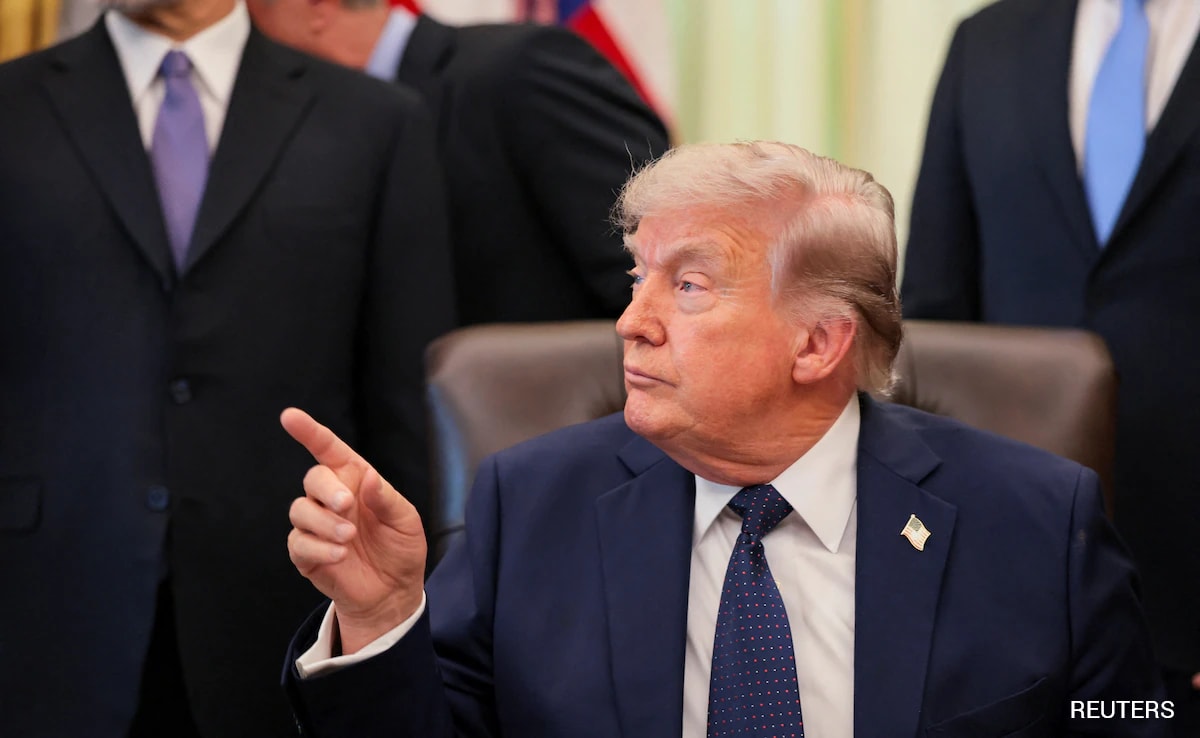
But in a small, cramped office within the West Wing, the mood is far from restful. Donald Trump has reportedly begun telling his closest aides to prepare for a reality that would shatter that faith: a lengthy, sustained blockade of the Strait of Hormuz.
The Strait is a sliver of water. At its narrowest point, it is only twenty-one miles wide. To put that in perspective, a fit marathon runner could cross its width on foot in less than three hours. Yet, through this tiny needle’s eye passes one-fifth of the world’s total oil consumption. It is the single most important energy artery on the planet. If that artery is severed, the world doesn't just feel a pinch. It goes into cardiac arrest.
The Captain’s Dilemma
Think of a man named Elias. He isn't a politician or a billionaire. He is the captain of a Very Large Crude Carrier (VLCC) currently steaming toward the Gulf of Oman. Under his feet are two million barrels of oil. To Elias, the Strait of Hormuz isn't a geopolitical talking point; it is a gauntlet.
As he nears the Musandam Peninsula, he looks at his radar. He knows that just over the horizon, the Iranian Revolutionary Guard Corps (IRGC) operates fast-attack craft. He knows that the seabed beneath him could, at any moment, be sown with sophisticated naval mines. In the past, "tensions" meant a slight increase in insurance premiums. Today, the reports trickling out of Washington suggest something far more permanent.
A "lengthy blockade" is a different beast entirely from a skirmish. A skirmish is a headline. A blockade is a structural shift in how civilization functions.
When Trump instructs aides to "prep," he isn't just talking about military maneuvers. He is talking about a world where the cost of shipping a single container might triple overnight. He is talking about a world where the strategic petroleum reserve becomes the only thing standing between a functioning society and a total shutdown of the transport sector.
The Math of Chaos
The numbers involved in a Hormuz shutdown are so large they become abstract, losing their ability to frighten us. We need to ground them.
Currently, about 20 million barrels of oil flow through that twenty-one-mile gap every single day. If that flow stops, the immediate vacuum in the market creates a price spike that is less of a curve and more of a vertical wall. Analysts have long whispered about $200 or even $300 per barrel.
But the real story isn't the price of oil. It’s the price of everything else.
Consider a farmer in Iowa. He doesn't trade in Brent Crude. He trades in corn. But his tractors run on diesel. His fertilizers are derived from natural gas. The plastic mesh he uses to wrap his hay is a petroleum product. When the Strait of Hormuz closes, the cost of planting his next crop surges beyond his credit limit. He stops planting. Six months later, the price of a loaf of bread in a Chicago grocery store doubles.
This is the "invisible stake." A blockade in a distant desert sea is, in reality, a direct tax on every human being who eats, moves, or uses a smartphone.
The Architecture of a Siege
The reason the administration is shifting its tone toward "lengthy" preparations is rooted in the changing nature of modern warfare. In decades past, a blockade was a matter of big ships sitting in a line. Today, it is asymmetrical.
Iran does not need a fleet of destroyers to close the Strait. They have spent thirty years perfecting the art of the "anti-access/area denial" (A2/AD) bubble. This includes:
- Swarm Boats: Hundreds of small, fast, explosive-laden crafts that can overwhelm the sophisticated sensors of a billion-dollar US destroyer.
- Coastal Missiles: Mobile launchers hidden in the rugged, mountainous terrain of the Iranian coastline, capable of striking any ship in the shipping lane within seconds.
- Smart Mines: Silent, waiting predators that can be programmed to ignore a small fishing vessel but detonate under the magnetic signature of a massive tanker.
If the IRGC decides to lock the gate, unlocking it isn't as simple as sending in the Marines. It requires a slow, methodical, and incredibly dangerous minesweeping operation that could take months. During those months, the global economy isn't just "slowing down." It is starving.
The Psychology of the Preparation
Why now? Why is the President signaling this shift to his inner circle?
The move reflects a realization that the previous era of "maximum pressure" has reached a terminal point. Diplomacy is no longer the primary lever; contingency is. By telling aides to prepare for a "lengthy" event, Trump is effectively admitting that the era of quick fixes is over.
There is also a darker, more pragmatic reason for this directive. In the world of high-stakes negotiation, the person most willing to endure the pain usually wins. By signaling that the United States is ready for a long-term disruption, the administration is trying to strip Iran of its primary weapon: the threat of global economic suicide. If the US shows it has the reserves, the domestic production, and the political will to sit through a year of closed straits, the "oil card" loses its power.
But "preparing" for a blockade is easier said than done. It involves a massive realignment of global supply chains. It means fast-tracking pipelines that bypass the Strait, like the Habshan–Fujairah line in the UAE, which can only handle a fraction of the current volume. It means asking American citizens to brace for a volatility they haven't seen since the 1970s.
The Human Cost of High Policy
Imagine a small business owner in a suburb of Ohio. She runs a local delivery service. Her margins are razor-thin. She has spent ten years building a fleet of five vans.
When the news hits that the Strait is blocked, her first thought isn't about geopolitics. It’s about the gas station on the corner. Within forty-eight hours, the price of a gallon jumps by two dollars. By the end of the week, it’s up by four. Her contracts are fixed-price. She can’t raise her rates on her customers fast enough to cover the cost of the fuel.
She watches her life’s work evaporate in a matter of weeks, all because of a disagreement over nuclear centrifuges and regional hegemony ten thousand miles away.
This is the vulnerability of our modern world. We have built a skyscraper of incredible complexity, but the entire structure is resting on a single, twenty-one-mile-wide pillar. We have optimized for efficiency, for "just-in-time" delivery, and for low costs. In doing so, we have sacrificed resilience.
Trump’s directive to his aides is an acknowledgment that the pillar is cracking.
The Silent Water
If you were to stand on the shores of Oman today, the water would look beautiful. Deep blue, sparkling under a relentless sun. You would see the massive tankers, those silent steel giants, gliding through the haze. They look permanent. They look invincible.
But they are fragile.
A single well-placed sea mine or a flurry of shore-to-ship missiles can turn that blue water into a graveyard of steel and fire. And when that happens, the silence that follows will be felt in every boardroom, every kitchen, and every gas station on earth.
The preparation being discussed in the White House isn't just about military strategy. It is about a fundamental change in the American way of life. It is an admission that the age of easy energy and guaranteed passage is under threat.
As the sun sets over the Persian Gulf, the ships continue to move. For now. But in the corridors of power, the clocks are ticking. They are planning for the day the music stops, the gates close, and the world has to learn how to survive in the dark.
The twenty-one miles are still there. The question is no longer if someone will try to close them, but what we will have left when they do.