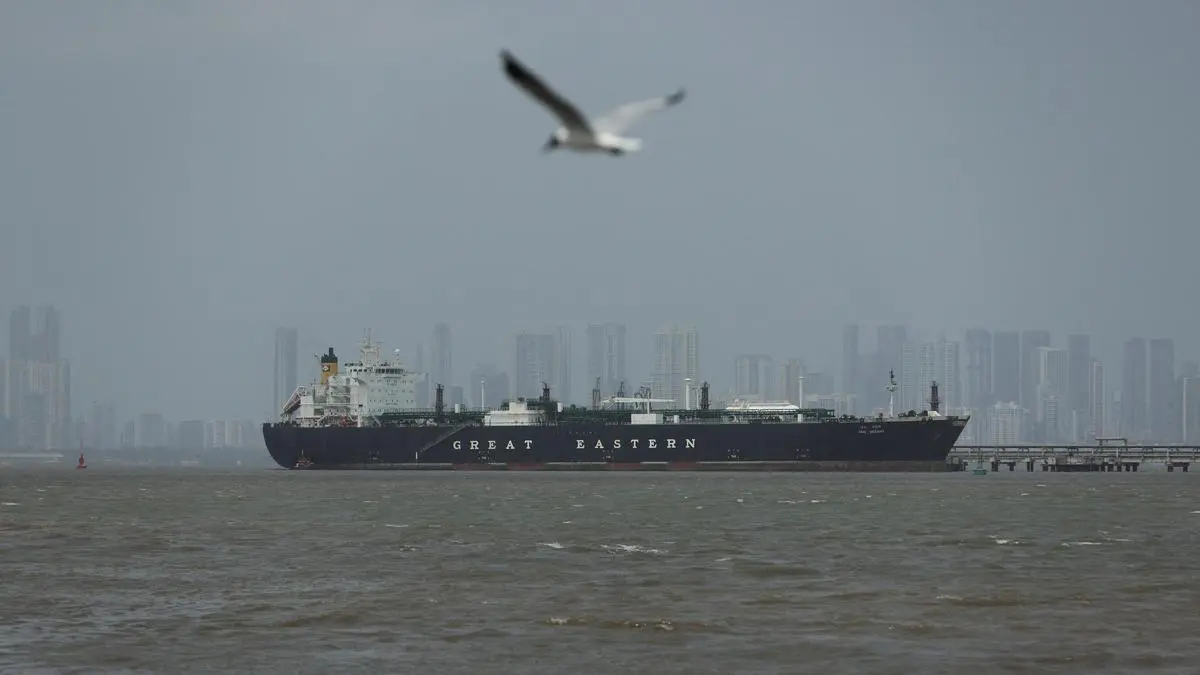
The sea is never actually still. Even on a calm night in the Strait of Hormuz, the water possesses a heavy, oily restlessness. It is a black mirror reflecting the mast lights of ships that carry the literal lifeblood of the modern world. Somewhere beneath the bridge of a massive crude carrier, a radar screen sweeps a rhythmic green line, marking the ghosts of other vessels. Then, the radio crackles. It isn’t a standard maritime greeting. It is a command.
Iran has closed its hand.
For decades, we have treated the Strait of Hormuz as a line on a map, a geopolitical trivia point, or a math problem for economists. We speak of "seizures" and "disruptions" as if they are abstract data points in a spreadsheet. They are not. When the first vessels are boarded and the engines are forced to a shuddering halt, the world doesn’t just lose oil. It loses its sense of security. The invisible gears that keep your lights on, your grocery shelves stocked, and your morning commute affordable have just ground against a handful of sand.
Everything stops.
The Captain’s Dilemma
Picture a man named Elias. He is a veteran mariner, a man whose skin has been cured by salt air and decades of sun. He is currently standing on the bridge of a Very Large Crude Carrier (VLCC). Behind him trail two million barrels of oil. If you lined up every car in a mid-sized city, Elias is carrying enough fuel to keep them all running for weeks.
His eyes are fixed on the horizon, where the jagged cliffs of the Musandam Peninsula loom. To his left is Oman; to his right, Iran. At its narrowest point, this stretch of water is only twenty-one miles wide. But the actual shipping lanes—the deep-water highways where these behemoths must stay—are only two miles wide in each direction.
When an armed boarding party descends from a helicopter onto a deck the size of three football fields, Elias isn't thinking about the price of Brent Crude. He is thinking about his crew. He is thinking about the terrifying fragility of a global system that relies on a single, narrow door remaining open.
The seizure of these first vessels isn't just a military maneuver. It is a psychological experiment. By stepping onto those decks, Iran has signaled that the rules of the "blue economy" are now subject to change without notice. The gray zone of maritime conflict has just turned pitch black.
The Arithmetic of Anxiety
We often hear that twenty percent of the world’s liquid petroleum passes through this strait. That is a number so large it becomes meaningless. To understand the stakes, you have to look at the pressure cooker of the energy market.
Oil isn't just a commodity; it is a time-sensitive promise. Refineries in South Korea, Japan, and India are designed to process specific grades of crude arriving on specific schedules. When those ships stop moving, the "just-in-time" supply chain begins to fracture.
Consider the immediate ripple effect. Within hours of the news hitting the wires, insurance premiums for every vessel in the Persian Gulf don't just rise—they skyrocket. War-risk surcharges are slapped onto every bill of lading. A ship that cost $30,000 a day to operate suddenly costs $100,000. These costs aren't swallowed by billionaires in glass towers. They are passed down, cent by cent, until they reach the pump at the corner of your street.
It is a domino effect of human anxiety. A trader in Singapore sees the headline and hits "buy" on futures. A logistics manager in Rotterdam sees the price spike and delays a shipment of grain because the fuel surcharges have eaten his margin. A mother in a suburb halfway across the world wonders why her heating bill just jumped.
The Strait of Hormuz is the world's jugular vein. When it is pinched, the entire body winces.
The Irony of the High Seas
There is a strange, haunting irony in the way we protect these waters. We have the most advanced naval technology in human history. We have carrier strike groups, satellite surveillance that can read a newspaper from orbit, and sub-surface sensors that can hear a whale sneeze.
Yet, all of that "cutting-edge" hardware is frequently held hostage by the simplest of means: speedboats and shadows.
The Iranian strategy doesn't require a fleet of equal size. It requires the threat of unpredictability. By seizing these vessels, they aren't just taking hulls and cargo; they are taking time. They are forcing the world to pause and look at the map. They are reminding every nation that their prosperity is contingent on the permission of those who control the shoreline.
Logically, one might ask why we haven't found a way around it. There are pipelines, yes. Saudi Arabia has the East-West pipeline; the UAE has the Habshan-Fujairah line. But these are like garden hoses trying to replace a fire hydrant. They can carry a fraction of the volume. The sea remains the only way to move the sheer mass required to keep the modern world spinning.
The Ghost Ships of the Gulf
As the traffic grinds to a halt, the Gulf transforms into a parking lot of giants. These ships cannot simply turn around. They are too large, their drafts too deep, their fuel reserves too calculated. They sit in the heat, the steel of their decks reaching temperatures that would blister skin, waiting for a diplomat in a cool room thousands of miles away to say a word.
The men and women on these ships become the involuntary protagonists of a story they never asked to join. They are pawns in a game of "tanker wars" that has been played, off and on, since the 1980s. During the original Tanker War, over 500 ships were attacked. We like to think we have evolved past such blunt-force geopolitics, but the current standstill proves that history doesn't repeat—it rhymes.
The silence on the water is the loudest thing in the world. When the engines of the global economy stop humming, the quiet is deafening. It is the sound of factories in China slowing their lines. It is the sound of European politicians frantically checking their strategic reserves. It is the sound of a world realizing it is much more vulnerable than it cared to admit.
The Price of a Narrow Door
We live in an age where we believe we have conquered distance. We buy things with a click and expect them to appear in forty-eight hours. We assume the fuel will be there, the electricity will flow, and the ships will always sail.
But our reality is anchored to geography. No amount of digital innovation can change the fact that the rocks of the Hormuz Strait are hard, and the water is narrow. We have built a skyscraper of a civilization on a foundation that passes through a twenty-one-mile gap.
The current halt isn't just a news cycle. It is a reminder of the "invisible stakes." It's about the thinness of the ice we all walk on. We have traded resilience for efficiency. We have built a world so interconnected that a single boarding party in a distant sea can change the price of bread in a mountain village.
As night falls again over the Strait, the mast lights of the seized vessels flicker like dying stars. The radar continues its sweep, marking the ships that aren't moving, the cargo that isn't arriving, and the tension that shows no sign of breaking. The world watches the black water, waiting to see if the hand will clinch tighter or finally let go.
The engine room is cold. The radio is silent. The map hasn't changed, but the world feels much smaller, and the water feels much deeper than it did yesterday.