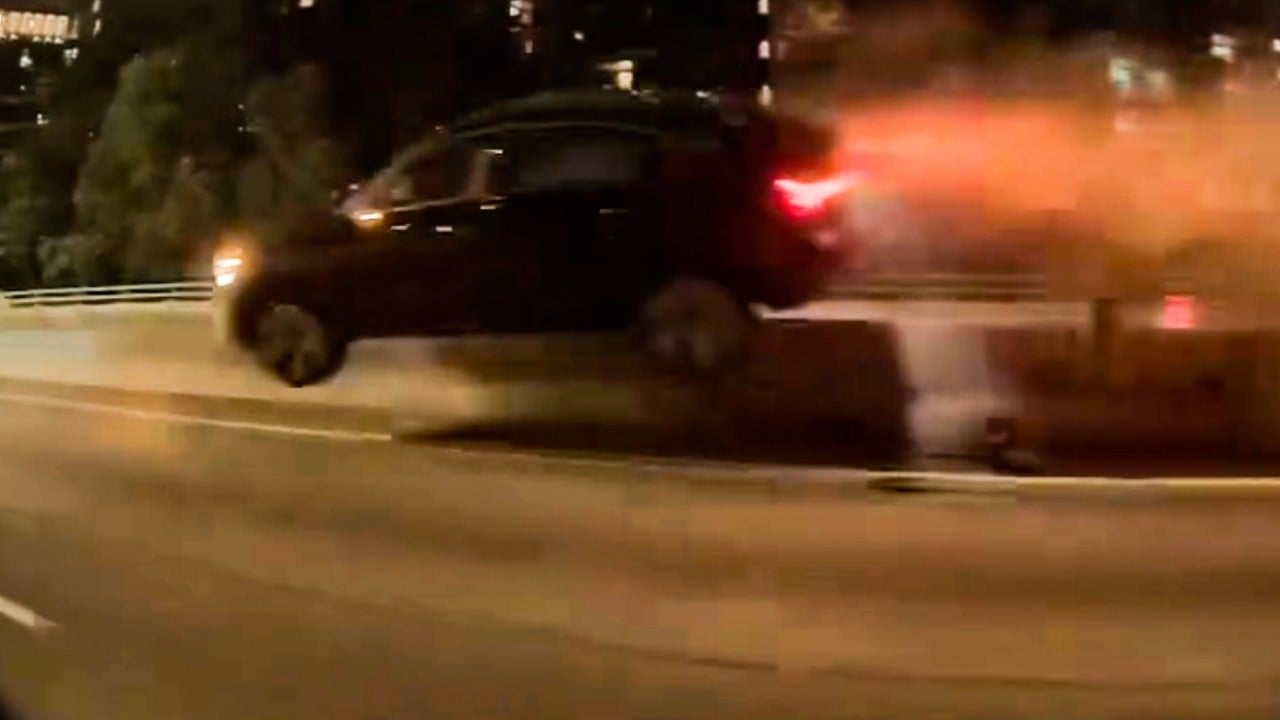
A standard Sunday evening commute turned into a chaotic scene mirroring an action movie on Tuen Mun Road. An Audi SUV traveling along the major arterial route lost control, airborne over the concrete central divider, and slammed into oncoming traffic.
The violent crash left two drivers hospitalized and highlighted the persistent dangers of one of Hong Kong's most notorious stretches of asphalt.
Here is what happened. Around 9:20 pm on Sunday, an Audi SUV was traveling along the opposite carriageway near the Gold Coast in Tuen Mun. Suddenly, the driver lost control. The vehicle didn't just skid. It vaulted clean over the central divider, pulverized a metal lamp post, and landed directly in the path of oncoming traffic.
Heading toward Yuen Long in the fast lane was a seven-seater family vehicle. Its driver saw the airborne SUV and slammed on the brakes, swerving hard to avoid a head-on impact. He almost made it.
The spinning rear section of the Audi clipped the seven-seater with immense force. The impact deflected the family car across the highway into the slow lane. Smoke and sparks erupted from the crushed front end of the vehicle.
Photos shared on local traffic social media groups showed both vehicles reduced to mangled heaps of metal. Debris littered multiple lanes. Paramedics rushed both drivers to Tuen Mun Hospital. While their injuries required immediate emergency treatment, officials confirmed they escaped fatal harm.
The Anatomy of a Tuen Mun Road Crash
If you drive in Hong Kong, you already know Tuen Mun Road has a bad reputation. Built in the late 1970s as the first major expressway connecting the New Territories to urban Kowloon, it has been plagued by design challenges from day one.
The highway cuts through tough terrain, meaning it's packed with sharp curves, steep inclines, and blind crests. Combine those geometric realities with high speeds, and you get a recipe for disaster. When a vehicle loses control at high speed on these specific bends, the physics work heavily against the driver.
In this Sunday night incident, the Audi SUV was traveling on a section known for fast-moving traffic. Losing control on a curve can easily cause a vehicle to trip when it hits a curb or a barrier. If the vehicle has a higher center of gravity, like an SUV, it can easily lift off the ground.
Knocking down a heavy steel lamp post requires massive kinetic energy. The fact that the central barrier failed to keep the Audi within its own bounds raises serious questions about the crash barriers installed along our expressways.
What Most People Get Wrong About Highway Dividers
Many drivers assume that concrete central dividers are impenetrable walls designed to stop any vehicle in its tracks. That's a misconception.
In reality, highway barriers are designed to absorb impact and redirect vehicles back into their traffic flow. They are not foolproof catch-nets for high-speed, airborne SUVs.
- The height problem: Standard concrete profile barriers stand around 800 to 1,000 millimeters tall. When an SUV or a larger vehicle strikes these barriers at an angle while skidding, the tires can climb the angled face of the concrete, effectively launching the car into the air.
- The maintenance factor: Decades of minor impacts, weathering, and shifting ground can compromise the structural integrity of older barriers.
- The speed variable: Barriers are crash-tested up to specific speed limits and impact angles. When a driver exceeds those thresholds, the barrier can fail to contain the vehicle.
The Transport Department has upgraded sections of Hong Kong expressways with higher, stronger concrete barriers. Yet, miles of older infrastructure still rely on designs that struggle to handle the weight and height of modern SUVs.
Surviving an Oncoming Crash Split Second Choices
The driver of the seven-seater survived because of rapid reflexes and hard braking. He couldn't avoid the collision entirely, but his actions changed the nature of the impact from a fatal head-on crash into a secondary rear-end collision.
If you ever find yourself facing a vehicle crossing into your lane, your survival depends on immediate, muscle-memory choices.
Don't just freeze and stare at the oncoming threat. Hard braking reduces the total energy of the inevitable impact. Every kilometer per hour you shed counts.
Swerve toward the slow lane or the shoulder, never toward the fast lane or the central divider. Vehicles losing control from the opposite side are moving outward. Swerving toward the left shoulder gives you the highest probability of opening up a escape corridor.
Accept that you might hit the guardrail or a ditch on the left side of the road. Side-swiping a stationary barrier on your left is infinitely better than taking a multi-ton vehicle directly through your front windshield.
The Immediate Steps After a Highway Wreck
The aftermath of a major highway crash is pure chaos. Secondary accidents happen frequently because following vehicles fail to stop in time. If you are involved in or witness a major incident on a highway like Tuen Mun Road, you need to act systematically.
First, turn on your hazard lights immediately to warn drivers behind you. If your car can still move, steer it out of the active traffic lanes toward the hard shoulder or an exit ramp.
Second, check yourself and your passengers for injuries. If the vehicle is smoking or you smell leaking fuel, evacuate everyone safely. Get behind the highway crash barrier on the side of the road. Never stand directly behind or in front of a disabled vehicle on an active expressway.
Third, call emergency services. Give them the exact location, mentioning major landmarks, highway exit numbers, or the direction of travel. On Tuen Mun Road, specifying whether you are heading toward Yuen Long or Kowloon saves critical minutes for ambulance crews.