Usha Vance wanted to launch a wholesome children's reading initiative. Instead, she handed Donald Trump a microphone in the Oval Office, and things went exactly how anyone who has watched the news over the last decade would expect.
The episode of Storytime with the Second Lady dropped on July 3, 2026, just in time for the Fourth of July weekend. It was meant to showcase the president reading a harmless picture book published by the White House Historical Association titled Presidents Play!. The book features cute illustrations of past commander-in-chiefs playing sports and enjoying the White House grounds.
It didn't take long for the script to go completely out the window. When the Second Lady asked Trump if he gets much time to read for fun while running the country, his answer stripped away any polished political veneer.
"So I end up reading mostly newspapers," Trump said. "I usually read stories about myself."
That single quote instantly blew up on social media, sparking intense backlash and turning a quiet literacy program into a viral lightning rod. Critics quickly pounced, asking why a children's podcast was being used to platform someone who can't stop talking about his own press coverage. But the self-absorption wasn't even the wildest part of the broadcast.
The Oval Office Becomes a Roast Stage
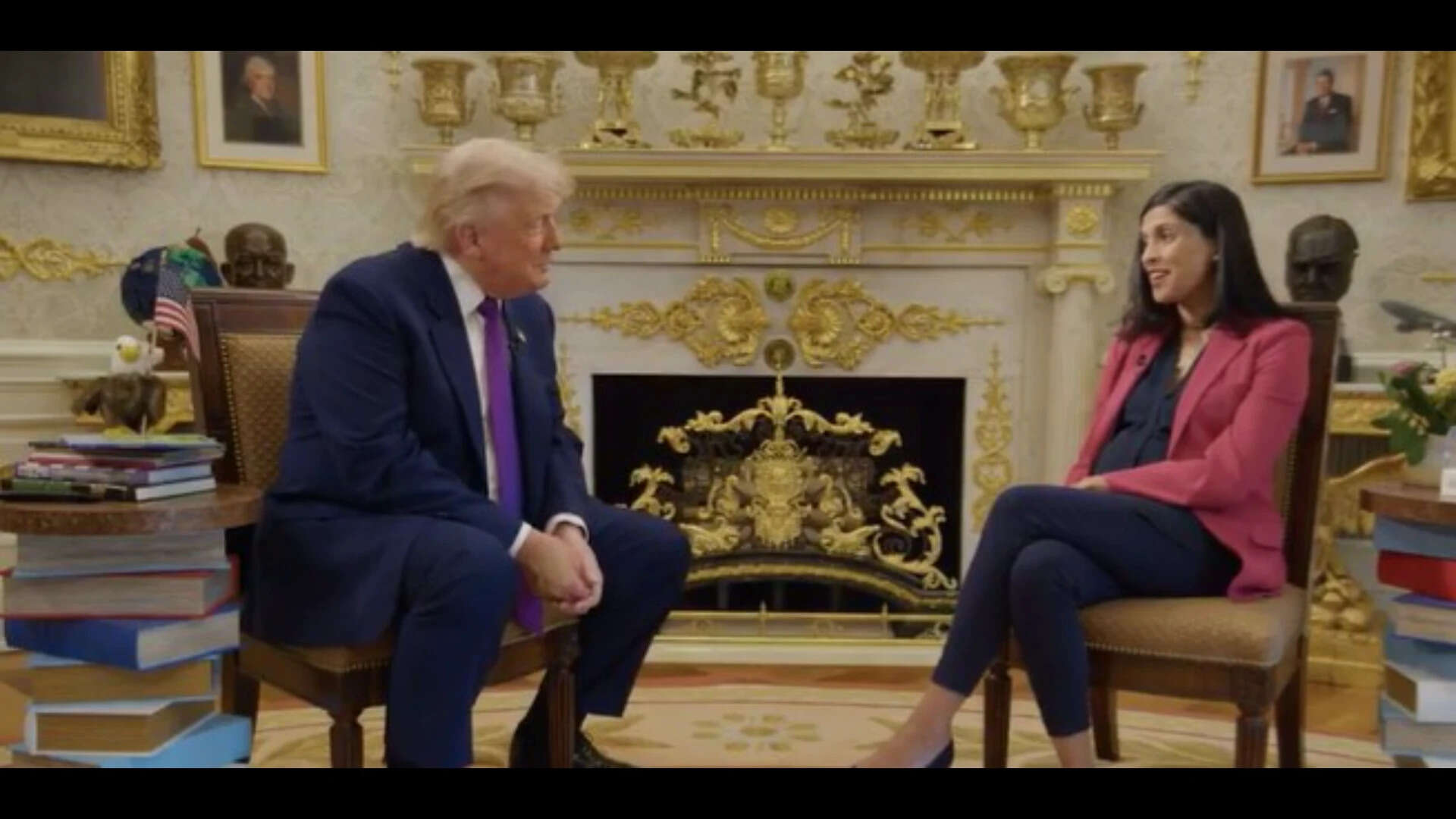
The setting for this children's show looked less like a library and more like a classic Trump branding exercise. Taped in mid-June inside the Oval Office, the room's intense gold accents were paired with bizarre props: a stuffed bald eagle, tables constructed out of stacks of oversized books, and a globe built entirely from Legos.
As Trump flipped through the pages of the children's book, he didn't just read the text. He provided a running commentary on his predecessors that felt more like a late-night comedy set or a campaign rally than a bedtime story.
He called Lyndon B. Johnson a "tough cookie." He praised Ronald Reagan as a "high-quality person" who felt "like your father was president." Then came the physical evaluations. Trump labeled John F. Kennedy "the second-most good-looking president," leaving the audience to guess exactly who he thinks occupies the number one slot.
The historical commentary didn't stop there. He noted that Richard Nixon "got himself into trouble, I guess," and joked that Herbert Hoover's homemade game of Hoover Ball "worked out better for him than the economy."
This wasn't historical education for kids. It was a raw, unfiltered stream of consciousness broadcast directly from the highest office in the land, packaged as children's entertainment.
Throwing Shade and Judging Bathing Suits
The commentary took a sharper turn when Trump reached the pages featuring his modern political rivals. An illustration of Barack Obama playing basketball prompted immediate skepticism from the president.
Trump referred to him as "Barack Hussein Obama" and openly doubted his athletic skills on the court. He shifted to Obama's well-known love for golf, dryly adding that "he won't be in the Masters anytime soon."
When Bill Clinton appeared on a page showing the jogging track he installed at the White House, Trump looked at the illustration and remarked, "I don't think I'll ever do that," though he quickly noted that he likes Clinton "a lot."
The absolute peak of the absurdity came when Trump saw an illustration of Gerald Ford swimming in a pool. The drawing forced the president to reflect on his own physical form and public image.
"I don't know if I look good in a bathing suit," Trump mused. "I haven't had a bathing suit in a long time."
He then moved on to William Howard Taft, America's heaviest president. Trump warned the children watching that he has to be incredibly careful because he doesn't want to "supersede his record," adding that "a thing like that would be possible if I allowed it to happen." He wrapped up the section by advising the young audience to keep themselves in good shape.
The Internet Explodes Over the Second Lady Strategy
The immediate fallout on platforms like X showed that the public wasn't buying the wholesome literacy angle. The backlash hit Usha Vance just as hard as it hit Trump. Social media users flooded timelines with sharp criticism, questioning the judgment of bringing a highly controversial political figure onto a show built for kids.
Many critics pointed out the deep irony of the situation. Comments ranged from mock concern to outright hostility. One viral post asked if Usha Vance was actually going to have to read to Trump, while others questioned whether the president has ever read a book to his own children.
The political strategy behind Storytime with the Second Lady has been transparent from the start. Launched earlier in 2026, the podcast seemed designed to soften the edges of the administration. Usha Vance, a corporate litigator and daughter of Indian immigrants, has often been viewed as a more moderate, relatable face for the MAGA movement. Her podcast set even featured decorations built by her own kids and nods to everyday things like Costco memberships.
But trying to run a normal, apolitical lifestyle program while married to the Vice President in an aggressive, polarizing administration is an impossible balancing act. Critics view the podcast as a calculated attempt to use children's literature to humanize a political machine that routinely enacts harsh policies.
The Fourth of July Message That Missed the Mark
The interview wrapped up with Usha Vance trying to pull the conversation back to a standard patriotic theme. She asked Trump what advice he had for children on why they should celebrate the United States on the Fourth of July.
Instead of a traditional, uplifting message about unity, freedom, or history, Trump offered a dark, tense assessment of the nation's current state.
"We have a great country," Trump stated. "We have a country that, it's on a little bit of a ledge right now. It can go one way or another, you understand that. But we're going to make it go the other. And we're going to make America greater than ever before."
Telling children that their country is dangling on a ledge just before a holiday weekend perfectly encapsulates why this entire crossover failed. Children's media relies on a sense of safety, structure, and simple values. Trump operates entirely on conflict, personal grievances, and high-stakes drama.
When you mix those two worlds, you don't get a successful public relations boost. You get a bizarre piece of political media that alienates parents, causes a massive social media backlash, and leaves everyone wondering why a kids' reading hour turned into a critique of Barack Obama's golf swing.
If the goal of the Second Lady's podcast was to create a quiet, safe space to promote reading, this episode completely destroyed that boundary. Moving forward, the administration will have to reckon with the reality that you cannot separate the political brand from the family brand. Parents looking for a simple bedtime story for their kids are going to look elsewhere, leaving Storytime with the Second Lady as just another battleground in the endless news cycle. Check out the official White House Historical Association page to see the actual book Presidents Play! and judge the illustrations for yourself.