Stop calling the Danakil Depression an alien world.
Every travel brochure, science documentary, and clickbait headline says the same thing. They look at the neon yellow acid ponds of Dallol, the boiling chlorine scum, and the sulfur chimney towers, and they declare it "Mars on Earth." They tell you it looks like another planet. They claim scientists know exactly what is happening beneath the salt crust.
They are wrong on both counts.
Calling the Danakil Depression "alien" is a lazy intellectual cop-out. It cheapens the raw, violent reality of our own planet's mechanics. Dallol isn't alien at all. It is the most intensely terrestrial place on Earth. It is the literal birth of an ocean, stripped bare of soil and water, exposed to the sky.
Worse, the standard narrative implies that Western science has wrapped this place up in a neat little package. The reality is far more chaotic, messy, and unresolved.
The Myth of the Astrobiological Playground
The lazy consensus goes like this: because Dallol is incredibly hot, hyper-saline, and ultra-acidic, it serves as the perfect analog for early Mars or the icy moons of Jupiter. Researchers flock to northern Ethiopia, scrape some multi-colored sludge into a vial, and publish papers claiming they are discovering the limits of extraterrestrial life.
I have spent years analyzing how we evaluate extreme environments. The obsession with framing everything through an extraterrestrial lens has blinded us to what the data actually shows.
In 2019, a team led by Jodie Belilla published a study that shattered the romantic illusion of Dallol’s universal habitability. They found that in the most extreme, hyper-acidic, magnesium-rich ponds of Dallol, life does not exist. Not even archaea. The combination of high chaotic salt concentrations and extreme acidity acts as a molecular barrier. It destroys lipid membranes and denatures proteins completely.
Yet, the media still hypes it up as a cradle for alien life.
We are looking at a sterile chemical desert and calling it a window into cosmic biology. The true value of the Danakil Depression is not that it mimics Mars. It is that it demonstrates the terrifying limits of chemistry right here on Earth. When you stare into those brilliant turquoise pools, you are not looking at the beginning of life. You are looking at the absolute triumph of geology over biology.
The Broken Blueprint of the Triple Junction
To understand why the mainstream explanations fall flat, you have to look at how geology textbooks oversimplify the Afar Triangle. They draw three neat lines meeting at a single point: the Red Sea rift, the Gulf of Aden rift, and the East African Rift system. They call it a textbook RRR (Rift-Rift-Rift) triple junction.
They tell you the Arabian plate and the African plates are pulling apart, magma rises, the ground sinks, and voila—you get a depression 125 meters below sea level.
It is a beautiful theory. It is also a massive oversimplification that ignores the actual plumbing beneath the Danakil block.
The standard model treats the depression like a simple dropping floor, a basic graben. But the sub-surface mechanics are highly asymmetrical. The crust underneath the Danakil Depression has been stretched so thin that it is effectively oceanic crust in all but name. The magma isn't just sitting in a neat chamber waiting to erupt; it is actively intruding into massive, kilometers-thick salt deposits left behind by ancient flooding events from the Red Sea.
When you mix shallow basaltic magma with ancient marine evaporites, you do not get standard volcanism. You get a volatile, unpredictable geochemical factory. The hyper-acidic pools of Dallol are not volcanic craters in the traditional sense. They are phreatic explosion craters, driven by superheated groundwater blasting through thick salt sheets.
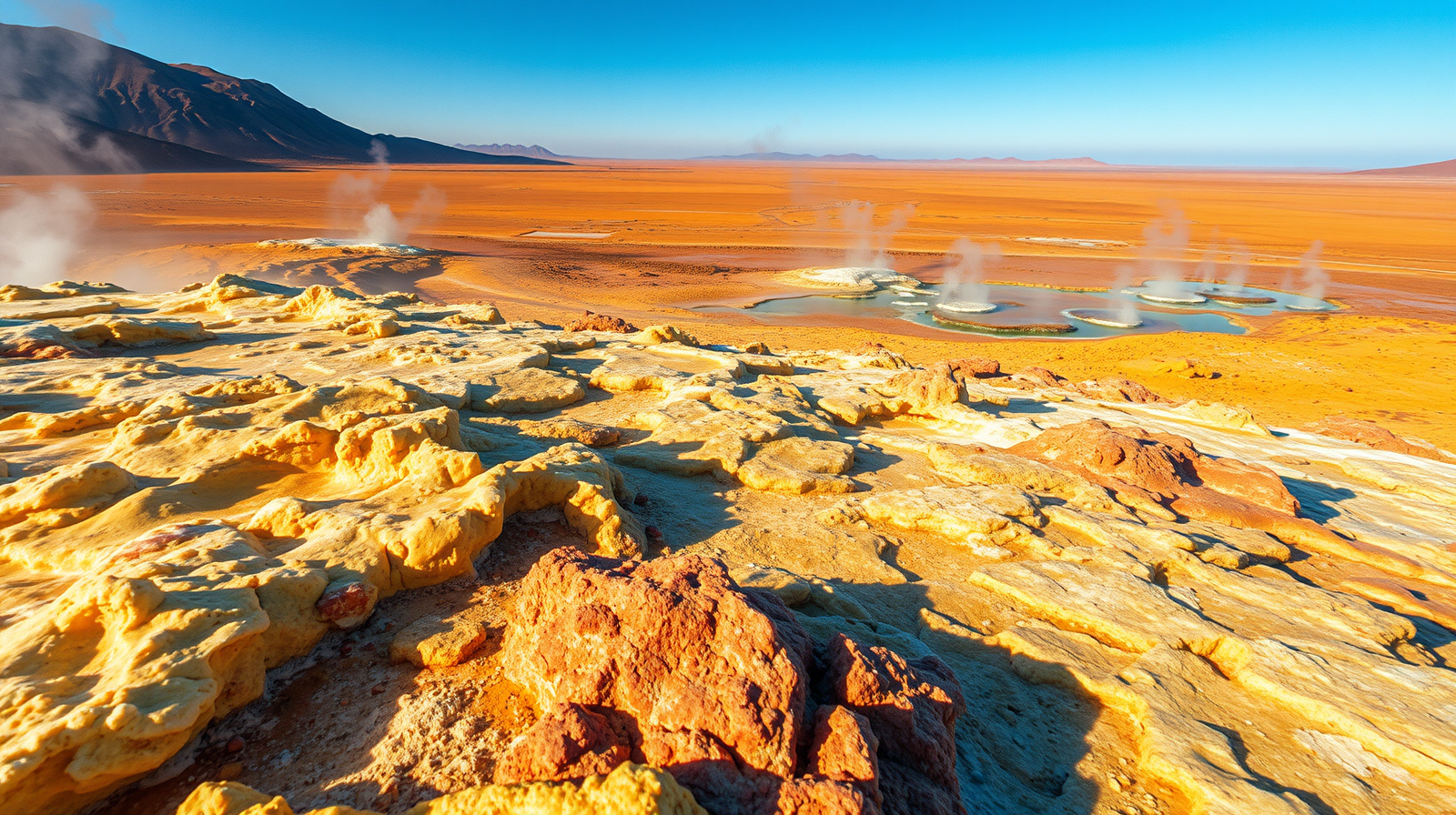
The brilliant colors that tourists snap photos of are not just "sulfur." They are a complex, shifting cocktail of iron chlorides, copper salts, and rock salt variations. The system changes weekly. A pool that was deep green and pH 0 on a Tuesday can dry up and turn into a white salt chimney by Friday.
The consensus treats Dallol as a static monument to extreme geology. In truth, it is a fleeting, high-speed chemical reaction.
The Eurocentric Expedition Bias
We need to talk about who gets to define what we know about the Danakil. For decades, the narrative around this region has been dominated by Western expeditionary teams who fly into Semera, hire local Afar guides to carry their gear through 50-degree Celsius heat, collect their samples, and fly home to analyze them in air-conditioned labs in Europe or America.
This has created a profound bias in how the data is interpreted.
Because these expeditions are expensive and logistically dangerous, they are almost always short-term. Scientists get a snapshot of the Danakil during the cooler winter months. They see a specific configuration of hydrothermal vents and salt terraces. They treat that snapshot as the baseline.
What they miss is the seasonal and multi-year dynamics that the Afar people have witnessed for generations. The Afar understand the movement of the salt crust, the subtle shifts in toxic gas emissions, and the cyclical flooding of the salt pans better than any academic with a three-week research grant. Yet, traditional indigenous knowledge is completely omitted from the scientific literature. Instead, it is packaged as exotic background flavor for travel journalism.
If you want real, actionable understanding of how the Danakil behaves over decades, you cannot rely solely on satellite imagery and sporadic field trips. You have to look at the interface between the changing regional climate and the geothermal subsurface. Increased flash flooding from the Ethiopian Highlands更改the chemistry of the salt plains drastically, dissolving old structures and creating entirely new hydrothermal pathways that confuse the existing geological models.
Dismantling the Top Three Danakil FAQs
The internet is full of bad information regarding the northern Afar region. Let's dismantle the premises of the questions people usually ask.
Is the Danakil Depression the hottest place on Earth?
People love superlative titles. They call the Danakil the hottest inhabited place on earth. But the way meteorologists measure heat vs. the way tourists experience heat are two completely different things. Dallol holds the record for the highest average temperature for an inhabited place, recorded between 1960 and 1966, where the mean daily maximum was 41 degrees Celsius (106 Fahrenheit).
But that is an average. It does not mean it reaches the peak absolute highs of Death Valley or the Dasht-e Lut desert in Iran. The horror of Danakil heat is its relentless consistency. The basalt rocks and salt flats absorb solar radiation all day and radiate it back out all night. There is no cooling period. It is a thermal trap.
Why are the pools so brightly colored?
The common answer is "bacterial action and sulfur." This is fundamentally wrong. While sulfur compounds are abundant, the dazzling yellows, reds, and greens are primarily driven by the oxidation states of iron.
As hyper-acidic, boiling water rises through the subsurface salt deposits, it dissolves massive amounts of divalent iron ($Fe^{2+}$). When this water reaches the surface and comes into contact with atmospheric oxygen, the iron oxidizes into trivalent iron ($Fe^{3+}$), shifting the color from deep green to bright yellow and orange. It is inorganic chemistry on a massive scale, not an ecosystem of colorful microbes.
Is it safe to visit?
Travel bloggers will tell you it is perfectly safe as long as you go with an armed military escort, which is mandatory due to past geopolitical tensions along the Eritrean border. They completely ignore the invisible danger: air quality.
The air around Dallol is frequently thick with carbon dioxide, sulfur dioxide, and hydrogen chloride gases. These gases are heavier than air. They collect in low-lying depressions and hollows. A sudden shift in wind direction can send a plume of invisible, suffocating gas over a tourist trail. There is no real-time gas monitoring infrastructure for visitors. You are relying on pure luck and the instinct of your local guide.
Stop Romanticizing the Chaos
The desire to see the Danakil Depression as a piece of the cosmos dropped into East Africa is driven by a deep-seated refusal to accept the earth on its own terms. We want the wild, violent parts of our world to be "other." We want them to belong to the stars because it makes them feel distant, safe, and theoretical.
It is a coping mechanism.
The Danakil is not a piece of Mars. It is a raw look at what happens when the thin veneer of our biosphere is ripped away by the tectonic engines driving the planet. It is volatile. It is hyper-corrosive. It is entirely indifferent to life.
Pack away the sci-fi metaphors. The Danakil Depression doesn't look like another planet. It looks exactly like Earth when it is building something new out of fire and salt.


