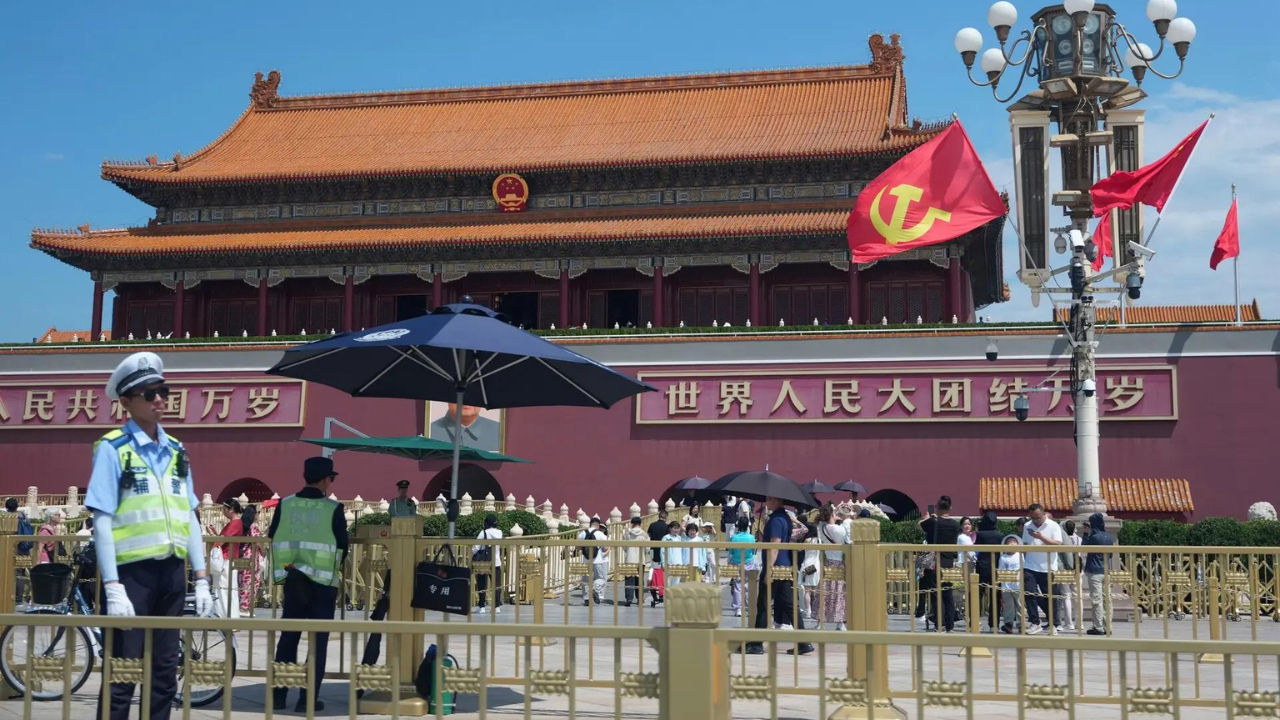
Western media outlets roll out the exact same editorial calendar every June. You can set your watch by it. The headlines write themselves: "Forbidden Anniversary," "Beijing Silences Grief," "The Totalitarian Erasure of Memory."
The narrative is simple, clean, and entirely wrong.
It paints a picture of a regime terrified that a single flower placed on a grave in Wan'an Cemetery will spark a sudden, nationwide democratic awakening. It assumes that memory is a fragile balloon, and the Chinese Communist Party (CCP) is desperately trying to pop it before anyone notices.
This lazy consensus misses the entire mechanics of modern authoritarian power. Beijing does not block those cemetery gates because it is afraid of the past. It blocks them because it understands how to manage the friction of the present.
The Compulsion Loop of the Annual Op-Ed
Every year, journalists stand outside restricted zones, take a photo of a gray security van, and declare that the CCP is trembling. They look at Beijing’s heavy-handed security theater and diagnose it as panic.
It isn't panic. It is routine maintenance.
By focusing entirely on the emotional tragedy of blocked families—which is undeniably real on an individual level—the standard analysis fails to comprehend the state's actual playbook. The goal of the Chinese security apparatus is not the total eradication of historical knowledge. The goal is the containment of public coordination.
There is a fundamental difference between a state that needs you to forget, and a state that merely requires you to remain disorganized.
What the "Memory Erasure" Narrative Gets Wrong
- The Ignorance Assumption: The common trope is that the post-90s and post-00s generations in China have no idea June 4th happened. This is an oversimplification. Anyone with a VPN, an international education, or older relatives knows something happened.
- The Apathy Reality: The state hasn't just scrubbed textbooks; it engineered an economic trajectory that made the knowledge irrelevant to daily survival. When prosperity is tied to compliance, historical curiosity becomes an expensive luxury.
- The Security Theater: The overt presence of police at cemeteries isn't a sign of a regime on the brink of collapse. It is a calculated display of capacity designed to remind the populace who controls the physical space.
Stability Maintenance is an Infrastructure, Not an Emotion
To understand why the gates are locked, you have to look at the budget. China’s domestic security spending—often referred to as weiwen (stability maintenance)—has famously rivaled or exceeded its official military budget for years.
This is not the behavior of an entity acting on impulse or fear. It is a highly institutionalized bureaucratic machine.
"When a state spends hundreds of billions on domestic surveillance, the restriction of a cemetery isn't a crisis response. It's a line item in a budget spreadsheet."
The bureaucracy must justify its own existence. Local security officials in Haidian District do not care about the geopolitical implications of blocking a grieving mother. They care about their Key Performance Indicators (KPIs). If a protest, a gathering, or a viral photo occurs on their watch, their careers are over. If they lock the gate and draw a few critical articles from foreign newspapers, they get a promotion for a quiet June.
It is a cold, rational optimization problem. The Western press views it as a moral battle between memory and forgetting. The bureaucrat views it as risk mitigation.
Dismantling the Premise of the "Inevitable Awakening"
The underlying theory of almost every Western article on this topic is that if China just allowed open remembrance, the regime would crumble. This is a flawed premise based on a Western-centric view of political evolution.
Let's look at the actual mechanics of political stability in the region.
| Western Media Assumption | The Structural Reality |
|---|---|
| Suppressing memory creates a pressure cooker that will eventually explode. | Suppressing coordination points prevents the pressure from ever finding a directional valve. |
| Citizens are yearning for western-style democratic reforms. | The primary concern for the vast majority remains economic stability and national strength. |
| Technology will inevitably pierce the firewall and liberate the truth. | Technology has been successfully weaponized to predict and neutralize dissent before it manifests. |
If you speak to political scientists who study Chinese governance, like those analyzing state-backed internet censorship data, they will tell you that the censors do not actually care about criticism of the government. You can complain about corruption. You can complain about local officials. What gets your post deleted immediately is an attempt to organize a gathering.
The cemetery is a physical gathering point. That is its crime. Not the history it contains, but the square footage it provides for collective action.
The Cost of the Counter-Intuitive Approach
There is a dark side to recognizing this reality. Admitting that the state's strategy is rational and effective means abandoning the comforting myth that truth possesses an inherent political gravity that automatically pulls down dictatorships.
It doesn't.
Truth without organization is just noise. Beijing knows this. The state allows vast amounts of historical horrors to exist in the background—the Cultural Revolution, the Great Leap Forward—as long as they remain historical, academic, and unlinked to current political mobilization.
By treating the cemetery lockdown as a unique act of tyrannical cowardice, we miss the broader, more terrifying truth: it is a standard operating procedure of a highly functional, deeply resilient technocratic state.
Stop looking for cracks in the pavement every time June rolls around. The gates aren't locked because the regime is weak. The gates are locked because they have the power to turn the key, and they know nobody is going to stop them.


