Cold.
That is the first thing you notice when you stand outside a diplomatic summit in late November, watching the breath of armored car drivers turn to white plumes under security floodlights while three men inside a heated room decide whether your son will ever have to wear a helmet.
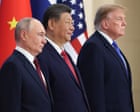
In the standard news dispatches, the headline is clean, metallic, and distant: Donald Trump, Vladimir Putin, and Xi Jinping have emerged from a historic trilateral meeting to release a joint "peace declaration." Wire services summarize the bullet points—commitments to strategic stability, de-escalation frameworks, renewed bilateral hotlines, and a shared pledge to avoid direct military confrontation among the world's primary nuclear powers. Journalists in press rooms parse the adjectives. Markets tick upward by two percent before lunch.
Yet if you strip away the podiums and the state flags, a peace declaration is not an ending. It is a heavy, unverified check handed across a mahogany table, and ordinary families are the ones who have to walk down to the bank to see if it clears.
The Arithmetic of a Kitchen Table
Consider a hypothetical family living in a mid-sized port city—say, a marine mechanic in Gdańsk, a semiconductor technician in Hsinchu, or a wheat farmer outside Odessa. Let us call the mechanic Marek.
For the past several years, Marek has lived his life inside the margins of other men’s press conferences. When sanctions tightened, the price of the diesel heating his garage doubled. When naval exercises crowded the shipping lanes, the container parts he needed to feed his children sat anchored forty miles offshore for six weeks. Marek does not read white papers on multipolar deterrence. He reads the back of electricity bills and the faces of his neighbors when the air-raid sirens run their monthly tests.
When news breaks that the presidents of the United States, Russia, and China have stood together to sign a joint declaration of peace, Marek does not pop champagne. He turns up the volume on the kitchen radio and waits to hear what the fine print actually trades away.
This is the invisible stake that conventional geopolitical coverage routinely misses. Diplomacy at the summit level operates like tectonic plates shifting ten miles beneath the ocean floor; the geologists measure the movement in millimeters, while the people living on the coast wait to see if the tide pulls back before a wave hits. To understand what a joint declaration between Washington, Moscow, and Beijing truly means, we have to look past the choreography of the handshake and examine the machinery of power that sits underneath it.
Why Three Men Walked Into the Same Room
History rarely produces a three-way summit out of sudden affection. It produces them out of exhaustion, mutual calculation, and the sobering math of overextension.
Think of the global security architecture over the last decade as a three-legged stool where each leg has been steadily sawing at the others. The United States has stretched its industrial base and naval commitments across two hemispheres simultaneously, managing proxy conflicts, alliance guarantees, and domestic political fatigue. Russia has absorbed the staggering economic and demographic toll of prolonged war on its western flank, trading long-term technological modernization for wartime production. China, meanwhile, has watched its export-driven growth model collide with tariffs, supply-chain decoupling, and the chilling realization that a major kinetic conflict in the Pacific would vaporize the very maritime trade routes upon which its economy breathes.
None of the three powers can achieve total dominance over the other two without risking catastrophic ruin. That is the cold, unvarnished reality behind the "peace declaration."
Analysts at institutions like the Carnegie Endowment and Chatham House have long noted that great-power detente almost never begins with shared values; it begins with shared vulnerability. In 1972, when Richard Nixon flew to Beijing and later to Moscow, the resulting communiqués were filled with lofty phrases about peaceful coexistence. Behind closed doors, however, each leader was buying time, managing domestic pressures, and leveraging the triangle to keep the other two off balance.
The current declaration follows that exact historical blueprint. By issuing a joint statement rather than three separate bilateral memos, Trump, Putin, and Xi are signaling a return to great-power concert politics—an arrangement where the largest states agree to manage global flashpoints directly among themselves, establishing guardrails against accidental nuclear escalation and carving out tacit spheres of predictability.
What the Declaration Actually Does—And What It Leaves Out
If you are trying to figure out whether this document makes the world genuinely safer or merely quieter for a season, you have to separate the architectural commitments from the diplomatic fog.
According to the released text and diplomatic readouts from the summit, the declaration rests on three core pillars:
- Strategic Nuclear Risk Reduction: A formal pledge to restore military-to-military communication channels, provide advance notification of ballistic missile launches, and freeze the deployment of certain intermediate-range systems. After years of collapsing arms-control treaties—from the demise of the INF Treaty to the suspension of New START—simply putting the three largest nuclear arsenals back inside a shared verification room pulls the world back from a hair-trigger posture.
- Maritime and Trade Corridor De-escalation: A commitment to avoid blockades, cyber-sabotage of undersea cables, and kinetic interference in critical shipping chokepoints. For a global economy battered by freight inflation, this is the clause designed to calm bond markets and central banks immediately.
- A Framework for Regional Ceasefires: Broad language endorsing negotiated settlements in ongoing European and Middle Eastern theaters, paired with a pledge to respect "legitimate security concerns" without explicitly redrawing borders on the page.
Notice what is missing.
There are no binding enforcement mechanisms. There are no timelines for troop withdrawals. There is no resolution to the status of Taiwan, the sovereignty of disputed territories in Eastern Europe, or the race for dominance in artificial intelligence and quantum computing.
In diplomacy, diplomats call this constructive ambiguity. You write a sentence broad enough that each leader can fly home and tell his domestic audience he won. Washington can claim it secured global stability and nuclear restraint without surrendering core alliances. Moscow can claim it broke Western diplomatic isolation and won recognition as an indispensable security guarantor. Beijing can present itself as the mature, stabilizing broker of a post-Western order.
The Trap of the Paper Peace
I remember standing in a border town years ago, two days after a celebrated ceasefire had been signed in a European capital five hundred miles away. The politicians on television were glowing, talking about a "new chapter of mutual trust." Down on the ground, the artillery did not stop; it simply shifted from firing at noon to firing at three in the morning when the international monitors were asleep.
That memory stays with you because it teaches a hard truth about pieces of paper: a declaration stops a war only when the people holding the rifles believe the penalty for shooting is higher than the reward.
Critics of the trilateral summit—including foreign policy hawks in Washington and nervous diplomats in smaller capitals from Warsaw to Taipei—point out the central danger of a three-power deal. When giants make peace over the heads of smaller nations, the smaller nations often become the currency used to pay for the agreement.
Suppose you are a defense planner in Tokyo, Seoul, or Tallinn. Watching the leaders of the United States, Russia, and China stand shoulder to shoulder on a stage triggers an immediate, visceral question: What did you promise him about us when the cameras were turned off?
If a peace declaration relies on tacitly accepting zones of influence, it can inadvertently invite future aggression by signaling that borders are negotiable so long as the negotiation does not inconvenience the three largest capitals. History offers a grim warning here. The 1928 Kellogg-Briand Pact, signed by almost every major power on earth, formally outlawed war as an instrument of national policy. Eleven years later, cities across Europe and Asia were burning.
The Quiet Machinery of Trust
Yet cynicism is just as lazy as naivete. To dismiss the summit entirely as empty theater is to ignore how catastrophic the alternative trajectory had become.
Before this meeting, the world was sleepwalking down a corridor with no exits. Direct communication between American and Russian military commanders had shriveled to near zero. Incidents between naval vessels and reconnaissance aircraft in the South China Sea and the Black Sea were occurring weekly, each one carrying the potential for a localized miscalculation that neither side could easily walk back without losing face.
Think of the trilateral declaration not as a marriage, but as installing a circuit breaker in an overloaded house. A circuit breaker does not fix frayed wiring inside the walls, nor does it lower your electric bill. What it does is stop a sudden surge from burning the entire structure down while you figure out how to rewire the basement.
When Trump, Putin, and Xi put their names on a document reaffirming that a nuclear war cannot be won and must never be fought, they are re-establishing a psychological floor. They are giving their own generals and intelligence agencies permission to step down from maximum alert. They are creating political cover for back-channel negotiators to hammer out the gritty, unglamorous details—prisoner exchanges, grain corridors, tariff exemptions, and embassy staffing—that actually lower the temperature of daily life.
Where the Ink Meets the Street
We live in an era that is deeply uncomfortable with uncertainty. We want to know immediately whether a headline is a triumph or a betrayal, whether the market will boom or crash, whether peace has arrived or war is merely paused.
The truth is far messier, and far more human.
Right now, in intelligence basements from Langley to Moscow to Beijing, analysts are tearing apart every comma of that declaration, looking for loopholes, testing satellite imagery for compliance, and preparing contingency plans in case the ink smears by spring. Meanwhile, shipping insurers in London are recalculating war-risk premiums, and diplomats from middle-power nations are scrambling to secure seats at the secondary tables where the real territorial bargains will be struck.
Back in his coastal garage, Marek the marine mechanic wipes grease from his knuckles and turns off the radio. The speeches are over. The motorcades have left the tarmac. Tomorrow morning, he will walk down to the docks at dawn, look out at the gray water, and count the cargo ships coming through the breakwater. That—not the signatures on the parchment—is how he will know whether the world has actually changed.