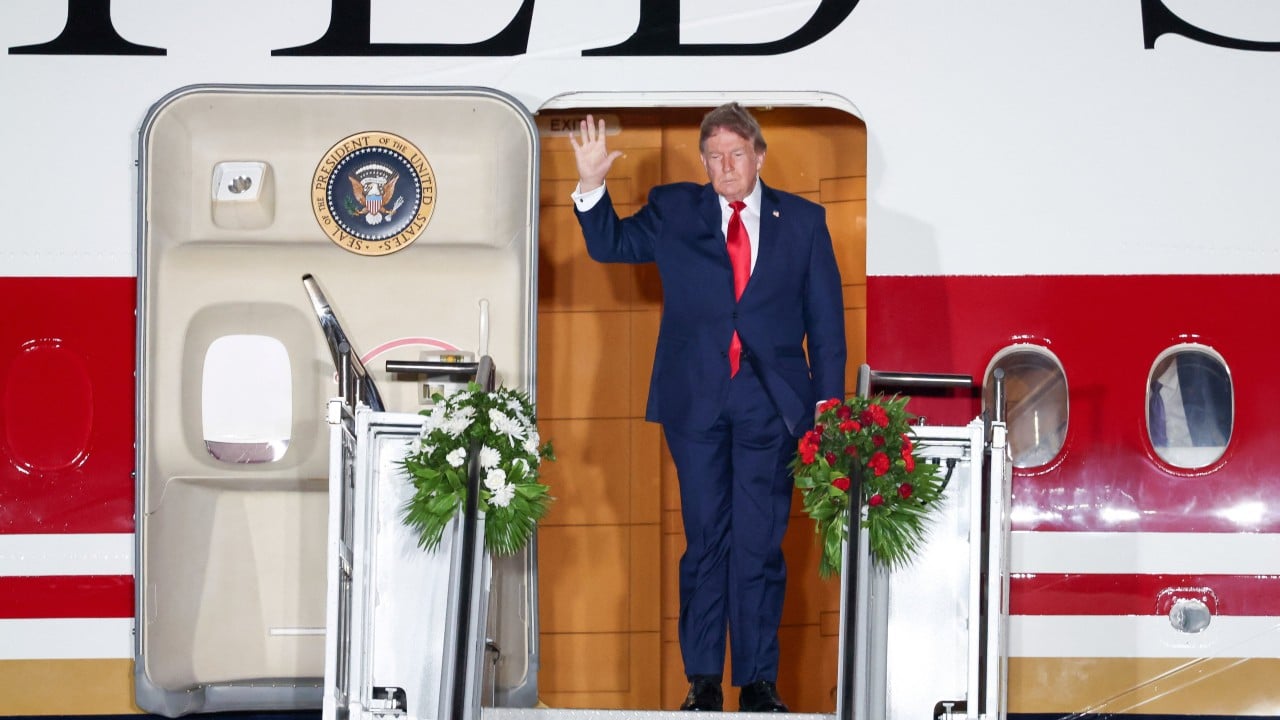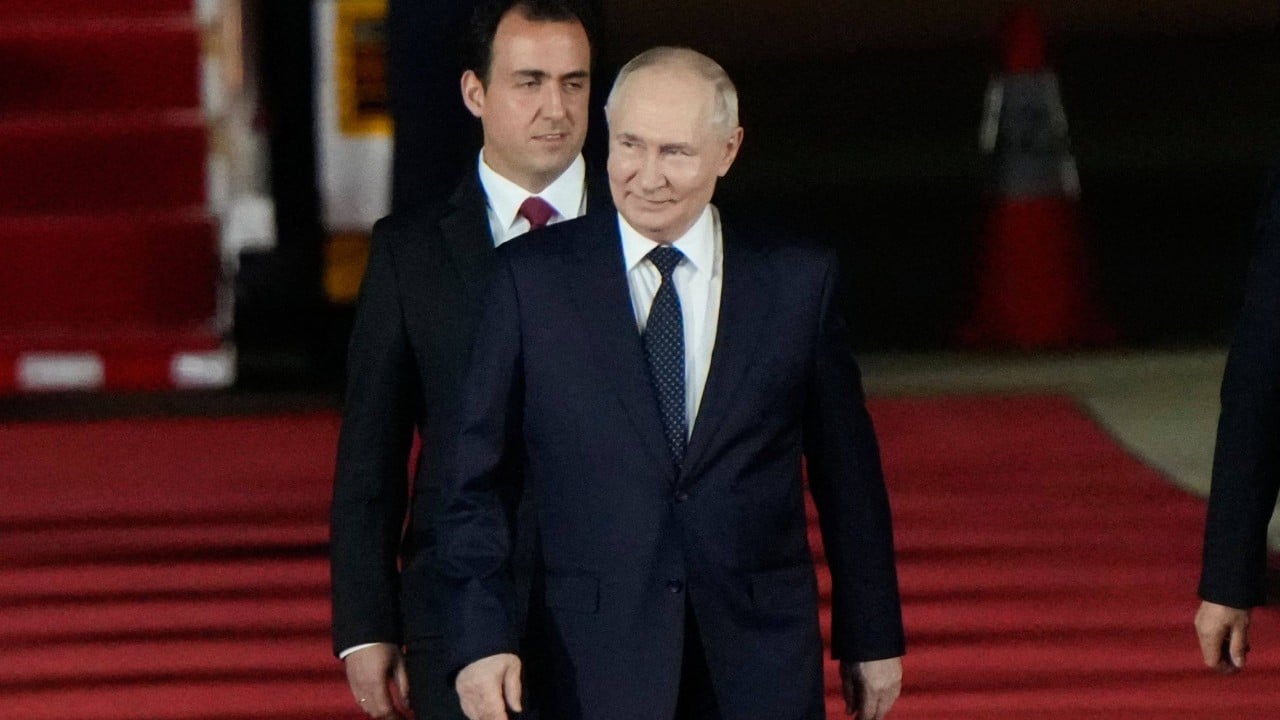
The fluorescent lights in a twenty-four-hour diner off Interstate 80 in Ohio hum at a frequency that gets into your teeth around three in the morning. That is where you find people like Marcus, a composite character representing thousands of third-shift freight dispatchers across the American Midwest, staring at a wall of monitors showing red and green dots creeping across the Pacific Ocean. Each dot is a container ship. Inside those steel boxes are lithium-ion battery cells, semiconductor wafers, winter coats, and blood pressure medication. When Donald Trump boards Air Force One for Beijing to sit across a polished mahogany table from Xi Jinping and Vladimir Putin, Marcus does not watch the cable news pundits argue over body language or lapel pins. He watches the shipping lanes.
Diplomacy is usually sold to the public as high theater. Cameras flash. Flags stand stiffly behind podiums. Translators murmur into earpieces while three of the most powerful men on the planet shake hands for thirty seconds longer than necessary, testing grip strength like schoolboys on a playground. Yet the real story of a trilateral summit between the United States, China, and Russia has very little to do with the choreography in the Great Hall of the People. It happens in the spaces between the handshakes. It lives in the invisible tremors that travel from a conference room in Beijing straight into the price of diesel in Nebraska, the interest rate on a mortgage in Manchester, and the quiet dread of a mother in Kharkiv listening to the night sky.
Wait.
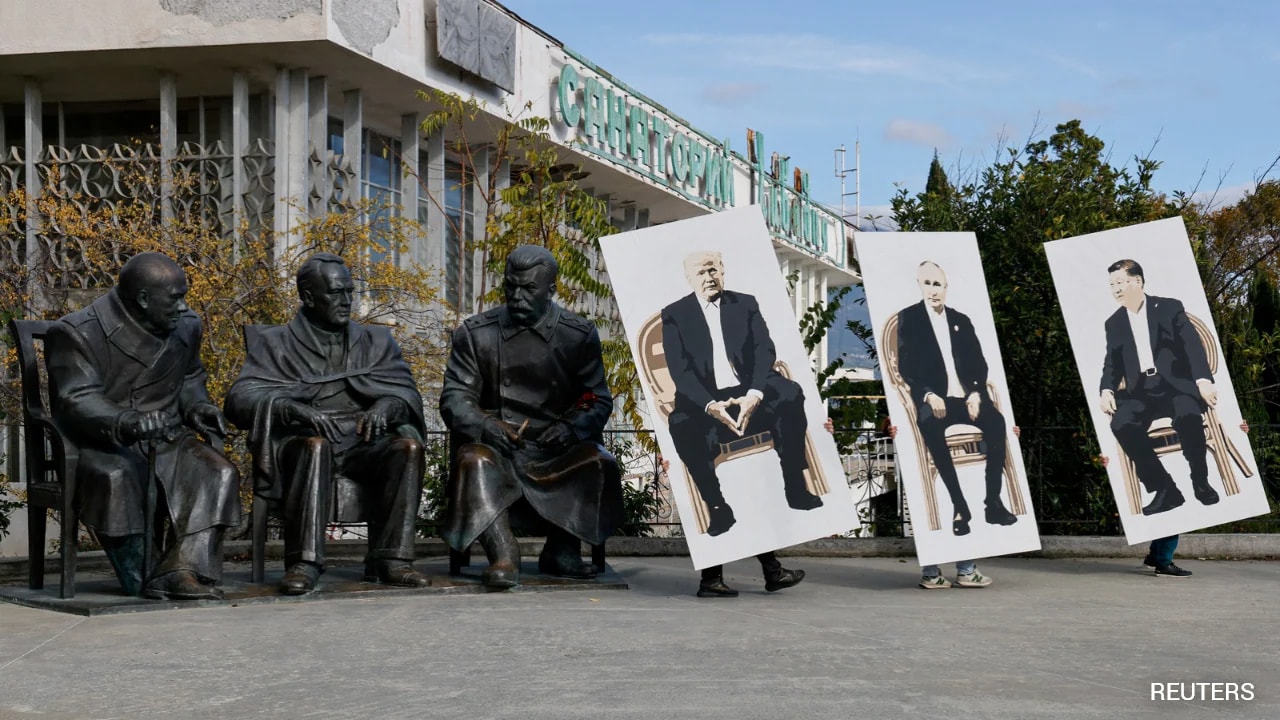
Think about the last time three leaders holding the keys to the world's largest nuclear arsenals, its biggest manufacturing engine, and its dominant reserve currency sat in the same room without a world war already raging outside the doors. You have to go back to 1945, to a sun-bleached resort town on the Crimean peninsula called Yalta, where Franklin Roosevelt, Winston Churchill, and Joseph Stalin divided the twentieth century over maps and cigarette smoke. That comparison is a metaphor, of course—Beijing is not Yalta, and the twenty-first century is not 1945—but the underlying human geometry feels eerily familiar. Once again, the fate of billions rests on the personal chemistry, grievances, and calculations of a remarkably small circle of men.
The Architecture of a Room
To understand why a meeting between Donald Trump, Xi Jinping, and Vladimir Putin carries such an electric charge, you first have to strip away the noise of daily headlines and look at the room itself. Imagine a triangular table. Not literally, though protocol officers lose sleep over the exact angles of seating arrangements, but strategically. Every side of that triangle pulls against the other two.
For years, Washington foreign policy orthodoxy held that Moscow and Beijing were natural rivals, bound by a four-thousand-kilometer border and centuries of mutual suspicion. The standard playbook said America could always play one off against the other, much as Richard Nixon and Henry Kissinger did in 1972 when they flew to Beijing to exploit the Sino-Soviet split. That playbook is obsolete. Over the past decade, Western sanctions, trade tariffs, and competing visions of global order have pushed Russia and China into an alignment that Xi and Putin have famously described as a partnership with "no limits." Russia supplies discounted oil, natural gas, grain, and raw minerals; China provides the industrial machinery, microelectronics, and consumer goods that keep the Russian economy breathing.
Into that tightly wound axis steps Donald Trump, a leader who has consistently rejected traditional multilateral diplomacy in favor of direct, personal dealmaking. Supporters of this approach argue that only a leader willing to break diplomatic china can shatter a dangerous stalemate—that talking directly to strongmen is the only way to prevent small regional fires from merging into a global inferno. Critics, including many veteran diplomats who spent careers building alliances in Europe and Asia, counter that sitting down in Beijing hands Xi and Putin an immediate propaganda victory, legitimizing their territorial ambitions while signaling to American allies from Tokyo to Warsaw that their security might be treated as a bargaining chip.
Both perspectives capture a slice of the truth, which is why the moment feels so disorienting. When you have lived through eras where the rules of international conduct seemed predictable—even if imperfectly enforced—watching the entire chessboard get lifted up and shaken induces a very specific kind of vertigo.
The Invisible Ledger
What actually gets traded when three superpowers meet behind closed doors? Rarely is it a single grand treaty tied up with a ribbon. Instead, diplomacy at this altitude resembles a sprawling, multi-currency auction where nothing is ever quite what it costs on the tag.
Consider the three primary pressure points on the table:
- The War in Eastern Europe: For Vladimir Putin, any conversation with Washington revolves around Ukraine, NATO's eastern boundary, and the lifting of financial sanctions that have frozen hundreds of billions of dollars in Russian central bank reserves. Trump has repeatedly asserted that the conflict would never have started on his watch and has framed himself as the only figure capable of brokering a rapid settlement. Yet a ceasefire drawn along current battle lines looks like pragmatic realism to some observers and rewarded aggression to others.
- Trade, Tariffs, and Supply Chains: For Xi Jinping, the overriding priority is economic stability at home. China faces a sluggish property sector, youth unemployment, and demographic headwinds, making unrestricted access to global markets vital. American tariffs on Chinese electric vehicles, solar panels, and steel—combined with strict export controls on advanced artificial intelligence chips—hit Beijing where it hurts most. Xi wants breathing room; Trump wants massive purchasing commitments, manufacturing reshoring, and an end to trade imbalances that have hollowed out American factory towns.
- The Shadow of Taiwan and the South China Sea: Beneath every discussion of soybeans and tariffs sits the unspoken question of Taiwan, the self-governing island democracy that Beijing claims as its own and that produces the vast majority of the world's most advanced semiconductors. A single miscalculation in the Taiwan Strait would not just trigger a military crisis; it would instantly freeze the global electronics industry, halting everything from smartphone production to hospital equipment manufacturing within weeks.
To grasp how tightly these issues are tangled together, picture three people standing in a small boat during a rising swell. If the person on the left lunges for an oar, the person on the right has to lean back just to keep the hull from taking on water. None of them can make a sudden move without altering the balance for everyone else. That is the reality of modern interdependence. You cannot pull a thread on Russian energy exports without tugging on European inflation, which in turn affects American interest rates, which shifts the value of the Chinese yuan.
The Weight of Unspoken History
There is a particular scent to old diplomatic archives—a mixture of dry paper, radiator dust, and stale coffee—that reminds you how often history turns on misunderstandings rather than master plans. During the Cuban Missile Crisis in October 1962, the world came within hours of nuclear exchange not solely because John F. Kennedy and Nikita Khrushchev wanted a confrontation, but because neither man could fully read the domestic pressures constraining the other.
We like to imagine world leaders as cold, calculating chess masters moving pieces across a board with total clarity. In truth, they are human beings operating inside echo chambers, surrounded by advisers who filter bad news, haunted by their own legacies, and acutely aware of how weakness looks to rivals back home.
Xi Jinping governs a system where showing softness to Western pressure can invite quiet pushback from hardliners inside the Communist Party. Vladimir Putin has staked his entire quarter-century rule on the narrative of restoring Russian great-power status; retreating without something he can frame as a triumph carries existential personal risk. Donald Trump operates within a fiercely polarized American democracy where every concession is immediately weaponized by political opponents and amplified across social media within seconds.
When these three men sit together, they are not merely representing states. They are managing their own survival. That human vulnerability is both the greatest danger and the faintest hope of the summit. Danger, because pride easily overrides prudence when cameras are rolling. Hope, because leaders who feel secure enough in their own stature can occasionally make pragmatic compromises that bureaucracies would spend ten years blocking.
What Happens Outside the Frame
Let us return for a moment to Marcus, our hypothetical freight dispatcher watching the glowing dots cross the Pacific at three in the morning. Or better yet, consider Elena, a real-world archetype found in every mid-sized European city—a schoolteacher watching her monthly heating bill climb every winter since energy pipelines across Eurasia became weapons of statecraft. Or Kenji, an engineer in Yokohama designing automotive sensors whose components cross four national borders before a single car rolls off an assembly line.
Ordinary people rarely get invited to summits, yet they absorb every decimal point of the outcome.
If the trilateral talks in Beijing produce even a narrow framework—say, a de-escalation mechanism in Eastern Europe paired with a temporary truce on escalating tariffs and a renewed hotline for military-to-military communication in the Pacific—the relief ripples outward almost immediately. Cargo insurers lower risk premiums on maritime routes. Currency markets steady. Small manufacturers in Pennsylvania and Guangdong can sign six-month supply contracts without wondering whether a midnight announcement will double their material costs overnight.
If the talks collapse in acrimony, however, the consequences do not stay confined to diplomatic cables. A breakdown accelerates the splitting of the global economy into rival blocs—one centered around Washington and its allies, the other around Beijing and Moscow. Economists call this "geoeconomic fragmentation." In plain English, it means two separate internets, two incompatible payment systems, duplicated supply chains, and a permanent tax on everyday life in the form of higher prices and slower innovation.
It also means a quiet, steady rise in background anxiety. Anyone who remembers the final decades of the Cold War knows that sensation—not a constant panic, just a low-grade hum in the back of the mind, a sense that the ground beneath normal life is slightly thinner than it used to be.
The Question Nobody Can Answer Yet
Honesty requires admitting what even the sharpest intelligence analysts in Washington, Beijing, and Moscow do not know right now: whether this meeting marks the beginning of a fragile new equilibrium or merely a brief pause before sharper confrontation.
History offers no guarantees. Sometimes high-stakes summits unlock doors that seemed welded shut—as when Ronald Reagan and Mikhail Gorbachev met in Reykjavik in 1986, walked away without a signed agreement, and yet laid the psychological groundwork for the nuclear arms reductions that followed. Other times, summits serve only to clarify how irreconcilable the positions truly are, hardening resolve on every side.
What makes this moment uniquely consequential is the absence of a safety net. The Cold War arms-control treaties that once capped nuclear warheads and required advance notice of missile tests have largely expired or been suspended. Artificial intelligence is beginning to enter military command systems, compressing decision times from hours to milliseconds. Meanwhile, climate shocks, debt burdens, and technological disruption are testing the resilience of governments everywhere at the exact same moment.
Three men walk into a room in Beijing carrying the weight of all that unfinished business. Outside the heavily guarded gates of the compound, bicycle bells ring along the wide avenues, delivery drivers weave through morning traffic, and the ordinary rhythm of a city of twenty-two million people rolls forward, indifferent to the microphones waiting inside. Half a world away, the fluorescent lights in an Ohio diner flicker once, the coffee pot hisses on its burner, and another container ship edges slowly toward the coast.