Cold.
That is the first thing you notice when the radiator dies in a fourth-floor walk-up outside Kharkiv, long before you ever hear the distant, rhythmic thud of artillery rolling across the frozen steppe. It is a specific kind of damp, bone-deep chill that settles into the marrow of your fingers, making the simple act of turning a brass key in a front door feel like a negotiation with iron. While television anchors in Paris, New York, and London read dry, breathless dispatches about diplomatic motorcades touching down on fresh asphalt in Beijing, a woman named Olena—a hypothetical composite of the millions of ordinary citizens whose lives hang by a thread of geopolitical arithmetic—is sitting at a laminate kitchen table, wrapping both hands around a chipped ceramic mug of lukewarm tea, waiting to find out whether her street will still exist by spring. Read more on a related subject: this related article.
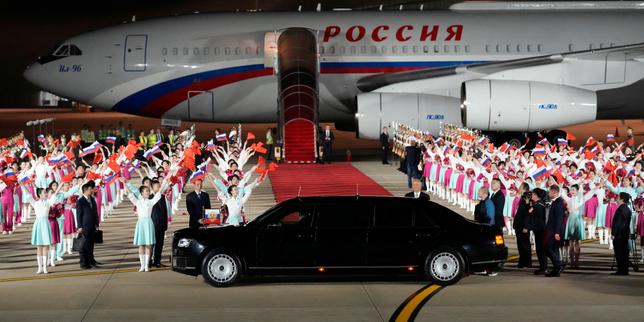
Moscou has confirmed it. Vladimir Putin has arrived in China, stepping down the carpeted stairs of his presidential Ilyushin into the crisp autumn air of Beijing, where he is scheduled to meet both Donald Trump and Xi Jinping.
On paper, the headline reads like a standard, if extraordinary, wire service alert. Three leaders. One capital. A war in Ukraine grinding relentlessly toward another winter. Yet treating this convergence as mere diplomatic theater misses the visceral truth of what is actually happening inside those mahogany-paneled rooms. When the presidents of the United States, Russia, and China occupy the same square kilometer, they are not simply exchanging handshakes for the benefit of pool photographers; they are deciding the price of bread, the borders of sovereign nations, and whether a generation of young men in muddy trenches from Zaporizhzhia to Kursk will ever come home to see their children grow up. Additional analysis by The Washington Post explores comparable views on this issue.
The Architecture of a Closed Door
To understand the suffocating tension hanging over Beijing right now, you have to strip away the flags and the simultaneous translators. Think of high-stakes diplomacy not as a grand chess match—chess is far too polite, governed by rigid rules where both players see the entire board—but as a high-stakes poker game played in a dark basement where the house itself is slowly catching fire.
Xi Jinping is the host, holding the deed to the building. For years, Beijing has walked a razor-thin tightrope, projecting an image of neutral peacemaker while simultaneously serving as Moscow’s indispensable economic lifeline. Chinese factories have kept Russian supply chains breathing through Western sanctions, buying discounted Siberian crude with one hand and selling dual-use electronics with the other. Yet Xi’s own house is groaning under the weight of a sluggish domestic economy, a battered property sector, and the constant, nagging fear that prolonged global instability will choke off the export markets China needs to survive. He wants stability. He wants deference. Above all, he wants the world to see that the road to resolving Europe’s deadliest conflict since 1945 runs straight through Zhongnanhai.
Then there is Vladimir Putin, arriving from a country transformed into a fortress economy. Russia has burned through vast reserves of treasure, armored steel, and human life to capture ruined towns in the Donbas whose names most people outside Eastern Europe could not pronounce four years ago. Every day the war drags on, Moscow’s dependency on Beijing deepens, turning a proud nuclear superpower into something uncomfortably close to a junior partner. Putin needs an exit ramp that looks like a victory parade at home—territorial concessions locked in ink, sanctions lifted, and a permanent veto over Ukraine’s western ambitions.
And sitting across from both of them is Donald Trump, a man who views alliances through the sharp, transactional lens of a Manhattan real estate developer examining a distressed asset. Throughout his return to the American presidency, Trump has insisted that the war in Ukraine is a catastrophic drain on American wealth and a dangerous flirtation with nuclear escalation, boasting repeatedly that he could end the bloodshed through sheer force of personal deal-making. To Trump, ideological crusades are expensive luxuries; leverage is the only currency that matters.
I remember standing in a crowded press room in Brussels years ago during an earlier European crisis, watching exhausted diplomats emerge at three in the morning with loosened ties and gray, hollowed-out faces. One veteran negotiator leaned against a marble pillar, lit a cigarette despite the indoor ban, and told me something I have never forgotten: "When great powers decide they are tired of a war, the small nations fighting it rarely get a seat at the table. They get a menu."
That is the unspoken dread pulsing beneath every official communiqué coming out of the Kremlin and the White House today.
What Happens When Maps Are Drawn in Pencil
Consider what happens next if a handshake in Beijing produces the outline of a ceasefire.
In Washington, pundits will immediately argue over whether the deal represents pragmatic realism or catastrophic appeasement. In Brussels and Berlin, European leaders—left cooling their heels outside the room while Washington, Moscow, and Beijing carve up the continent’s security architecture—will scramble to salvage whatever influence remains. Markets will surge on the hope of falling energy prices and reopened shipping lanes.
Now zoom out from the trading floors and step back into Olena’s kitchen outside Kharkiv.
For the people living along the front lines, a "frozen conflict" is not peace. It is a sentence served in purgatory. Imagine being told that the town where your parents are buried, the orchard your grandfather planted, and the school where you learned to read are now permanently on the wrong side of an armed perimeter—not because your army surrendered, but because three men thousands of miles away decided that your neighborhood was an acceptable rounding error in a larger bargain.
History offers brutal, unambiguous lessons about deals struck over the heads of the people who have to live inside them. In 1938, leaders gathered in Munich believing they had purchased "peace for our time" by trading away slices of Czechoslovakia; within twelve months, Europe was engulfed in total war. In 1945 at Yalta, tired titans drew lines across a map with colored pencils, condemning half a continent to four decades behind concrete walls and barbed wire. The ink dries quickly in warm conference rooms. The blood takes generations to wash out of the soil.
Yet the alternative carries its own terrifying weight, and pretending otherwise would be dishonest.
We have to be candid about the arithmetic of attrition. Ukraine, despite astonishing courage and ingenuity, faces an acute, agonizing shortage of infantry, air defense interceptors, and artillery shells. Western arsenals have been stretched thin, political will in democratic capitals fractures with every election cycle, and Russia—despite staggering casualties—continues to feed men and machinery into the grinder. If the fighting continues unchecked for another two years, how many more cities will look like Bakhmut or Avdiivka, reduced to gray lunar landscapes of pulverized concrete? How many more twenty-year-olds will never get the chance to grow old?
This is the moral trap that makes anyone paying close attention feel slightly sick. There is no clean, cinematic ending waiting in Beijing. Every path forward demands a staggering price; the only question is who will be forced to pay it.
The Invisible Strings Pulling the Room
Look closer at the dynamic between Putin, Trump, and Xi, because the real negotiation is not a three-way conversation—it is three separate bilateral wars of nerves happening simultaneously.
Trump and Xi are locked in a generational struggle over tariffs, semiconductors, Taiwan, and global primacy. For Trump, bringing Putin to the table in Beijing is a high-wire act: can he peel Moscow slightly away from Beijing’s orbit, or at least extract a swift settlement in Ukraine that frees Washington to pivot its full military and economic weight toward the Indo-Pacific?
Xi sees the exact same chessboard from the opposite angle. By hosting both men, the Chinese leader positions himself as the indispensable global arbiter, driving a subtle wedge between Washington and its European allies who already feel sidelined and anxious about American reliability. If Trump pressures Kyiv to accept territorial losses in exchange for peace, NATO’s internal cohesion fractures without Xi having to fire a single shot.
Meanwhile, Putin plays the role he has perfected over a quarter-century in power: the patient survivor waiting for democracies to lose their nerve. He knows that American administrations change every four years, European coalitions collapse over inflation and migration, and voters in Paris or Ohio eventually grow weary of funding a war they cannot see from their front porches. Time, in the Kremlin’s calculation, has always been a Russian weapon.
If you want to understand why this summit feels so volatile, think of three men standing on a frozen lake in late March. The ice looks thick enough to hold their weight, solid and gleaming under the winter sun. Each man believes he can walk across to the far shore and claim the prize. None of them wants to admit that beneath their boots, the spring thaw has already begun, and one wrong step will plunge everyone into freezing water.
Beyond the Motorcades
When the cameras finally flash inside the Great Hall of the People, watch the body language rather than the prepared remarks. Watch whether Trump leans in with the familiar, practiced warmth of a dealmaker closing a contract, or keeps his shoulders squared in warning. Watch Putin’s hands—whether they rest calmly on the armrests or betray the tight, coiled tension of a leader gambling his legacy on a single roll of the dice. Watch Xi’s expression, carved from decades of party discipline, revealing nothing while calculating everything.
A few hours later, the motorcades will sweep back toward the airport. The red carpets will be rolled up. Statements will be issued praising "constructive dialogue" and "frank exchanges of views"—the timeless diplomatic code for arguments that settled nothing, or agreements too ugly to print in full.
And six thousand kilometers to the west, as night falls over eastern Ukraine, the radiators will still be cold, the air raid sirens will still whine across darkened rooftops, and millions of people will stare at their phone screens in the blue glow of the dark, waiting to learn whether three men in Beijing just bought them a future, or quietly signed it away.