The ceramic tiles are always cold. That is the first thing you notice when the world outside turns into a cacophony of iron and fire. You stand in the doorway of your bathroom, clutching a towel, staring at the showerhead as if it were a ticking time bomb. It isn't the water you’re afraid of. It is the silence.
In Tel Aviv, Haifa, or the outskirts of Jerusalem, the sound of a siren isn't just a warning; it is a physical weight. It settles in the pit of your stomach. When the Red Alert app screams on your phone, you have a matter of seconds to reach a fortified room or a stairwell. If you are mid-lather, covered in soap, with the roar of the water drowning out the world, those seconds evaporate.
This is the psychological tax of living under a sky that occasionally rains ballistic missiles. It creates a specific, jagged kind of anxiety that turns the most mundane human ritual—getting clean—into a high-stakes gamble.
The Arithmetic of Adrenaline
Consider a woman named Adina. She is a composite of a thousand people living through the current escalation between Israel and Iran, but her dilemma is entirely real. Adina hasn't washed her hair in three days. Every time she reaches for the faucet, she thinks about the flight time of a Fattah-1 missile launched from 1,000 miles away. She thinks about the twelve minutes it takes to cross the border and the ninety seconds she has once the sirens catch it.
She calculates the time to strip, the time to rinse, and the time to bolt to the shelter. The math never feels safe.
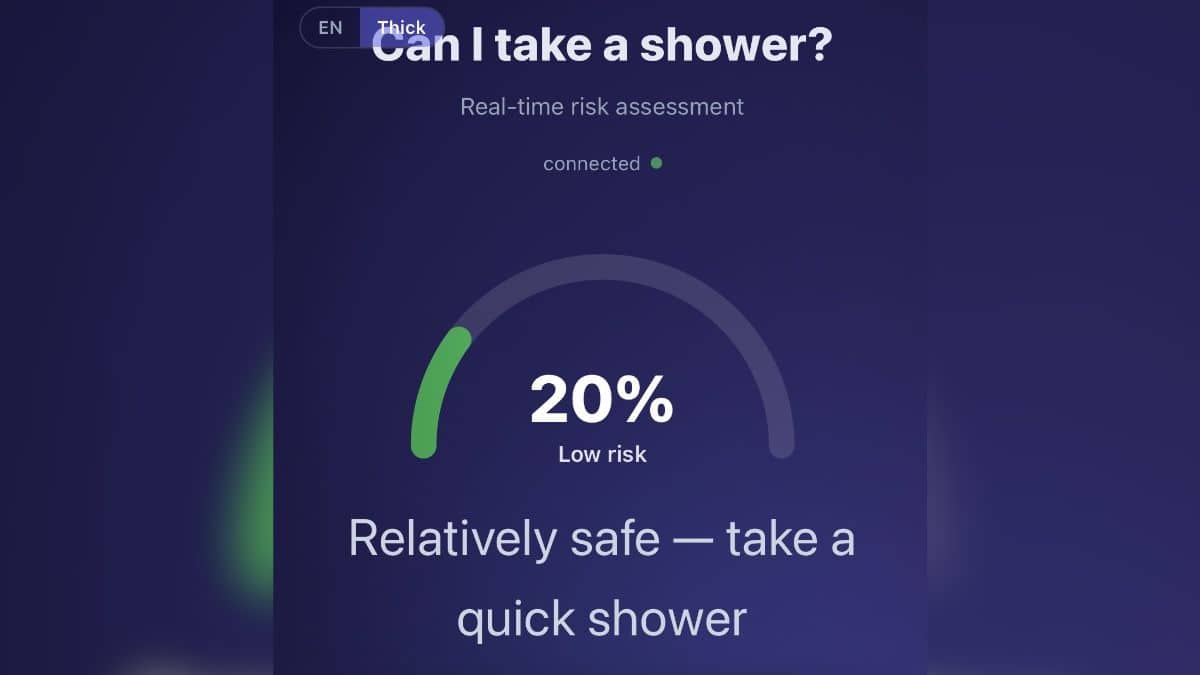
Into this atmosphere of domestic paralysis stepped a developer named Noam Pinkas. He didn't build a complex military interceptor or a geopolitical strategy. He built an app called "Can I Shower?" (Efshar Lehitkaleach).
It is a piece of software born from the absurd reality that when the macro-world is falling apart, humans prioritize the micro-world. We just want to know if we can wash our faces without dying.
More Than an Algorithm
At its surface, the "Can I Shower?" app is a data aggregator. It pulls real-time information from the Home Front Command, tracking missile launches, intercepted threats, and the current state of the "sky." But to describe it that way is to miss the point entirely.
The app functions as a digital permission slip for the nervous system.
When you open it, the interface doesn't bombard you with terrifying maps or flight trajectories. It gives you a status. It tells you, based on the current intelligence and the lull in activity, whether the statistical probability of a strike in your specific zone is low enough to justify a fifteen-minute window of vulnerability.
It is the bridge between raw military data and human dignity.
We often talk about "smart cities" in the context of traffic lights or waste management. But this is the dark side of the smart city—a landscape where your phone must tell you if your physical environment is momentarily hospitable to your basic needs. The app’s popularity—surging to the top of the local charts during the waves of Iranian drone and missile barrages—reveals a deep truth about how we handle trauma. We don't want the big picture. The big picture is too loud. We want a green light that says, You have ten minutes. Go.
The Invisible Stakes of a Ticking Clock
Technology is usually designed to save us time. We want faster processors, quicker deliveries, and instant gratification. In a conflict zone, technology is tasked with something much more profound: it is designed to give us time.
The "Can I Shower?" app works because it addresses the "Action Bias." When humans are under threat, we feel a desperate need to do something, even if there is nothing to be done. By checking the app, Adina isn't just checking the weather for missiles; she is reclaiming a sense of agency. She is making a data-driven decision about her own body.
But the logic of the app also underscores a terrifying evolution in modern warfare. We are no longer looking at "front lines" in the traditional sense. The front line is now the glass door of a walk-in shower. The theater of war has expanded to include the most private, vulnerable spaces of the civilian home.
When Iran launched nearly 200 ballistic missiles toward Israel in late 2024, the "Can I Shower?" app wasn't a luxury. It was an essential tool for maintaining a semblance of mental health. Without it, the "what if" becomes a paralyzing fog. What if the siren goes off while I’m in the basement laundry room? What if I’m in the middle of a bath?
The app provides a "calculated calm." It uses the same logic as a stock market ticker or a weather vane, but the stakes are measured in heartbeats and shrapnel.
A Language of Probability
The app uses a simple color-coded system. Green means the coast is relatively clear. Yellow suggests caution. Red means you should stay near your protected space.
It sounds clinical. It is anything but.
Behind that green light is a massive infrastructure of radar arrays, satellite surveillance, and international cooperation. Thousands of people are working with billions of dollars of hardware so that a person in a small apartment in Petah Tikva can feel okay about turning on the hot water.
There is a strange, dark irony in the fact that we have reached a level of technological sophistication where we use satellites to schedule our hygiene. It is a testament to human adaptability, certainly. But it is also a somber reflection on the "new normal."
We have learned to live in the gaps. We have learned to find pockets of peace between the streaks of light in the night sky. The app doesn't stop the missiles. It doesn't negotiate peace. It simply tells you that for the next twenty minutes, the world might leave you alone.
The Ritual of the Lull
Imagine the moment the app turns green.
Adina sees it. She doesn't hesitate. She doesn't linger. She moves with a practiced, military efficiency that no civilian should ever have to master. The water hits her skin, and for a moment, the roar of the shower replaces the phantom sound of the siren that she hears even when the air is still.
In that moment, she is not a citizen of a country at war. She is not a target on a ballistic trajectory. She is just a person, feeling the heat on her shoulders, washing away the dust of a long, tense day.
The app provides a "tactical silence."
But the silence is always temporary. The phone sits on the sink, its screen glowing, waiting for the data to change. The developer, Pinkas, noted in interviews that he never expected the app to become a cultural phenomenon. He saw a problem—his friends were afraid to shower—and he coded a solution.
It is a reminder that in the face of overwhelming geopolitical forces, the most effective tools are often the ones that focus on the smallest human needs. We cannot always stop the storm, but we can build a better umbrella.
The Digital Shield
We are entering an era where our devices are no longer just for connection or entertainment; they are sensory extensions of our survival instincts. The "Can I Shower?" app is the precursor to a world where AI and real-time data feeds will constantly negotiate our safety for us.
It is a comforting thought, and a chilling one.
It suggests a future where we are never truly "safe," but rather "statistically secure" for intervals. We are moving away from the idea of peace as a permanent state and toward peace as a series of downloadable windows.
If you look at the logs of the app, you can see the pulse of a nation. You see the spikes in usage at 7:00 PM, when families are trying to get their children ready for bed. You see the dips when the news breaks that a ceasefire is being discussed, followed by a massive surge when those talks fail.
The app is a mirror. It reflects a society that refuses to stop living, even when the ceiling feels like it might cave in. It reflects the stubbornness of the human spirit—the insistence that even in the shadow of an apocalypse, we will still comb our hair.
Adina finishes her shower. She steps out, dries off, and checks her phone one last time. The light is still green. She breathes a sigh of relief that tastes like peppermint toothpaste and damp air. She has won this round. She has managed to be human for twenty minutes.
Outside, the iron domes wait. The radars spin. The satellites watch the desert 1,000 miles away. And in a thousand bathrooms, the water starts to run, governed by a little green light on a screen that promises nothing more—and nothing less—than a moment of ordinary life.
The tiles are still cold, but the steam has warmed the room. For now, that is enough. For now, the sky is empty, and the soap is gone, and the world is still turning.
Adina puts on her clothes, picks up her phone, and waits for the next window to open. Or close.