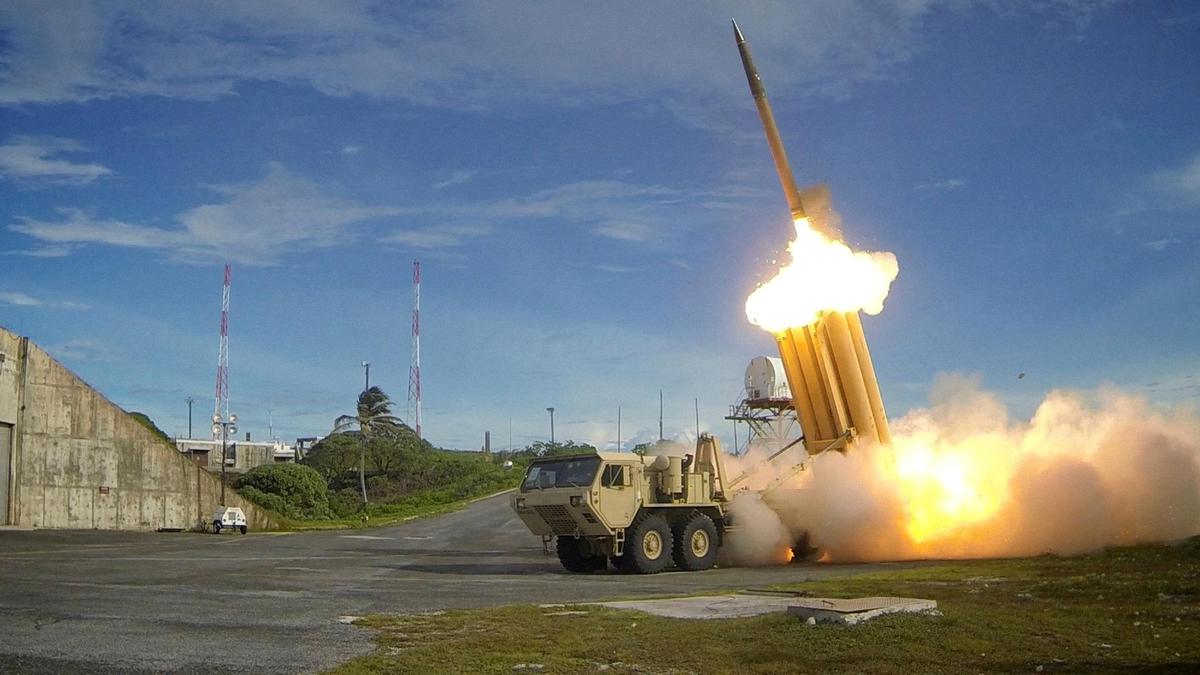
The strategic utility of the Terminal High Altitude Area Defense (THAAD) system rests not on its explosive yield—of which it has none—but on the surgical application of kinetic energy to neutralize short, medium, and intermediate-range ballistic missiles. While traditional surface-to-air missiles rely on fragmentation warheads to shred a target, THAAD utilizes a "hit-to-kill" approach. This requires an order of magnitude increase in guidance precision, as the interceptor must physically collide with a target moving at hypersonic speeds. The efficacy of this system is defined by three interdependent variables: sensor fidelity, energy management during the endo-exoatmospheric transition, and the seeker's ability to discriminate between a lethal warhead and defensive decoys.
The Triple-Tier Architecture of Interception
A THAAD battery operates as a closed-loop system comprising three distinct hardware segments. The failure of any single segment results in a total loss of mission capability.
1. The AN/TPY-2 Radar: High-Resolution Discrimination
The AN/TPY-2 is an X-band, solid-state, phased-array radar. Its primary function is not merely detection, but high-resolution discrimination. At the X-band frequency ($8–12 \text{ GHz}$), the radar achieves the wavelength necessary to identify small objects at extreme ranges.
In a saturation attack, the radar must distinguish the Re-entry Vehicle (RV) from tank fragments, booster components, and intentional decoys. The radar uses "pulse-doppler" processing to measure the radial velocity of every object in its field of view. Objects that do not match the expected ballistic coefficient of a lethal warhead are filtered out, preventing the battery from wasting interceptors on "junk" targets.
2. The Fire Control and Communications (TFCC)
The TFCC acts as the central nervous system. It receives data from the AN/TPY-2 and external satellite cues (such as SBIRS/OPIR), calculates the predicted intercept point (PIP), and generates a firing solution. This logic must account for the "uncertainty ellipse"—a three-dimensional volume of space where the target is likely to be. The TFCC manages the "engagement coordination" if multiple batteries are linked, ensuring that two interceptors are not assigned to the same target unless a "shoot-look-shoot" doctrine is specifically commanded.
3. The Interceptor: Kinetic Kill Vehicle (KKV)
The interceptor is a single-stage, solid-fuel rocket. Unlike the Patriot (PAC-3), which is optimized for lower-altitude terminal defense, THAAD is designed for the "high-terminal" phase. This means it can engage targets both inside the atmosphere (endoatmospheric) and outside (exoatmospheric). This dual-environment capability introduces a significant engineering bottleneck: the transition.
The Physics of Hit-to-Kill
The "Hit-to-Kill" mechanism is an application of the fundamental principle of kinetic energy, expressed as:
$$E_k = \frac{1}{2}mv^2$$
Because both the interceptor and the incoming ballistic missile are traveling at several kilometers per second, the closing velocity is massive. At these speeds, the chemical energy of a traditional high-explosive warhead becomes redundant. The structural integrity of the incoming warhead is obliterated by the sheer transfer of momentum. This approach minimizes the risk of "low-order" detonations or the dispersal of chemical/biological agents that could occur if a warhead were merely damaged by fragments.
The Seeker and the Shroud
During the initial boost phase, the interceptor is protected by a nose shroud. As the interceptor nears the predicted intercept point, the shroud is jettisoned to reveal an Indium Antimonide (InSb) infrared seeker. This seeker must operate in a cryogenic state to detect the thermal signature of the incoming warhead against the cold background of space or the friction-heated environment of the upper atmosphere.
A critical failure point in hit-to-kill systems is "boresight error." If the seeker is misaligned by even a fraction of a degree, the KKV will miss its target by meters. To counter this, the KKV utilizes a Divert and Attitude Control System (DACS). The DACS consists of small liquid-fueled thrusters that allow the KKV to make rapid lateral shifts in its final seconds of flight. This is not "flying" in the traditional sense; it is a series of controlled explosions used to nudge the KKV into the direct path of the target.
Strategic Bottlenecks and Constraints
While THAAD is technically superior to earlier generations of missile defense, its operational utility is governed by hard constraints that strategy consultants must quantify.
- Launch-to-Intercept Windows: Ballistic missiles follow a predictable parabolic arc. However, THAAD is a "terminal" defense system. It only engages during the final minutes of flight. If the radar detects a launch too late, or if the target is fired from a "depressed trajectory," the time available for the TFCC to calculate a solution and for the interceptor to reach the PIP may be shorter than the system’s minimum reaction time.
- The Saturation Threshold: A THAAD battery typically carries 48 to 72 interceptors. In a conflict scenario involving "large-scale, low-cost" saturation, an adversary can deplete the battery’s magazine by launching decoys or older, cheaper missiles. Once the magazine is empty, the radar—no matter how advanced—is a passive observer.
- Atmospheric Friction and Blurring: When engaging at lower altitudes, the friction of the air against the seeker window creates "aero-optical" distortion. The heat generated on the window can blind the infrared seeker. THAAD manages this through sophisticated signal processing and cooling, but there is a physical limit to how fast and how low the interceptor can go before the seeker becomes ineffective.
The Economic Logic of Missile Defense
The deployment of THAAD is as much an economic calculation as a military one. There is a fundamental "cost-exchange ratio" at play. A single THAAD interceptor costs approximately $12 million. The ballistic missiles it is designed to kill can range from $2 million (older Scuds) to over $30 million (advanced MRBMs).
If an adversary can force a 2:1 interceptor-to-target ratio (a common "shoot-look-shoot" or "salvo" tactic to ensure a kill), the defender faces a significant economic disadvantage. Therefore, THAAD’s value is not measured by the cost of the missile it destroys, but by the "Value of Asset Protected." If a $12 million interceptor protects a city or a carrier strike group, the ROI is absolute. If it is used to protect an empty desert, the strategy has failed.
Integration with the Integrated Air and Missile Defense (IAMD)
THAAD does not operate in a vacuum. It occupies the "middle tier" of a layered defense architecture:
- Aegis BMD: Engages targets in the mid-course phase (outer space).
- THAAD: Engages targets in the high-terminal phase (upper atmosphere/space boundary).
- Patriot (PAC-3): Engages targets in the low-terminal phase (lower atmosphere).
The integration of these systems via the Command and Control, Battle Management, and Communications (C2BMC) network allows for "Launch on Remote." This capability enables a THAAD battery to fire an interceptor based on data from an Aegis ship or a remote radar before its own AN/TPY-2 has even seen the target. This significantly expands the "keep-out altitude"—the height at which a target is destroyed—providing more time for follow-up shots if the first intercept fails.
Critical Vulnerabilities in the Current Model
The primary threat to the THAAD paradigm is the emergence of Hypersonic Glide Vehicles (HGVs). Unlike traditional ballistic missiles, which follow a predictable path, HGVs can maneuver within the atmosphere. THAAD’s fire control logic is optimized for ballistic trajectories. While the interceptor has the speed to catch a hypersonic target, the "uncertainty ellipse" of a maneuvering vehicle is too large for current TFCC algorithms to resolve reliably.
Furthermore, the AN/TPY-2 radar is a "sector-fixed" asset. It looks in one direction (typically a 120-degree arc). In a multi-axis attack where missiles arrive from different vectors simultaneously, a single THAAD battery can be flanked. Defense against such an attack requires multiple batteries or the integration of 360-degree sensors that are currently in the prototyping phase.
Strategic Realignment for High-Intensity Conflict
To maintain the relevance of the THAAD system against peer adversaries, the focus must shift from pure kinetic capability to "left-of-launch" integration and sensor fusion. The hardware—the rocket and the radar—is approaching the limits of Newtonian physics. Future gains will be found in the software layer:
- Algorithmic Discrimination: Utilizing machine learning to analyze radar returns and identify "micro-changes" in decoy behavior compared to weighted warheads.
- Networked Interleaving: Deploying smaller, distributed sensor nodes to feed the THAAD TFCC, reducing the reliance on a single, high-value AN/TPY-2 radar that acts as a magnet for anti-radiation missiles.
- Magazine Depth Optimization: Developing "lower-cost" interceptors for low-tier threats to preserve the primary THAAD inventory for high-end threats.
The move toward a distributed, sensor-agnostic defense network is the only viable path to counter the volume and complexity of modern missile inventories. Operational commanders should prioritize the hardening of TFCC nodes and the expansion of the "Launch on Remote" network to maximize the effective range of existing interceptor stocks.
Would you like me to analyze the specific radar cross-section (RCS) requirements for detecting HGV threats with the AN/TPY-2?