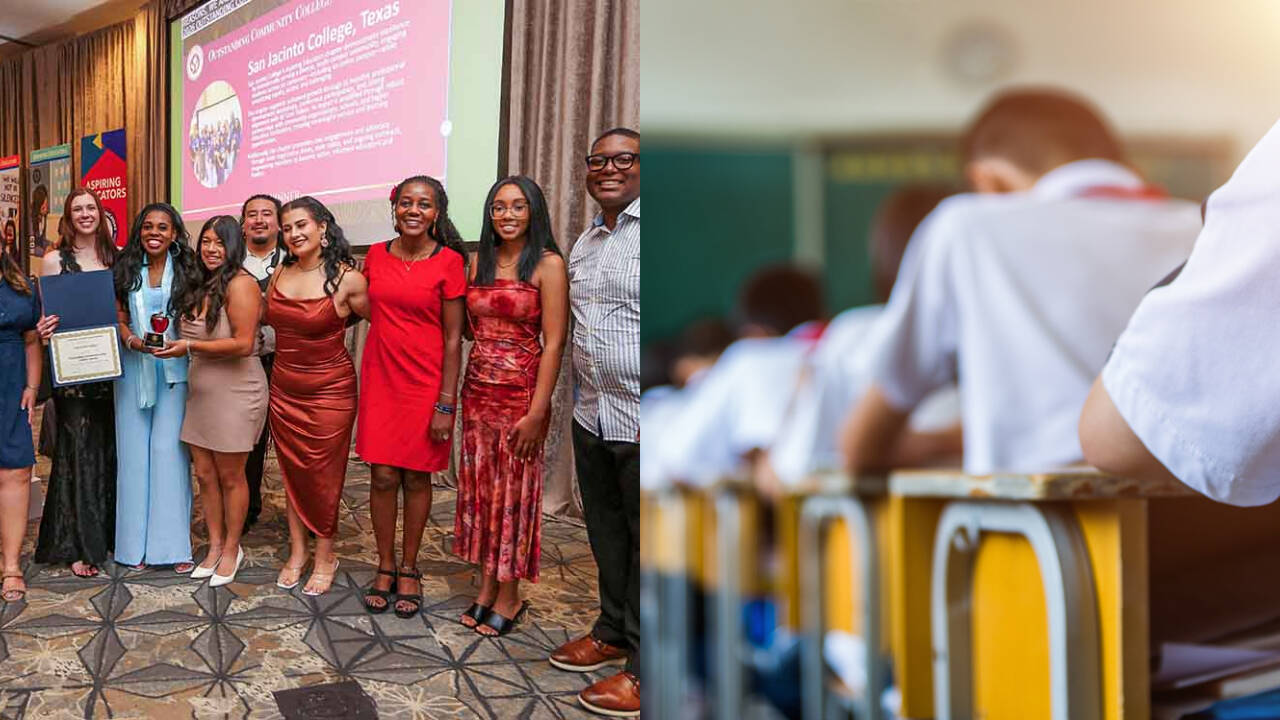
The desk does not remember you.
That is the first strange thing you notice when you walk back into a room you left a decade ago. The wood is scarred by the same initials carved into the corner back when smartphones still had physical keyboards. The fluorescent light above hums with that exact, familiar electrical rattle. But your hands on the keyboard are older now. They carry the faint, dry calluses of a life built in the interim—a life of drywall dust, or morning rush-hour traffic, or quiet hospital corridors, or the endless, rhythmic clicking of a retail register.
Ten years.
In the language of the modern world, a decade is an epoch. Empires rise and fall on social media in less time. Entire industries are born, bloated, and buried. And yet, for a student sitting in a Texas lecture hall, staring down a syllabus that looks like a map written in a dead language, ten years is simply the quiet distance between a door they closed and the one they are finally brave enough to unlock again.
We talk endlessly about momentum. We praise the straight line. The eighteen-year-old who marches from high school graduation straight into a university quad, moving from bachelor's to master's in a pristine, uninterrupted arc, is treated as the gold standard of human progress. Society loves a conveyor belt. It moves predictably. It produces clean statistics.
It also leaves no room for gravity.
Gravity is what happens when life interrupts the blueprint. Gravity is a sick parent, a collapsed economy, a sudden eviction, a devastating crisis of confidence, or simply the paralyzing realization that the path you started on was chosen by a frightened kid who had no idea who they actually were. So you step off the belt. You put the textbook away. You go out into the gritty, unscripted world and you live. You learn how to pay rent when the bank account sits at four dollars and twelve cents. You learn how to keep going when the alarm clock rings at five in the morning for a job that feels entirely disconnected from any grand destiny.
And for a long time, the textbook stays shut.
Then comes Tuesday.
It is never a dramatic moment with a sweeping orchestral score. Usually, it is just a Tuesday morning when you look at your hands, or your children, or your paycheck, and you feel that old, quiet itch. The one that whispers: You left a chapter unfinished.
When a Texas student returned to campus after a ten-year absence, the headlines dutifully recorded the mechanics of the event. They noted the return, the completion of the degree, and the subsequent national leadership honor that followed like a late-arriving sunrise. Journalism is good at recording the mechanics. It tells us who, what, and where. But it routinely misses the heavier, invisible architecture of the transition.
Consider what it actually feels like to walk into a modern college classroom after a decade away.
The nineteen-year-olds around you look like creatures from a different planet. They speak in compressed digital dialects you have to decode. They navigate learning management systems with a fluid, thumb-twitching grace that makes you feel like an archaeologist trying to operate a spaceship. Your lower back aches in a way it definitely did not when you were twenty. You carry a quiet, gnawing impostor syndrome that sits in your chest like a stone. Every lecture feels like trying to catch running water in cupped hands.
What if I am too slow?
What if my brain has rusted?
What if everyone looks at me and sees an intruder?
These are the questions that keep non-traditional students awake at two in the morning, staring at glowing ceiling fans. They are the invisible taxes paid by anyone brave enough to rewrite their own story mid-stream.
Yet, something fascinating happens when maturity collides with education. The restless urgency of youth—that desperate, frantic need to get everything right immediately—is replaced by something far more formidable: patience.
When you are twenty, an assignment is an obstacle to be cleared so you can get to the weekend. When you are thirty, with ten years of real-world friction behind you, an assignment is a puzzle made of actual human experience. You read a case study on organizational behavior, and you do not just see a theoretical framework. You see your old manager from the warehouse. You see the exact communication failure that tanked your department three years ago. You read history, and the dates stop being numbers on a page; they become human choices, echoing into the kitchen where you now make coffee for your family.
This is the secret weapon of the returned student. They do not just consume information; they metabolize it.
The national leadership honor that eventually finds someone like this does not arrive because they memorized the textbook better than the kids half their age. It arrives because they know how to listen. They know how to weather a crisis without melting down because they have survived actual crises—the kind that do not come with a rubric or a letter grade.
Leadership, stripped of its corporate buzzwords, is simply the ability to stand steady when the ground starts shaking. And nobody learns that by sitting in a continuous, unbroken line of classrooms from kindergarten to graduate school. You learn it in the trenches of ordinary life. You learn it by failing, by regrouping, by swallowing your pride, and by deciding—against all statistical probability—that it is not too late to finish what you started.
We live in a culture obsessed with optimization, as if human lives were software patches designed for maximum efficiency. We measure success by speed. We applaud the prodigy who burns bright at twenty-two. But there is a deeper, quieter kind of power that belongs exclusively to those who know how to turn around.
It takes an immense amount of courage to be a beginner twice.
Think about that for a moment. To walk away from the safety of what you already know how to do—even if what you know is just a comfortable routine of mediocrity—and subject yourself to the humiliation of not knowing. To sit in the back row, raise your hand, and ask the naive question. To hand in a paper and wait for the red ink, knowing that your identity is no longer tied up in being the "smart kid," because you have already lived through periods of your life where you felt entirely stupid and survived.
That vulnerability changes a person. It strips away the fragile armor of ego. What remains is remarkably resilient.
When the certificate is finally handed over, or the honor is finally bestowed under the bright lights of a ceremony hall, the audience sees a moment of triumph. They see the finish line. But the person standing on that stage is thinking about the long, dark drives home from a dead-end shift ten years ago. They are thinking about the kitchen table littered with bills where they first dared to fill out the readmission application. They are thinking about the exact moment they decided their story was not finished yet.
The gap between who we were and who we become is rarely a bridge. It is a chasm. We have to cross it on foot, carrying whatever baggage we picked up along the way. Some of us drop our loads halfway across. Some of us drag them all the way to the other side, bruised and bleeding, until our fingers finally wrap around the handles of our own destiny.
The desk in the lecture hall may not remember you when you return.
But when you finally stand up from it, holding the proof of your own persistence, the world looks entirely different. It is wider. It is kinder. And it belongs, unmistakably, to those who refused to let an interruption become an ending.


