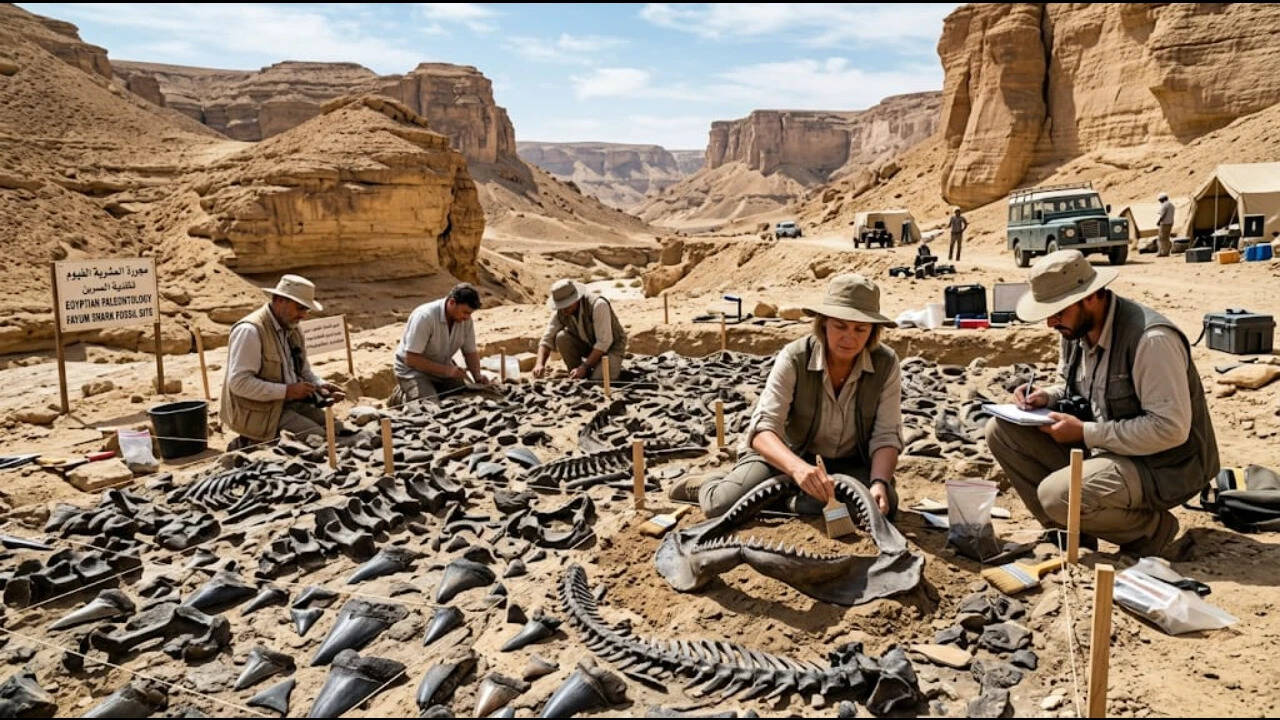
Beneath the blistering expanse of Egypt's Western Desert, where sand dunes roll toward a merciless horizon, a handful of black and yellow fragments has just rewritten eighty million years of marine history. Fourteen isolated fossilised teeth, recovered from the phosphate-rich layers of the Abu-Tartur Plateau, prove that this arid wasteland was once a thriving tropical sea. Led by Cairo University researcher Tarek Yassin, a team of paleontologists identified five extinct lamniform shark species within this tiny trove, expanding our understanding of the predators that prowled the ancient waters of North Africa during the Late Cretaceous.
Shark skeletons consist primarily of cartilage rather than bone. Cartilage rots away long before it can fossilize under normal conditions, leaving an incomplete chronicle of ancient marine life. Teeth, however, are built like bricks. A single shark sheds thousands of them over a lifetime, and their enameloid coating resists decay far better than skeletal tissue. When these teeth drop to the ocean floor, they occasionally find their way into mineral-dense environments like the Duwi Formation, where chemical reactions replace organic material with stone. Fourteen teeth sounds like a meager haul for an expedition. In the hands of a rigorous paleontological team, those fourteen fragments function as a high-resolution snapshot of an entire lost ecosystem.
The collection includes specimens attributed to Cretalamna cf. maroccana, Scapanorhynchus cf. raphiodon, Serratolamna cf. serrata, Squalicorax bassanii, and Squalicorax pristodontus. Two of these—Serratolamna cf. serrata and Squalicorax bassanii—have never before been documented anywhere in Egypt. More arresting still is the presence of Scapanorhynchus cf. raphiodon, an ancient relative of the modern goblin shark equipped with long, needle-like teeth. This specimen represents the first time this particular taxon has surfaced on the African continent, and it may well be the youngest fossil record of its kind ever discovered.
Anatomy of an Ancient Food Web
Te
- The Slicers: Species belonging to the genus Squalicorax sport broad, serrated teeth designed for cutting flesh from large marine reptiles or fish carcasses.
- The Spearers: Scapanorhynchus features slender, forward-curving fangs meant to impale slippery, fast-moving prey in deep water columns.
- The Generalists: Cretalamna carries robust, triangular main cusps capable of crushing hard-shelled invertebrates and medium-sized fish.
These variations matter because they answer a fundamental question about prehistoric survival. How do multiple apex predators coexist in the same regional waters without driving each other to extinction through direct competition? They do not share the exact menu. The physical architecture of their dental work proves they occupied distinct ecological niches. While Squalicorax patrolled nearshore environments, Scapanorhynchus hunted along the outer continental shelf and slope. They were neighbors separated by water depth and dietary specialization, operating within a massive, interconnected biological engine.
The Phosphate Archive
Why do these fragile relics survive in such pristine condition? The answer lies in the commercial wealth beneath the Egyptian desert. The Duwi Formation is famous for its massive phosphorite deposits, laid down during periods of intense biological productivity millions of years ago.
When organic matter rains down onto certain shelf environments, chemical processes concentrate phosphate minerals. This sudden chemical shift mineralizes bone and teeth rapidly, shielding them from scavengers and physical erosion. It creates what researchers call a time-averaged deposit.
Sediment accumulation rates during the Campanian stage were remarkably low in this specific sector. Layers of rock that might represent mere inches of buildup actually compress thousands of years of ecological turnover. The fourteen teeth did not necessarily belong to sharks that swam together on a single afternoon. Instead, they represent a cumulative graveyard, a geological savings account where the detritus of generations was stored away in stone.
Rewriting North African Paleontology
For decades, the history of African paleontology suffered from an equatorial bias. Rich fossil beds in North America and Europe dominated academic literature, while vast regions of the Global South remained underexplored due to logistical hurdles, political instability, and the sheer physical hostility of terrain like the Western Desert.
Discoveries like the Abu-Tartur shark assemblage dismantle that imbalance piece by piece. They reveal that North Africa was not a biological backwater during the age of dinosaurs, but a dynamic crucible of marine evolution. The presence of taxa shared with distant regions demonstrates that ancient oceanic currents allowed marine species to migrate across vast distances, connecting the Tethys Ocean from modern-day Europe down through the Middle East and North Africa.
Fieldwork in these regions is grueling. Temperatures routinely cross fifty degrees Celsius. Logistics require military-style convoys of water, fuel, and heavy screening equipment. Every successful excavation represents weeks of physical exhaustion under an unforgiving sun, kneeling in the grit to sieve tons of phosphatic rock through fine mesh screens just to find objects smaller than a thumbnail.
The work is far from finished. Each new tooth extracted from the desert floor adds another vector to a map of a world that vanished before human eyes evolved to see it. Underneath the dry winds of the Western Desert, the ancient tides continue to speak through stone.