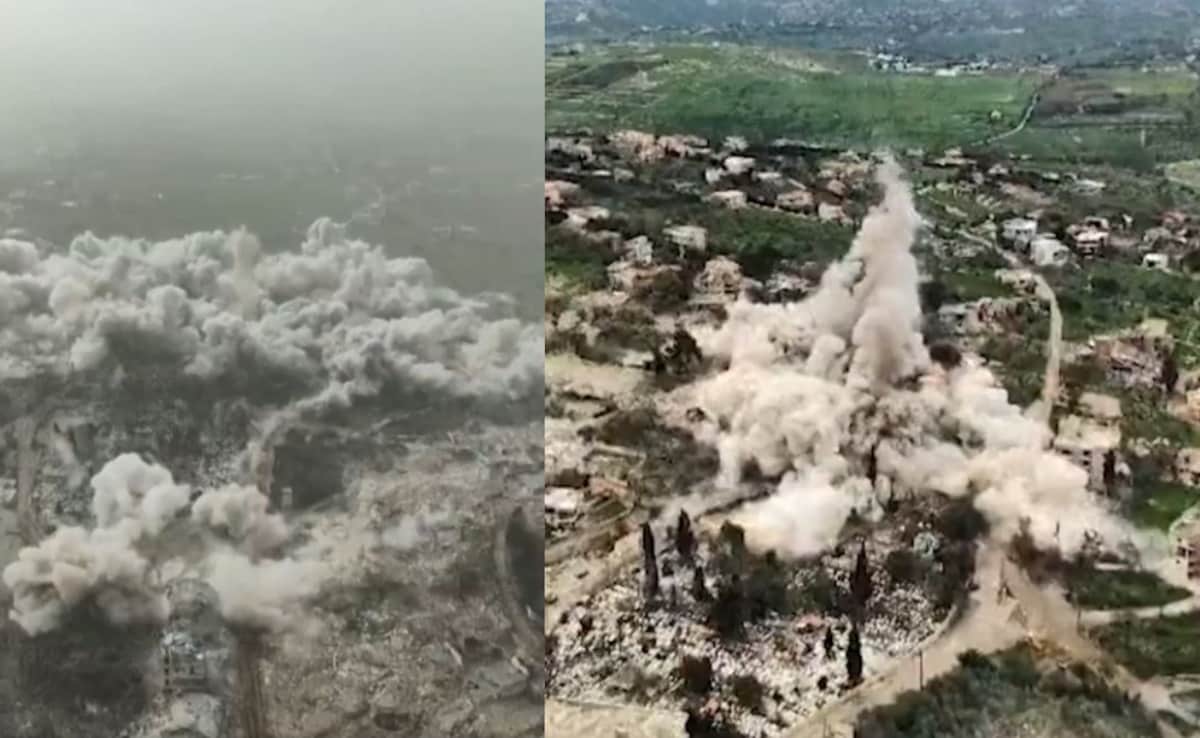
What's happening along the border between Israel and Lebanon isn't just a series of skirmishes anymore. It’s a literal erasing of the landscape. Entire Lebanese villages are being wiped out by rigging homes with explosives and detonating them in massive, coordinated blasts. This isn't just about hitting a specific target or a single house where a weapon was found. We're looking at the total flattening of neighborhoods.
Satellite imagery and local footage from late 2024 and early 2025 show a pattern that's hard to ignore. Towns like Mhaibib, Ramyeh, and Odaisseh have seen their historical centers reduced to gray dust in seconds. If you've seen the videos, you know they look like controlled demolitions you'd see at an old stadium site in the U.S., except these are people's homes, mosques, and clinics.
The Israeli military claims these areas are used as staging grounds for Hezbollah. They say the tunnels and weapon caches are so deeply integrated into the civilian infrastructure that the only way to neutralize the threat is to bring the whole thing down. But when you see a dozen buildings go up at once, the military objective feels like it's shifting from tactical clearing to creating a permanent "no-man's land."
The Mechanics of Systematic Demolition
Israel's approach in southern Lebanon has moved beyond airstrikes. Airstrikes are surgical, or at least they’re supposed to be. What we're seeing now involves ground troops entering a village, literally wiring entire blocks with mines and C4, and then hitting the switch from a distance. It’s efficient. It’s thorough. It’s also incredibly final.
Basically, this method ensures that nobody can come back. Even if a ceasefire is signed tomorrow, where do you return to? There’s no grid. No plumbing. No walls. By rigging homes with explosives, the IDF is effectively pre-empting the "return" phase of the conflict. It’s a scorched-earth policy in everything but name.
Military analysts often call this "shaping the battlefield." But for the people living in South Lebanon, it’s the end of a multi-generational way of life. You can't just rebuild a 200-year-old stone house once it's been vaporized. The scale of the demolition suggests the goal is to create a buffer zone that is physically uninhabitable for miles.
Why the Buffer Zone Strategy is Back
If this feels like déjà vu, that’s because it is. Israel has tried the "security belt" idea before. During the occupation that ended in 2000, they maintained a physical presence. This time, they seem to be trying to achieve the same result without the constant troop presence by simply making the terrain impossible to use.
If there are no buildings, there's no cover. If there are no villages, there's no civilian population for militants to blend into. It’s a brutal logic. Critics and human rights groups like Amnesty International have pointed out that this might constitute a war crime—specifically, the "wanton destruction" of property not justified by military necessity. The IDF counters that every building destroyed had a military use. It’s a stalemate of narratives, but the physical reality on the ground isn't up for debate. The towns are gone.
The Impact on Cultural Heritage
It’s not just about modern apartments. Southern Lebanon is dotted with ancient sites and religious shrines. When the explosives go off, they don’t discriminate between a basement used for storage and a shrine with 400 years of history. In Mhaibib, the ancient shrine of Benjamin was reportedly caught in the blast radius.
When you wipe out a village's center, you're killing the collective memory of that community. It’s a form of psychological warfare. It tells the population that their ties to the land are erasable. Honestly, this kind of destruction creates a resentment that lasts far longer than any security arrangement. It’s a short-term tactical win that might be a long-term strategic disaster.
The Humanitarian Cost of a Flattened Border
Right now, over a million people in Lebanon are displaced. Many of them come from these border towns. They’re watching videos on Telegram of their childhood homes being blown up in 4K resolution.
- Displacement becomes permanent: Without homes to return to, refugees stay in Beirut or move abroad, permanently altering Lebanon's demographics.
- Economic Ruin: These villages were agricultural hubs. The destruction of homes usually includes the destruction of farming equipment and local businesses.
- Environmental Damage: The sheer amount of debris and unexploded ordnance makes the land toxic for years.
The international community has been mostly toothless here. While there are "expressions of concern" from Washington and Paris, the demolitions continue. It’s a shift in how modern war is fought in dense areas. Instead of house-to-house clearing, which is dangerous for infantry, you just remove the house.
What Happens When the Dust Settles
The real question is what the border looks like in two years. If Israel succeeds in creating a five-kilometer-wide strip of rubble, they might feel safer in the short term. But history shows that vacuums don't stay empty. Hezbollah or whatever comes after them will adapt. They've lived in these hills for decades; they don't necessarily need a standing house to operate.
You're seeing a fundamental change in the laws of engagement. If "rigging entire villages" becomes an accepted military tactic, the concept of civilian infrastructure is basically dead. We're moving toward a reality where the geography itself is the enemy.
Pay attention to the satellite passes over the coming months. They don't lie. Look for the gray patches where green and red-roofed clusters used to be. That’s the new map of the Middle East being drawn in real-time. If you want to understand the future of this conflict, stop looking at the political speeches and start looking at the demolition logs. The rubble tells you everything you need to know about where this is heading.
Stay informed by following independent monitors like Bellingcat or the UN's UNIFIL reports, though even they are being pushed out of the way. The less we see, the more that gets leveled. Don't look away.