Everybody thought Jimmie Åkesson and the Sweden Democrats were about to claim their first-ever seats inside a Swedish cabinet. They didn’t. Instead, Sweden’s 13 September 2026 general election handed the nationalist party its first electoral retreat since entering parliament in 2010, flipping the script on what looked like an unstoppable European trend.
If you only read the initial headlines calling the race "too close to call," you missed the real story. The margin wasn’t just razor-thin. It shattered the governing coalition’s majority while leaving the winners almost completely paralyzed. More than two months later, Stockholm still doesn't have a new permanent government.
I’ve followed Nordic coalition math for years, and honestly, this is one of the messiest standoffs Stockholm has seen in decades. Let’s break down what actually happened at the ballot box, why the Sweden Democrats stalled out, and why Magdalena Andersson’s narrow victory feels more like a political trap than a triumph.
The Razor-Thin Math Behind Sweden’s 2026 Election
When Swedish voters went to the polls on 13 September 2026, turnout hit a massive 84.9 percent. Swedes take voting seriously. Yet out of more than 6.8 million ballots cast, the entire election came down to a gap of just 50,359 votes between the two rival blocs.
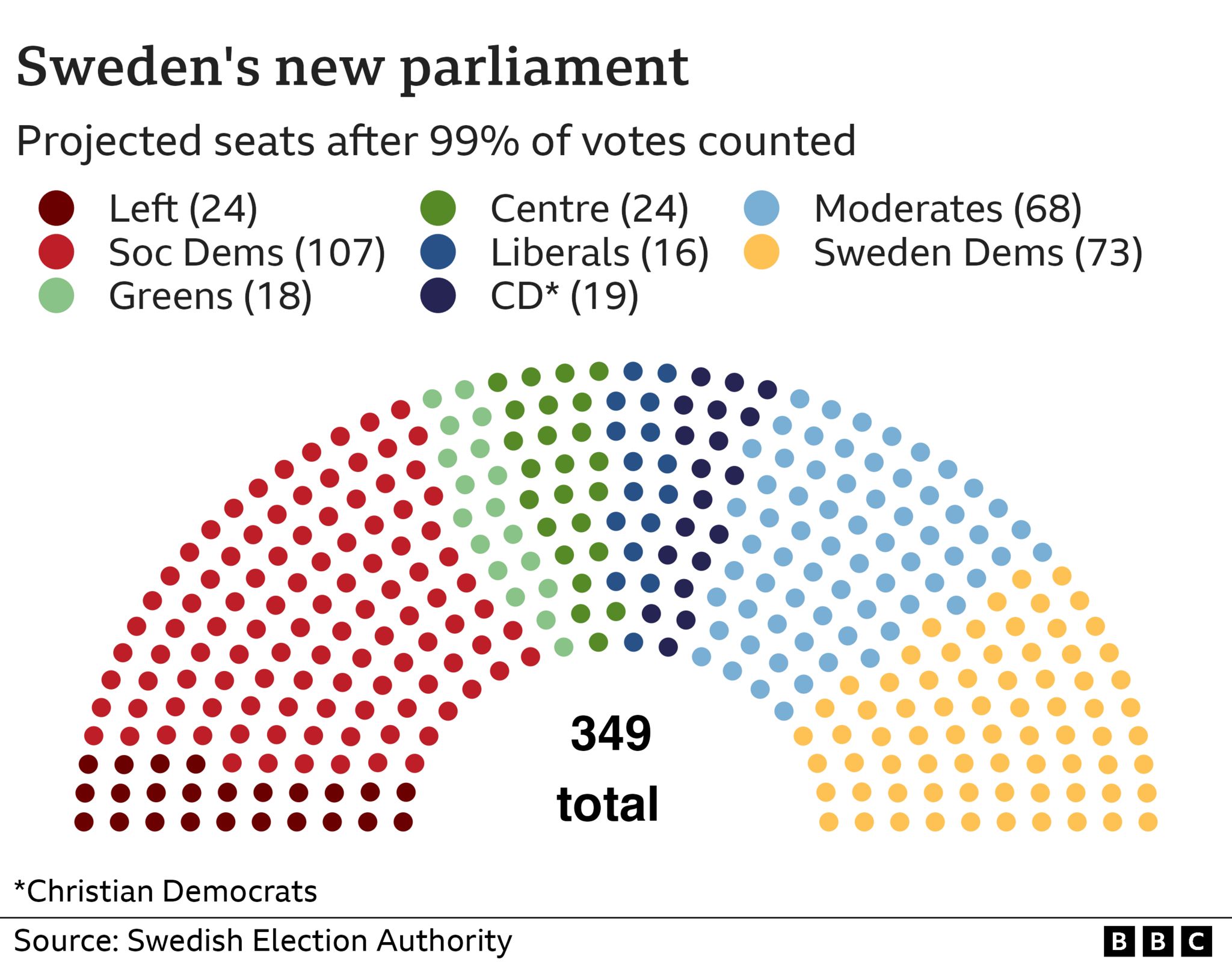
That tiny margin gave the four-party centre-left opposition—the Social Democrats, the Left Party, the Centre Party, and the Greens—176 seats in the 349-seat Riksdag. You need 175 seats for a majority. Prime Minister Ulf Kristersson’s right-leaning Tidö alliance fell just short with 173 seats.
Two seats. That’s all that separated a return to power for Kristersson’s coalition from his resignation four days after the vote.
Look closer at the individual party totals, though, and you see a weirdly fractured picture. Nobody really ran away with it.
- The Social Democrats (S) stayed the largest single party, pulling in 99 seats. Still, that was down from 107 seats in 2022 and marked their lowest vote share in over a century.
- The Moderate Party (M) actually gained ground. Ulf Kristersson’s conservatives rose slightly to 70 seats, reclaiming second place on the political ladder.
- The Sweden Democrats (SD) took the biggest hit. They dropped roughly three percentage points to around 17.5 percent, losing 11 seats to finish with 62.
- The Left Party (V) surged to 30 seats, up from 24 four years earlier.
- The Centre Party (C) edged up slightly to 25 seats.
- The Christian Democrats (KD) and the Green Party (MP) both finished with 22 seats each.
- The Liberals (L) defied pre-election polls that had them flirting with the 4 percent parliamentary threshold, climbing to 19 seats.
Most commentators treat this result like a simple pendulum swing back to the left. It wasn't. Three of the four parties in Kristersson’s outgoing right-wing bloc actually gained seats. The right didn’t collapse across the board. One specific party dragged the whole alliance down.
Why the Sweden Democrats Lost Ground for the First Time
For sixteen years, the Sweden Democrats had only moved in one direction. Up. Under Jimmie Åkesson’s leadership since 2005, the party shed its fringe skin, broke into the Riksdag in 2010, and reached 20.5 percent in 2022 to become Sweden’s second-largest party.
Under the 2022 Tidö Agreement, SD propped up Kristersson’s minority government from the outside while shaping policies on immigration, criminal justice, and energy. Heading into 2026, Åkesson wanted the ultimate prize. In March 2026, the Liberals and Sweden Democrats even struck a pre-election deal called "The Sweden Promise" that cleared the way for SD to take actual ministerial posts if their bloc won.
Then voters pulled the rug out from under them. Why did a party riding high on anti-immigration sentiment suddenly lose 11 seats?
They Became Victims of Their Own Policy Success
Here is the irony of modern European populism. Once mainstream parties copy your homework, voters stop needing you.
Over the past four years, Sweden adopted some of the strictest asylum and migration rules in Europe. Asylum applications fell to record lows, and gang shootings began trending downward. Even Magdalena Andersson’s Social Democrats abandoned their old liberal stance and backed keeping most of those tougher immigration controls in place.
As political scientist Ann-Kristin Kölln and election analysts like Sofia Axelsson and Axel Fredén noted after the vote, migration simply wasn't the dominant crisis it had been in 2015 or 2022. With nearly every major party now favoring restrictive border policies, voters started asking what else the Sweden Democrats brought to the table. On healthcare, inflation, and everyday kitchen-table economics, voters didn't trust SD nearly as much.
The Governing Trap
Oppositions get to complain. Governing coalitions have to deliver.
Even though SD didn't hold formal cabinet seats between 2022 and 2026, Swedish voters treated them like part of the establishment. Four years of sluggish growth, strained public hospitals, and rising living costs stuck to the Tidö parties. Voters who backed SD in 2022 as a protest vote against the system suddenly realized SD was the system.
Meanwhile, younger voters swung hard in the opposite direction. In 2022, SD had made surprising inroads with first-time voters. In 2026, youth support rotated back toward the Left Party and the Greens, who hammered the government over climate policy, housing costs, and welfare funding.
What Most People Miss About Sweden’s Post-Election Paralysis
If you look at the seat count—176 to 173—you might assume Magdalena Andersson simply walked back into the prime minister’s office. In Sweden, winning an election and forming a government are two completely different sports.
Under Sweden’s constitution, a prime ministerial candidate doesn't actually need 175 MPs to vote for them. They just need fewer than 175 MPs to vote against them. It’s called negative parliamentarism, and right now, it has tied the entire country in knots.
Andersson’s 176-seat majority depends on four parties that can barely stand to be in the same room.
- The Left Party (V) won 30 seats and immediately demanded formal cabinet positions as the price for backing Andersson. Leader Nooshi Dadgostar made it clear her party wouldn't sit quietly on the sidelines anymore.
- The Centre Party (C) holds 25 seats and flatly refuses to support any government that gives cabinet posts or formal influence to the socialist Left Party. Centre Party leader Elisabeth Thand Ringqvist represents pro-market, rural liberals who view the Left Party’s economic policies as toxic.
Do the math. Without the Left Party’s 30 votes, Andersson drops to 146 seats. Without the Centre Party’s 25 votes, she drops to 151 seats. Either way, the right-wing bloc’s 173 MPs can vote her down instantly.
Two Failed Votes and a Bizarre Twist in Stockholm
Nobody expected the government formation talks to drag past mid-November, yet here we are.
Right after Kristersson resigned in mid-September, Riksdag Speaker Andreas Norlén handed Andersson the first exploratory mandate. That fell apart within weeks. In a stunning tactical move at the end of September, the Left Party backed the Moderate Party’s Andreas Norlén to remain Speaker of Parliament, signaling to Andersson that they wouldn't be taken for granted.
By 15 October, Andersson put a pure Social Democratic minority government to a floor vote in the Riksdag anyway. It failed. The Centre Party voted against her because she hadn't bridged the gap with the Left.
Speaker Norlén then turned to Centre Party leader Elisabeth Thand Ringqvist on 19 October, asking her to explore a broad centrist coalition. That ended in pure political theater on 3 November. When Thand Ringqvist’s proposal hit the floor, 324 MPs voted no. Literally only her own 25 Centre Party lawmakers voted yes.
That handed the initiative right back to caretaker Prime Minister Ulf Kristersson. And on 6 November, Jimmie Åkesson made a surprise concession that scrambled the board again. The Sweden Democrats announced they were dropping their demand for cabinet seats and would back a four-party centre-right government made up of the Moderates, Christian Democrats, Liberals, and the Centre Party.
Speaker Norlén granted Kristersson an extra week on 10 November to keep negotiating. Meanwhile, Finance Minister Elisabeth Svantesson had to present an interim caretaker budget to parliament on 12 November just to keep the lights on.
Could Sweden Face a Rare Snap Election
Swedish politics rarely gets this stuck, and the constitution has a built-in circuit breaker.
Under Sweden’s Instrument of Government, the Riksdag Speaker gets four formal attempts to propose a prime minister to parliament. Two votes have already failed—Andersson on 15 October and Thand Ringqvist on 3 November. If two more prime ministerial votes fail, Sweden automatically triggers an extraordinary snap election within three months.
Sweden hasn't held an extra general election since 1958. Nobody in Stockholm actually wants one right now, especially not the smaller parties who risk getting wiped out by frustrated voters.
For the deadlock to break before vote number four, someone has to blink. Either the Centre Party drops its veto against the Left Party to let Magdalena Andersson govern, or the Centre Party abandons its refusal to rely on Sweden Democrat support and crosses over to Ulf Kristersson. Both options carry massive political risk. In Swedish politics, breaking a campaign red line usually gets punished brutally at the next ballot box.
What This Means for Europe and How to Track What Happens Next
Political analysts across Europe jumped on Sweden’s September numbers as proof that the far-right wave had finally crested. That’s a dangerous misreading.
Look at the broader picture. Yes, the Sweden Democrats lost 11 seats and missed their shot at cabinet power. Even so, they still hold 62 seats—nearly 18 percent of parliament—and their core ideas on border enforcement and criminal sentencing have become the baseline consensus for both left and right in Stockholm. Much like in neighboring Denmark, the Social Democrats only stayed competitive by adopting hardline migration policies that would have been unthinkable a decade ago.
If you’re watching European politics or tracking Nordic markets, don't get distracted by surface-level headlines about who "won" election night. Watch the mechanics of coalition survival instead.
- Follow the Riksdag Speaker’s deadlines: Speaker Andreas Norlén’s weekly check-ins with party leaders dictate when the third floor vote happens. You can track official floor votes and press briefings directly through the Swedish Riksdag website.
- Watch the Centre Party’s red lines: Elisabeth Thand Ringqvist holds the keys to the kingdom. Whichever bloc convinces her 25 MPs to abstain during a prime ministerial vote will form Sweden’s next government.
- Check the certified district breakdowns: If you want to see how urban-rural divides drove the 50,359-vote gap, review the final certified constituency data published by the Swedish Election Authority (Valmyndigheten).
- Separate rhetoric from policy: Regardless of whether Andersson or Kristersson ends up holding the prime minister’s gavel, Sweden’s tougher posture on immigration, NATO defense spending, and gang crime isn't going anywhere.
Sweden proved that populist parties aren't invincible at the ballot box. It also proved that beating them by two seats is the easy part compared to actually governing afterward.