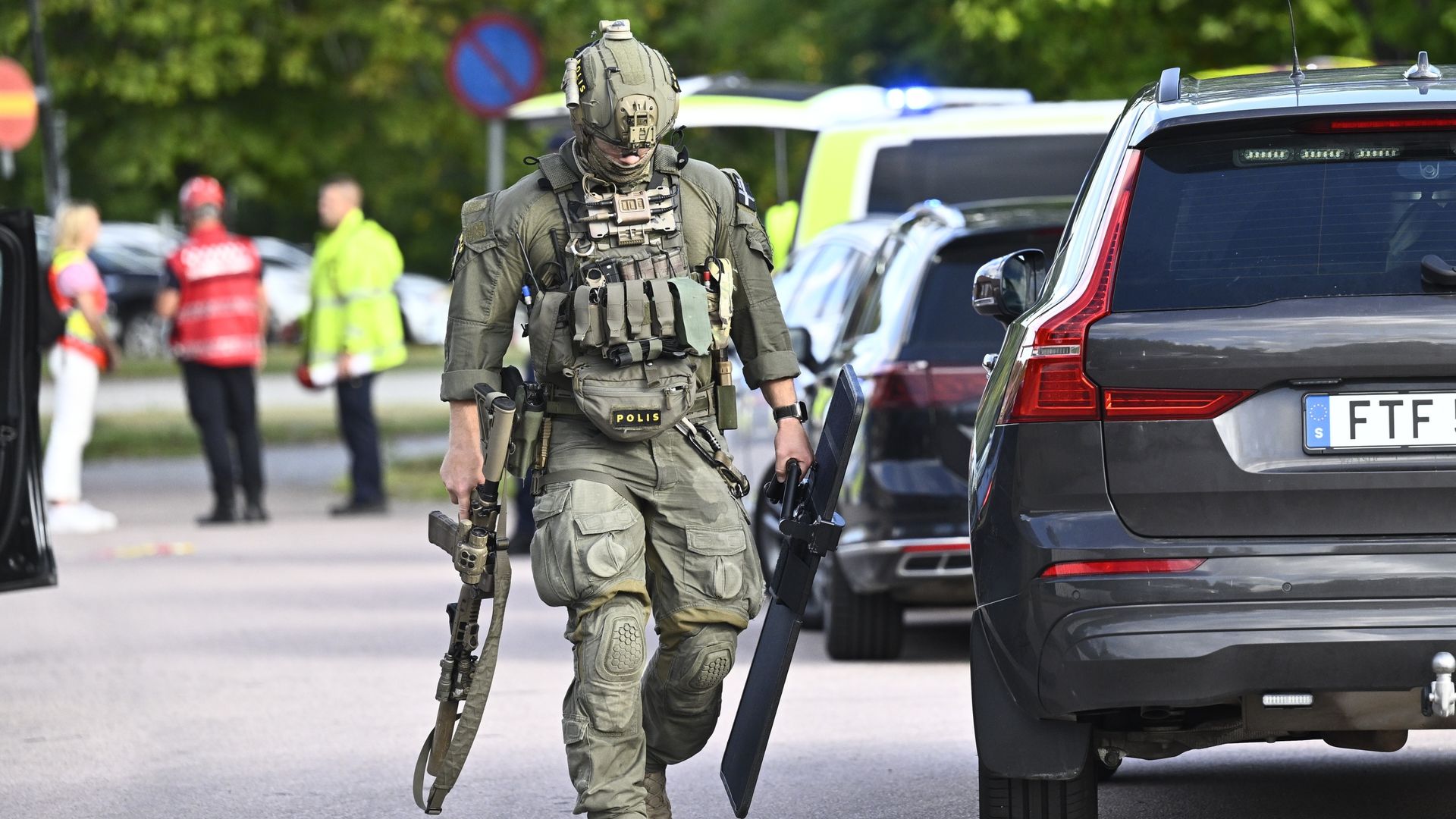
Another school. Another horrific body count. Another ritualistic parade of politicians rushing to microphones to express their profound shock that violence has managed to breach the pristine glass-and-steel facade of the Swedish welfare state. Prime Minister Ulf Kristersson stood outside the Brinell School in Fagersta, lamenting that "what must never happen has happened again."
The lazy consensus across the media landscape immediately defaulted to the weapon. An 18-year-old wielding a sword sliced through classrooms, leaving a 17-year-old girl dead and children fighting for their lives. Predictably, the chatter has already pivoted to weapon restrictions, perimeter security upgrades, and institutional hand-wringing.
Stop right there. Focusing on the blade is a coward's evasion of reality.
Sweden does not have a weapon problem. It has an acute, accelerating crisis of social atomization and systemic alienation that its comforting political myths refuse to diagnose. When you treat every violent implosion as an isolated tactical anomaly to be solved with more bureaucracy, you guarantee the next body count.
The Lazy Consensus of Institutional Denial
Every time a school attack shatters the illusion of Scandinavian safety, the script never changes. Mainstream reports treat these horrors as weather events—random anomalies descending from a clear blue sky. Politicians hold solemn press conferences, lay flowers, suspend election campaigns for twenty-four hours, and gesture vaguely toward mental health support or tighter controls on whatever object was used to spill blood.
Let us look at the historical pattern. In Trollhättan, a killer used a knife. In Malmö, an attacker wielded a knife and an axe. In Örebro, a massive firearm tragedy unfolded. Now, in Fagersta, it is a sword.
If your primary takeaway from this bloody progression is that Sweden needs to regulate kitchen cutlery, sharp steel, and sporting goods more strictly, you are entirely missing the plot. The instrument changes because the instrument is irrelevant. A society hyper-fixated on regulating the physical tools of destruction is like a physician treating a stage-four tumor by prescribing throat lozenges for the cough.
The uncomfortable truth nobody in Stockholm wants to admit is that Sweden’s institutional safety net has hollowed out into an empty shell of administrative compliance. Behind the high-minded rhetoric of equality lies a landscape of profound institutional loneliness, fractured integration, and a generation of young men rotting in digital subcultures of absolute nihilism.
The Anatomy of Modern Alienation
We must define terms precisely. What we are witnessing is not spontaneous criminality; it is the delayed detonation of systemic isolation. Modern Swedish youth institutions—from sprawling comprehensive schools down to local municipal support structures—are paralyzed by a culture of compliance and administrative avoidance. Teachers are legally constrained, resources are stretched thin by decades of structural underfunding disguised as fiscal restraint, and warning signs are routinely filed away in digital spreadsheets rather than intercepted by human intervention.
When an 18-year-old wakes up, arms himself, and walks into a school to slaughter children, he has already completely divorced himself from the social contract. He views his community, his peers, and his own future as entirely valueless.
Blaming the weapon allows the state to bypass its own culpability. If the problem is the sword, then the state only needs to pass a new law, increase police patrols outside school gates, and pretend the social fabric remains intact. It is a comforting illusion designed to protect politicians from the terrifying work of rebuilding real, functional community safety nets.
The Unspoken Cost of Administrative Complacency
I have spent years analyzing how institutional failure cascades through public infrastructure. When organizations prioritize institutional reputation over raw, uncomfortable honesty, small rot spreads unchecked until it metastasizes into tragedy.
In Sweden, the obsession with consensus has created a blind spot for extreme deviance. Local authorities are terrified of stigmatizing troubled youth early on, so they lean into soft bureaucratic interventions that achieve nothing. By the time a perpetrator crosses the threshold from isolated digital radicalization into physical mass violence, the system treats it as an unforeseeable shock.
It was entirely foreseeable.
Imagine a scenario where school administrators and local law enforcement were legally mandated to treat severe social alienation with the same emergency response level traditionally reserved for active physical threats. Imagine an environment where troubled youths were met with aggressive psychological intervention and community integration rather than institutional apathy masked as privacy protection.
Instead, the response remains reactive. The political class gathers for photo-ops at makeshift memorials, offers hollow condolences, and waits for the news cycle to wash away the blood so they can return to business as usual.
The 17-year-old girl who lost her life in Fagersta did not die because of a regulatory loophole regarding sharp objects. She died because a broken system chose to look away until it was far too late. Until Sweden drops its self-righteous denial and confronts the deep-seated social rot eating away at its youth, the flowers at the memorial site will simply be replaced by new ones next season.