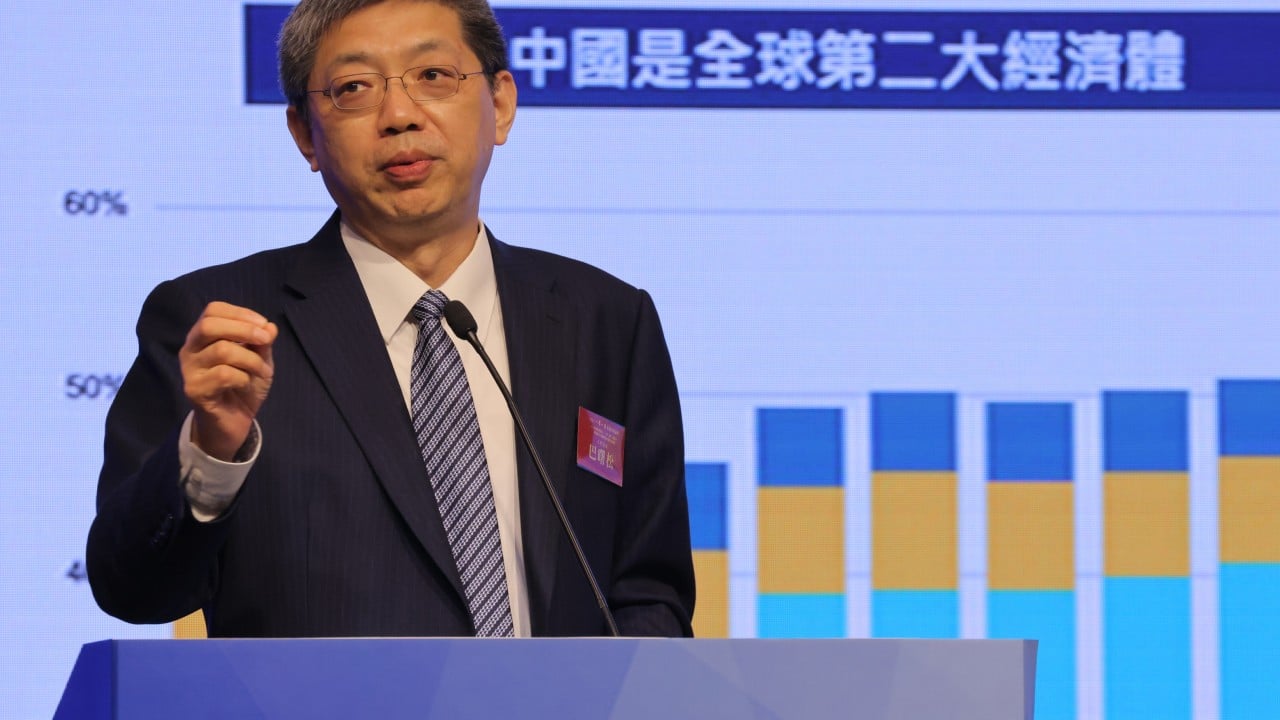
The sudden absence of Ba Shusong, a high-profile economist and former managing director of Hong Kong Exchanges and Clearing (HKEX), from the public sphere signals a tightening of the alignment between financial expertise and state-driven ideological oversight. This is not a isolated event of personnel turnover; it is a manifestation of the Information-Control Paradox in modern financial systems. To understand the implications of Ba’s disappearance, one must deconstruct the specific intersection of academic influence, market leadership, and the shifting boundaries of permissible financial discourse in a bifurcated global economy.
The Three Pillars of Financial Influence
The career of an individual like Ba Shusong is built upon three distinct pillars that, while providing immense value to market participants, create significant exposure during periods of regulatory contraction.
- Institutional Connectivity: As a former Chief China Economist at HKEX and a researcher for the State Council’s Development Research Center (DRC), Ba served as a bridge between mainland policy intent and international capital market execution. This role requires navigating two distinct linguistic and legal frameworks.
- Intellectual Arbitrage: Ba’s value proposition rested on his ability to translate complex Chinese macro-policy into actionable intelligence for global investors. When the state shifts toward a "security-first" rather than "growth-first" model, the space for this translation narrows.
- Public Proliferation: With millions of followers on social media and frequent appearances at international forums, his influence was not merely technical but cultural. In a system prioritizing centralized messaging, high-decibel independent voices—even those previously sanctioned—become liabilities.
The Cost Function of Intellectual Autonomy
In a standard market economy, the "cost" of providing a contrarian or detailed economic analysis is primarily the risk of being wrong and losing reputational capital. However, in the current geopolitical environment, the cost function shifts from market-based risk to systemic-alignment risk. The variables influencing this cost include:
- Sensitivity Coefficient of Data: The more an analyst relies on non-public or "alternative" data to predict market trends, the higher the perceived threat to national data security.
- The Divergence Factor: The degree to which an individual’s economic forecast deviates from the official "Bright Prospect" narrative. If the official GDP target is $5.0%$ and an influential economist suggests $4.2%$ based on structural debt analysis, the gap ($0.8%$) represents a political friction point.
- External Integration: Participation in foreign think tanks or advisory boards increases the "External Exposure Variable." For Ba, his deep ties to the Hong Kong financial ecosystem—a space currently undergoing rapid legal and political integration with the mainland—placed him at the center of this friction.
The Mechanism of Institutional Erasure
The disappearance of a figure of Ba's stature typically follows a non-linear trajectory of institutional distancing. This is not a sudden "vanishing" but a sequence of structural deletions:
- Digital Scrubbing: The removal or freezing of social media accounts (such as Weibo) serves as the primary indicator. This functions as a "Soft Shutdown," preventing the dissemination of real-time commentary that could conflict with breaking policy shifts.
- Professional Redaction: Removal from board lists, advisory panels, and speaking circuits. This is a signaling mechanism to the market that the individual no longer carries the "Imprimatur of Authority."
- The Information Vacuum: Unlike Western corporate scandals, where a firing is followed by a PR statement, the mechanism here is silence. This vacuum creates a speculative premium, increasing market volatility as investors struggle to price in the "regulatory unknown."
Systematic Risk vs. Idiosyncratic Failure
Market observers often mistake these disappearances as idiosyncratic failures—errors made by the individual. A more rigorous analysis suggests they are a systematic output of Information Centralization.
When a financial system moves from a "Disclosure-Based" model to a "Guidance-Based" model, the utility of the independent economist declines. In a disclosure-based model, the economist adds value by uncovering truth. In a guidance-based model, the economist’s role is to amplify the guidance. If an economist continues to operate under the old model—relying on empirical data that contradicts the guidance—they become a source of systemic noise that the regulator seeks to filter out.
The Hong Kong Pivot and the DRC Connection
Ba’s position at the Development Research Center (DRC) is critical. The DRC is a top-tier think tank under the State Council. Traditionally, this role allowed for a degree of "Internalized Criticism"—the ability to provide blunt, data-driven feedback to leadership behind closed doors.
However, the "leakage" of this criticism into the public or international domain (via HKEX roles or public speeches) is now treated as a breach of internal discipline. The tightening of the National Security Law in Hong Kong has effectively removed the "firewall" that previously allowed economists in the territory to speak with greater latitude than their mainland counterparts. We are seeing a "Convergence of Oversight," where the rules governing a researcher in Beijing now apply with equal force to a practitioner in Hong Kong.
Quantifying the Impact on Market Sentiment
The disappearance of a "bridge" economist like Ba increases the Opacity Discount on Chinese and Hong Kong equities. Investors calculate the value of an asset based on the quality of information available. When the primary translators of that information are removed from the circuit, the "Information Risk Premium" ($R_i$) rises.
The total expected return ($E[R]$) must now account for this:
$$E[R] = R_f + \beta(R_m - R_f) + R_i + R_p$$
where $R_i$ is the Information Risk Premium and $R_p$ is the Political Alignment Risk. As $R_i$ and $R_p$ increase, the cost of capital for firms in the region rises, leading to lower valuations even if the underlying company fundamentals remain stable.
The Strategic Shift in Financial Analysis
For global firms and institutional investors, the "Ba Shusong Incident" mandates a transition in analytical strategy. Relying on high-profile "Star Economists" as proxies for state intent is no longer a viable risk-management strategy. Instead, firms must adopt a Structural Decoding Approach:
- Monitor the Narrative, Not the Individual: Focus on the frequency and tone of keywords in official state media (e.g., People’s Daily) rather than the interpretations of specific academics.
- Track Institutional Footprints: Watch for changes in the bylaws of organizations like the DRC or the HKEX regarding "political alignment" and "confidentiality."
- Diversify Information Nodes: Move away from single-point-of-failure analysts. Use decentralized data sets—satellite imagery, shipping manifests, and energy consumption—to verify macro trends without relying on human interpretation that is subject to regulatory silencing.
The Logic of the Transition
The disappearance of Ba Shusong is a lead indicator of the professionalization of silence. It suggests that the era of the "Celebrity Economist" who navigates both East and West is ending. In its place, we are seeing the rise of the "Technical Bureaucrat"—an individual who provides specific, narrow data to the state but remains invisible to the public and the global market.
This transition creates a permanent bottleneck in global finance. The inability to predict the "human element" of Chinese economic policy will lead to a more defensive posture from international capital.
Strategic Recommendation: Investors must de-risk their reliance on "insider" economic commentary. The removal of Ba Shusong from public sight is a signal to re-weight portfolios toward assets where transparency is a legal requirement rather than a discretionary permission. Assume that any individual operating at the intersection of Chinese state policy and international finance is subject to immediate and unannounced "re-calibration." The move is to value automated data over human intelligence in this specific geographic sector.