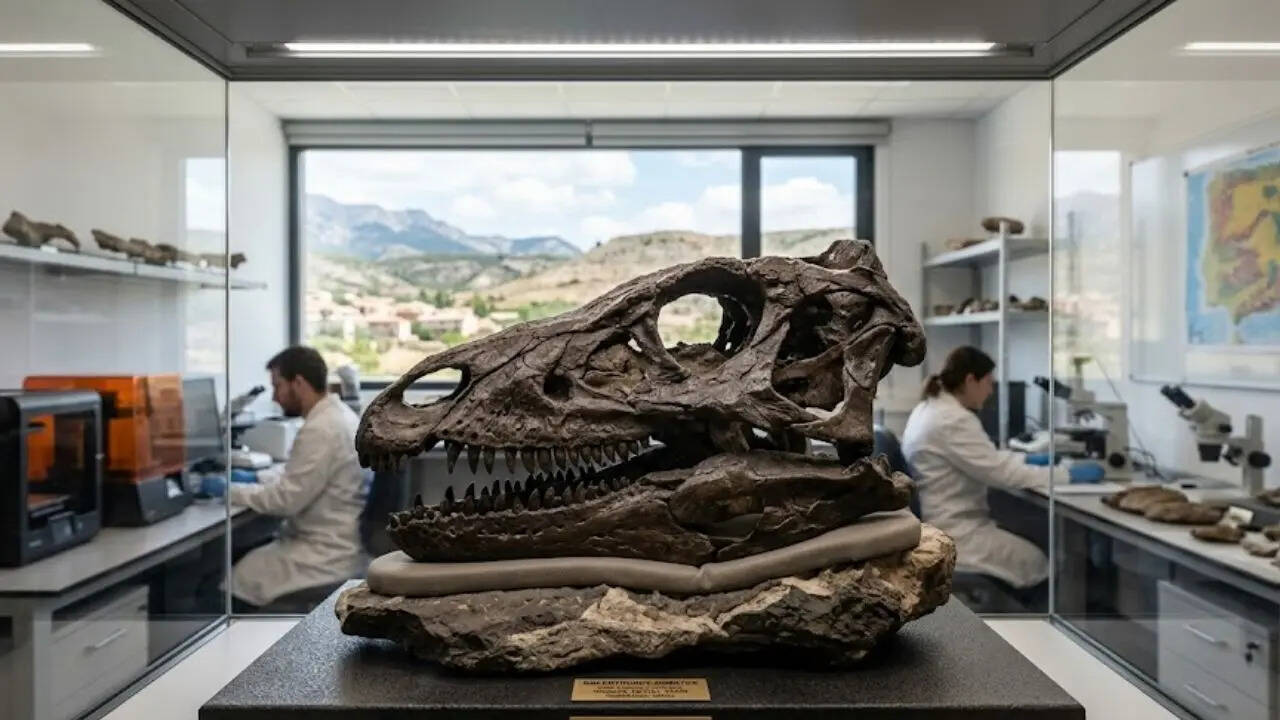
The discovery of a near-complete Camarasaurus skull in the Villar del Arzobispo Formation of Teruel, Spain, represents a critical data point in Late Jurassic vertebrate paleontology. While most dinosaur fossils comprise postcranial fragments or isolated dental elements, the preservation of a skull—particularly one belonging to a sauropod—provides a high-resolution window into the cranial mechanics and evolutionary trajectory of Macronarian dinosaurs. This find serves as a benchmark for understanding the transition of sauropod lineages across the Jurassic-Cretaceous boundary in the Iberian Peninsula.
The Taphonomic Bottleneck of Sauropod Crania
To appreciate the rarity of this specimen, one must analyze the biological and geological filters that typically prevent skull preservation. Sauropod anatomy is characterized by a massive size disparity between the axial skeleton and the cranium. In a Camarasaurus, the skull is relatively small, comprised of thin, pneumatic bones designed to minimize weight at the end of a long neck.
Three specific variables dictate the preservation probability of such a structure:
- Structural Fragility: The cranial kinesis—the mobility between skull bones—means that once soft tissue decays, the skull often disarticulates into dozens of small, easily transportable elements.
- Hydraulic Transport: Because the skull is light and air-filled (pneumatized), it possesses a different settling velocity than the heavy limb bones or vertebrae. In a river-delta system like the one that existed in Teruel 150 million years ago, water currents frequently separated the skull from the body, washing it away or destroying it via abrasion.
- Predatory Selection: The cranial cavity and the surrounding musculature represent high-protein targets for theropod scavengers. Feeding behavior usually involves the crushing of the skull to access the brain, leading to fragmented remains that are rarely diagnostic.
The Teruel specimen bypasses these filters, suggesting a rapid burial event in a low-energy sedimentary environment that locked the elements in place before biological or mechanical degradation could occur.
Morphological Architecture of Camarasaurus
The Camarasaurus genus is defined by a "box-like" skull profile, which diverges sharply from the elongated, "peg-toothed" skulls of Diplodocoids. This morphological distinction is not merely aesthetic; it indicates a specific ecological niche and feeding strategy.
The Dental Battery and Bite Force
Unlike the pencil-like teeth of Diplodocus located at the front of the mouth, Camarasaurus possessed spatulate (spoon-shaped) teeth distributed along the length of the jaw. These teeth are robust, featuring thick enamel layers capable of withstanding high-pressure contact with fibrous vegetation.
The structural implication is a high-force vertical bite. The skull's height allowed for larger attachment sites for the adductor musculature. This created a mechanical lever system optimized for "bulk-browsing"—the ability to shear through tough woody plants rather than just stripping leaves.
Cranial Fenestration
A primary feature of the Spanish find is the clarity of the fenestrae (skull openings). The Camarasaurus skull is dominated by large preantorbital and antorbital fenestrae. These openings served two functions:
- Weight Reduction: Decreasing the mass of the head allowed for greater neck mobility and reduced the metabolic cost of supporting the cranium.
- Space for Soft Tissue: These cavities likely housed large nasal glands or sinus systems, which may have played a role in thermoregulation or water conservation in the semi-arid environments of the Late Jurassic.
The Iberian Peninsula as a Paleobiogeographic Bridge
The presence of this specimen in Spain reinforces the "Iberian Bridge" hypothesis. During the Late Jurassic, the supercontinent Pangea was fragmenting. Iberia acted as a terrestrial link between what would become North America, Europe, and Africa.
The Spanish Camarasaurus allows for a direct comparative analysis with the Morrison Formation in the United States, where Camarasaurus is the most common sauropod. By mapping the subtle morphological differences between the Teruel specimen and its North American counterparts, researchers can quantify the rate of evolutionary divergence caused by geographic isolation.
This is not a case of simple migration; it is a study in "vicariance"—the process where a species is split by a geographic barrier, leading to the development of distinct lineages. The Teruel skull provides the high-resolution character states (specific bone shapes and sutures) necessary to determine if the Spanish population was a subspecies or a distinct, endemic Iberian taxon.
Sedimentary Context of the Villar del Arzobispo Formation
The specimen was recovered from the Villar del Arzobispo Formation, a geological sequence characterized by a transition from marine to terrestrial environments. The stratigraphy consists of sandstones, clays, and carbonates deposited in a coastal plain environment.
The specific lithology surrounding the skull—likely fine-grained mudstone or siltstone—is the key to its 150-million-year survival. Fine sediments exclude oxygen, slowing the chemical breakdown of the bone hydroxyapatite. Furthermore, the presence of carbonate-rich groundwater in this region often leads to permineralization, where minerals precipitate into the pore spaces of the bone, essentially turning the biological material into rock before the weight of overlying sediment can crush it.
The Functional Evolution of the Macronarian Braincase
Beyond the external "face" of the dinosaur, the Teruel find offers a rare opportunity to examine the braincase. In sauropods, the braincase is a dense, ossified unit that houses the brain, the inner ear, and the major cranial nerves.
Using micro-CT scanning on a complete skull like this one, paleontologists can reconstruct the "endocast"—a digital model of the brain's shape. This allows for several key inferences:
- Olfactory Capability: The size of the olfactory bulbs indicates the animal's reliance on scent for finding food or mates.
- Inner Ear Orientation: The semicircular canals of the inner ear dictate the habitual head posture of the animal. If the canals are oriented at a specific angle, we can determine whether Camarasaurus typically held its head horizontally, upward, or downward.
- Auditory Range: The length of the lagena (the hearing organ) provides data on the frequency range the dinosaur could perceive, offering clues into their social communication.
Comparative Taxonomical Analysis
To categorize the Teruel specimen within the broader Sauropoda, one must apply a cladistic framework. Camarasaurus is a basal Macronarian. This group is defined by:
- Nares (Nostrils): Larger than the orbital (eye) sockets.
- Shortened Snout: A reduction in the premaxillary length compared to more primitive sauropods.
- Metacarpal Structure: Long, vertically oriented hand bones that supported the massive weight of the torso.
The Spanish skull allows researchers to verify if these Macronarian traits were stable across the entire Tethyan Seaway or if regional variations in vegetation led to localized adaptations in jaw mechanics.
Quantitative Limitations and Uncertainties
While the find is exceptional, several analytical constraints remain. A single skull, regardless of quality, cannot provide data on the ontogenetic (growth) stage of the entire population. We must distinguish between "taxonomic variation" (differences between species) and "ontogenetic variation" (differences between a juvenile and an adult).
The size of the Teruel skull must be cross-referenced with the fusion levels of the braincase sutures. If the sutures are fully fused, the specimen represents an adult; if they are open, the specimen is a juvenile, meaning its "box-like" features might have become even more pronounced as it aged.
Strategic Value of the Teruel Discovery
The extraction and preparation of the Camarasaurus skull is not the end of the process, but the start of a multi-year analytical cycle. The strategic objective is to integrate this specimen into a global phylogenetic matrix.
The next phase of analysis involves:
- Synchrotron Scanning: Utilizing high-energy X-rays to visualize internal structures without damaging the fossil.
- Isotopic Analysis: Sampling the tooth enamel to measure oxygen and carbon isotopes. This provides hard data on the dinosaur’s diet and the temperature of the water it drank, allowing for a reconstruction of the Jurassic climate in Spain.
- Biomechanical Modeling: Using Finite Element Analysis (FEA) to simulate the stresses on the skull during feeding. This will prove whether Camarasaurus was a "specialist" capable of eating plants other sauropods could not touch.
The Teruel skull is a high-fidelity record of a successful evolutionary design. It confirms that the Macronarian body plan was highly adaptable, allowing these giants to dominate diverse environments from the American West to the European archipelago for millions of years.
The data derived from this specimen will ultimately redefine the faunal maps of the Late Jurassic. The focus must now shift to the surrounding matrix to locate postcranial elements that can confirm the total biomass and growth rates of this specific Spanish population. Future excavations in the Villar del Arzobispo Formation should prioritize high-sensitivity geophysical surveys to identify further articulated remains before they are exposed to modern weathering.