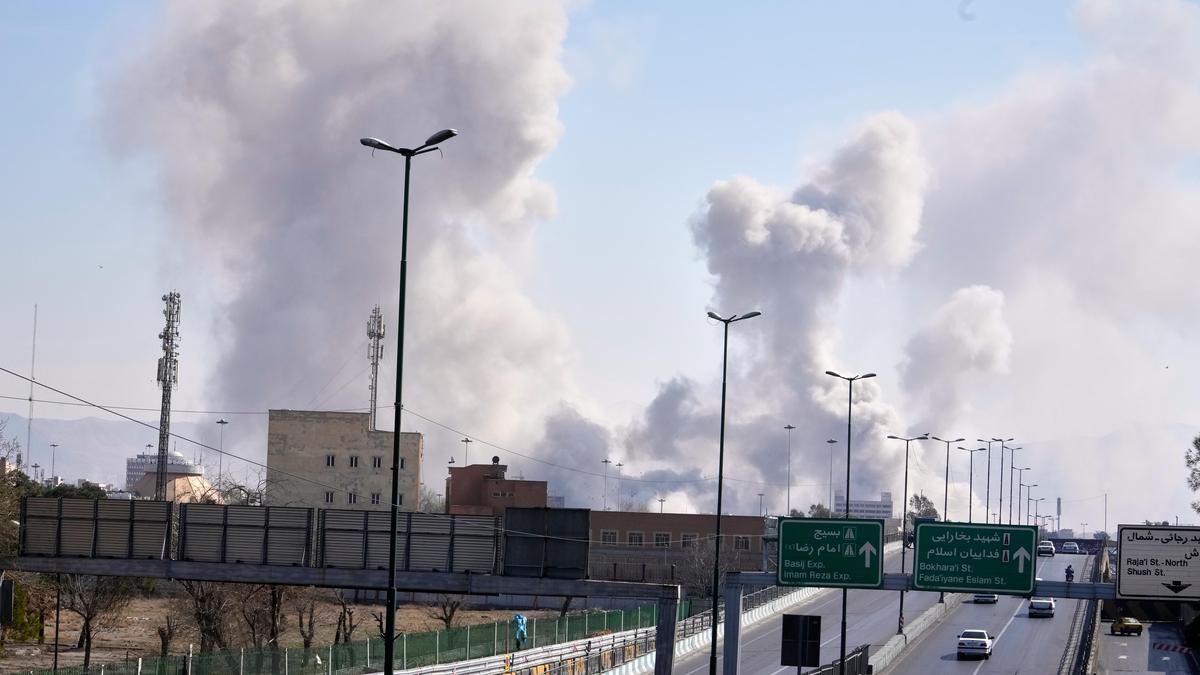
The Indian economy currently operates within a narrow corridor of stability where the primary threat is not a domestic failure, but a series of external price shocks originating from the Iran-Israel conflict. This geopolitical friction functions as a direct tax on Indian consumption and a primary disruptor of the Reserve Bank of India’s (RBI) inflation-targeting framework. While high-frequency indicators suggest domestic resilience, the transmission mechanism of Middle Eastern volatility into the Indian fiscal balance is near-instantaneous, primarily through the dual channels of energy imports and the "fear premium" in global capital markets.
The Transmission Mechanism of Geopolitical Risk
The impact of the Iran-Israel escalation on India is best understood through a three-factor model: the Energy Input Cost, the Currency Depreciation Loop, and the Logistics Friction Coefficient.
1. The Energy Input Cost
India imports approximately 85% of its crude oil requirements. When conflict flares in the Persian Gulf, the market doesn’t just price in physical supply disruptions; it prices in the probability of a blockade at the Strait of Hormuz. For every $10 increase in the price of a Brent crude barrel, India’s Current Account Deficit (CAD) typically widens by roughly 0.4% to 0.5% of GDP.
This is not a linear relationship. At certain thresholds—specifically above $95 per barrel—the Indian government faces a binary choice: pass the costs to consumers and risk an inflation spiral, or absorb the costs via excise duty cuts and widen the fiscal deficit. Both paths erode the quality of the sovereign balance sheet.
2. The Currency Depreciation Loop
In periods of high-intensity conflict, global capital retreats to "safe haven" assets, primarily the US Dollar and Gold. This flight to safety triggers capital outflows from emerging markets like India. The Indian Rupee (INR) faces downward pressure, which in turn makes even non-oil imports more expensive. This "imported inflation" forces the RBI to maintain higher interest rates for longer durations, suppressing domestic private investment and increasing the cost of corporate borrowing.
3. The Logistics Friction Coefficient
The Red Sea crisis, an offshoot of broader regional instability, has already forced a significant portion of Indian maritime trade to bypass the Suez Canal in favor of the Cape of Good Hope. This adds 15 to 20 days to transit times and increases freight costs by 40% to 60%. For India’s export-oriented sectors—specifically textiles, chemicals, and agricultural products—these margins are the difference between profitability and insolvency.
The RBI Monetary Policy Constraint
A key member of the RBI’s Monetary Policy Committee (MPC) recently highlighted that these external shocks are "near-term challenges." However, this phrasing understates the structural difficulty of the "Last Mile" of disinflation. The RBI aims for a 4% inflation target. While food prices are often influenced by domestic monsoons, fuel and manufacturing inputs are tied to the West Asian theater.
The "sticky" nature of core inflation in India means that even if oil prices spike briefly and then retreat, the second-round effects—higher transport costs being embedded into the price of FMCG goods—remain. This creates a policy "trap" where the RBI cannot cut rates to stimulate growth because it must keep them high to defend the currency and anchor inflation expectations.
Strategic Vulnerabilities in the Indian Supply Chain
The conflict exposes three specific structural weaknesses in the Indian industrial strategy:
- Fertilizer Feedstock Dependency: India is a massive importer of natural gas and finished fertilizers from the region. A disruption here doesn't just raise prices; it threatens food security and requires massive increases in government subsidies to keep farmer input costs stable.
- The Remittance Engine: Approximately 9 million Indians live and work in the Gulf Cooperation Council (GCC) countries. They are the primary source of India’s $100 billion+ annual remittance inflow. Any regional war that destabilizes these host economies would lead to a catastrophic drop in foreign exchange inflows, further weakening the INR.
- The Semiconductor and Electronics Bottleneck: While India is pushing for "Atmanirbhar" (self-reliance) in electronics, the current supply chains for high-end components remain sensitive to global shipping lanes that pass through contested waters.
Quantifying the Opportunity Cost of Volatility
The real cost of the Iran-Israel conflict is not just the immediate price of oil; it is the "uncertainty discount" applied to Indian equities. When global investors calculate the Weighted Average Cost of Capital (WACC) for Indian infrastructure projects, they add a risk premium for geopolitical instability.
If the conflict remains "simmering" rather than "boiling," the impact is manageable. However, a transition to direct state-on-state warfare would likely force the following economic shifts:
- A mandatory pivot to Russian or African crude, potentially at higher logistics costs but lower base prices.
- An acceleration of the Strategic Petroleum Reserve (SPR) filling, which ironically increases short-term demand and prices.
- A tactical shift in the RBI's stance from "Withdrawal of Accommodation" to "Neutral," not to help growth, but to provide liquidity to banks facing sudden capital flight.
The Disconnect Between Markets and Macro-Reality
There is a notable divergence between the Indian stock market’s resilience and the underlying macroeconomic data. While domestic retail investors continue to pump liquidity into the market via Systematic Investment Plans (SIPs), institutional players are increasingly cautious. This creates a "buffer" that prevents a market crash but doesn't solve the fundamental problem: India's growth is being funded by expensive capital while its primary energy source is located in a war zone.
The Indian government's strategy of diversifying energy sources and pushing for trade settlements in Rupees is a long-term hedge, but it offers little protection against a sudden closure of the Strait of Hormuz. In such a scenario, the "near-term challenge" described by the MPC would evolve into a multi-quarter stagnation of the manufacturing sector.
The strategic imperative for Indian firms is to move beyond "just-in-time" inventory models toward "just-in-case" stockpiling of critical inputs. On a sovereign level, the focus must shift from merely managing the exchange rate to securing long-term, fixed-price energy contracts that bypass the spot market's volatility.
Identify the high-exposure segments of your portfolio—specifically those with high crude-derivative inputs or Middle East export dependencies—and stress-test them against a $110 Brent crude scenario. If the current regional "shadow war" transitions into a blockading action, the priority shifts from growth to liquidity preservation.
Would you like me to develop a sector-specific vulnerability matrix for Indian mid-cap companies under various oil price shock scenarios?