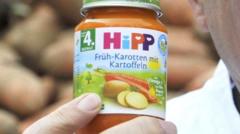
Product recalls in the premium infant nutrition sector represent more than localized logistical errors; they are catastrophic failures of the quality assurance (QA) protocols that justify premium price points. When HiPP, a market leader in organic baby food, initiated a recall of its "Couscous with Chicken" jars in Austria due to potential metal contamination, the incident exposed the inherent fragility of high-volume glass packaging lines. This analysis deconstructs the mechanics of the HiPP recall, the physics of contamination, and the economic fallout of brand equity erosion in the high-stakes pediatric market.
The Triad of Recall Causation
Food contamination events are rarely isolated accidents. They are the output of a specific failure within the Contamination Probability Matrix. In the context of the HiPP recall, the risk is categorized into three distinct operational silos:
- Mechanical Fatigue and Shearing: Most metallic contaminants in jarred food originate from the manufacturing line itself. High-speed capping machines or glass-to-metal contact points on the conveyor system can experience micro-fractures. If a sensor fails to detect a misaligned jar, the resulting friction can shear off microscopic or macroscopic shards.
- Upstream Raw Material Integrity: While the assembly line is a primary suspect, the couscous or poultry components are processed at secondary facilities before reaching HiPP’s final integration point. If the supplier's metal detectors or magnets are not calibrated to the specific density of the raw ingredient, foreign bodies pass through the initial sieve.
- Detection Threshold Limitations: Standard X-ray and metal detection systems have a "Minimum Detectable Size" (MDS). Factors such as "product effect"—where the salinity or moisture content of the chicken and couscous creates an electromagnetic signal that masks small metal fragments—can render high-end scanners ineffective.
The Economics of Consumer Trust in the Pediatric Vertical
In the baby food industry, the customer (the parent) and the consumer (the infant) are decoupled. This creates a unique psychological risk profile. The parent is not just purchasing calories; they are purchasing a Safety Guarantee. When HiPP issues a recall, they aren't just losing the margin on a specific batch of "Couscous with Chicken" (Lot number: 1044422, Best-before date: 15.01.2025); they are triggering an "Affinity Devaluation."
The cost of a recall is calculated via the Total Loss Function:
$$L = C_{log} + C_{ret} + C_{eq}$$
Where:
- $C_{log}$ represents the physical logistics of removing product from shelves and destruction.
- $C_{ret}$ is the retail penalty and lost sales volume.
- $C_{eq}$ is the long-term erosion of brand equity, which is the most difficult variable to stabilize.
HiPP’s decision to voluntarily recall suggests a prioritization of $C_{eq}$ protection over $C_{log}$ expenses. By moving faster than regulatory mandates from Austrian health authorities, the firm attempts to frame the failure as an example of "Vigilant Stewardship" rather than "Manufacturing Negligence."
The Physicality of Metal Contamination
Metal fragments in soft food matrices like couscous present two distinct physiological risks: mechanical laceration of the digestive tract and potential toxicity, though the latter is secondary to the immediate physical trauma. In infants, the esophageal lining is significantly more delicate than in adults, meaning fragments as small as 1–2 millimeters can cause significant internal damage.
The "Recall Radius" is determined by the batching logic. HiPP identified the specific production window to minimize the scope of the recall while ensuring 100% containment. However, the reliance on consumers to check lot numbers at home is the "Bottleneck of Compliance." Statistics in consumer behavior suggest that only 20% to 30% of affected product is ever returned or destroyed by the end-user; the remainder is often consumed before the news reaches the parent or sits in a pantry as a latent risk.
Structural Improvements for Zero-Tolerance Manufacturing
To prevent the recurrence of the Austrian contamination event, the manufacturing framework must shift from Reactive Detection to Predictive Maintenance.
1. Acoustic Emission Monitoring
Current systems rely on visual or electromagnetic signatures. Integrating acoustic sensors on the filling line allows the system to "hear" the high-frequency vibration of a bearing failure or a metal-on-glass strike before a fragment ever breaks off. This moves the intervention point from the finished product back to the machinery.
2. Digital Twin Verification
By maintaining a digital twin of the Austrian production line, HiPP can simulate stress points. If the line speed is increased by 5% to meet a surge in demand, the digital twin can predict which components are likely to experience the shearing forces that lead to metal shedding.
3. Blockchain-Enabled Batch Granularity
The current recall covers an entire production date. Implementing blockchain at the individual unit level would allow for "Precision Recalls." If a sensor detects a fault at 10:14 AM, the system could flag the specific 50 jars affected, rather than pulling thousands of units across an entire region. This reduces food waste and focuses consumer attention on a smaller, more manageable set of data.
The Regulatory Gap in the EU Market
The Austrian Agency for Health and Food Safety (AGES) operates under the European Rapid Alert System for Food and Feed (RASFF). While this ensures communication across borders, it does not mandate standardized hardware for detection. The HiPP incident highlights a discrepancy between "Organic Certification" and "Operational Certification." A product can be organic, pesticide-free, and non-GMO, yet still be physically dangerous due to antiquated mechanical processes.
The market is currently witnessing a divergence. Brands that invest in Total Quality Management (TQM) are outperforming those that rely on traditional sampling methods. HiPP’s infrastructure, while robust compared to generic brands, failed at the point of physical containment. This suggests that the "Organic" label no longer provides a sufficient moat; the new competitive advantage is "Verifiable Purity."
Strategic Imperatives for Stakeholders
The recovery of market share in Austria requires a three-phased operational pivot.
First, HiPP must publish the "Root Cause Analysis" (RCA) with full transparency. Vague references to "impurities" are insufficient for the modern, data-literate parent. Specifying the exact nature of the metal and the failure point in the line restores the perception of control.
Second, the supply chain must undergo a "Sensitivity Audit." This involves recalibrating every X-ray unit in the supply chain to a lower threshold, even at the cost of an increased "False Positive" rate. In the infant sector, the cost of a false positive (discarding a clean jar) is significantly lower than the cost of a false negative (distributing a contaminated one).
Third, the firm should implement a "Consumer-Side Verification" tool. A mobile application that allows parents to scan a barcode and receive an instant "Green Light" status based on real-time recall databases would bridge the gap between corporate notice and kitchen-table awareness.
The Austrian recall is a signal that the ceiling for "acceptable risk" in food manufacturing is dropping to zero. Companies failing to integrate advanced sensor arrays and real-time batch tracking will find themselves in a perpetual cycle of reactive crisis management, eventually ceding their market position to more technologically integrated competitors.