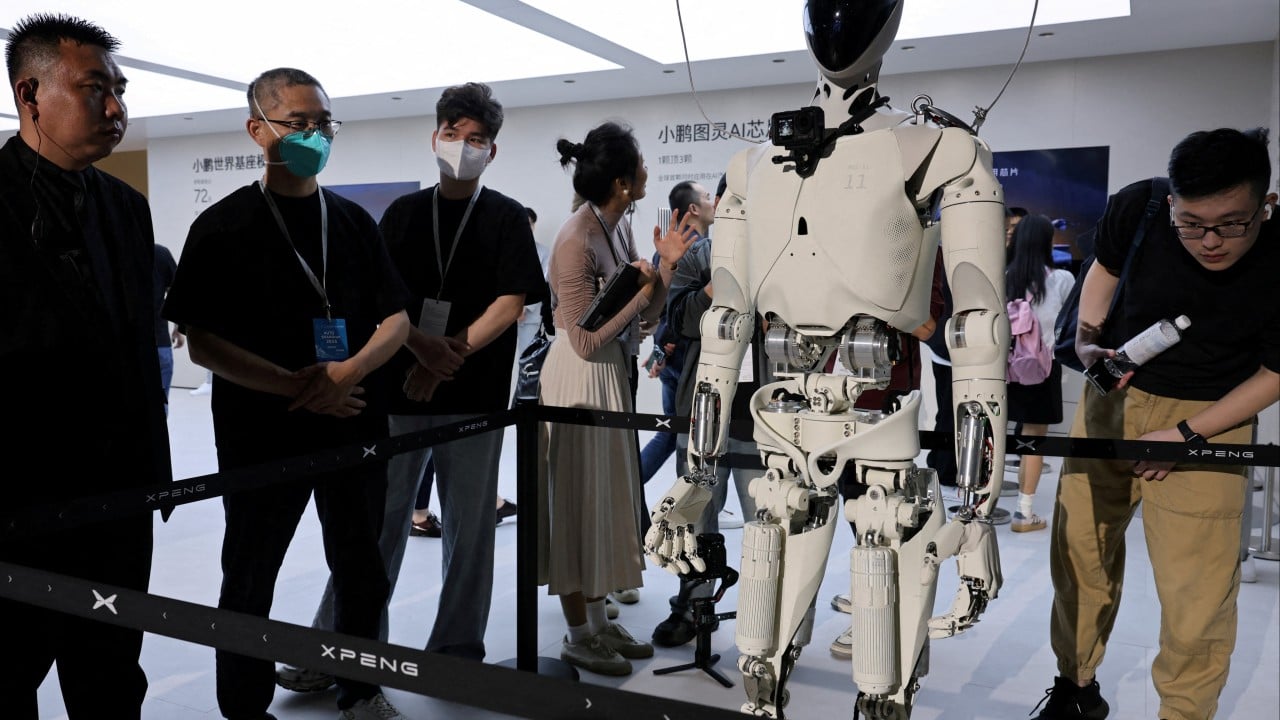
The commercial viability of humanoid robotics depends less on mechanical novelty and more on capital structure, localized compute density, and the amortization of training datasets. When capital markets direct over nine hundred million dollars into a single private financing round for an automotive spin-off, the underlying economic mechanics reveal a strategic race to escape margin compression in traditional vehicle manufacturing. The recent funding of the robotics subsidiary Dogotix at a post-money valuation exceeding six billion dollars illustrates how original equipment manufacturers are attempting to reprice their core competencies into physical artificial intelligence.
Understanding this capital deployment requires deconstructing the unit economics, the hardware constraints, and the strategic positioning relative to primary market competitors like Tesla.
The Three Pillars of Physical AI Monetization
Transitioning from automotive assembly lines to generalized humanoid deployment involves three distinct structural layers: compute architecture, kinematic complexity, and data feedback loops. Each layer represents a separate cost center that dictates long-term scalability.
[Compute Architecture: Turing Chips / 2,250 TOPS]
        │
        ▼
[Kinematic Control: 76 Degrees of Freedom]
        │
        ▼
[Deployment Scenarios: Showrooms & Factories]
1. Compute Density at the Edge
Operating a foundational physical model locally on a robotic chassis rather than relying on remote cloud inference changes the operational expenditure model. The architecture deployed in the IRON humanoid platform utilizes three proprietary Turing AI chips delivering up to 2,250 TOPS of effective computing performance.
This localized processing capacity addresses latency vulnerabilities inherent in wireless control networks. By moving inference to the edge, the system reduces bandwidth costs and eliminates safety hazards caused by network drops in industrial environments. However, the trade-off is higher thermal dissipation and power draw, which directly restricts active operating hours per battery charge cycle.
2. Kinematic Range and Actuation Costs
Mechanical design dictates the physical ceiling of utility. The platform incorporates 76 degrees of freedom across its frame, with 21 dedicated exclusively to each dexterous hand. High degrees of freedom expand the task envelope, allowing the machine to manipulate standard industrial tools, sort irregular inventory, and navigate unstructured environments.
The economic penalty for high kinematic precision is component wear and maintenance frequency. Each active joint requires specialized actuators, position sensors, and closed-loop feedback controllers. As the degree of freedom increases past seventy, the mean time between failures drops exponentially unless material science innovations match the mechanical complexity.
3. Vertical Integration and Corporate Restructuring
To protect the parent entity's balance sheet while unlocking venture-scale valuations, the corporate restructuring separates robotics assets into a standalone subsidiary over an 18-month timeline. The parent company retains roughly 82 percent ownership, maintaining financial consolidation while allowing external funds from strategic backers like Alibaba and Tencent to establish a distinct market price.
This structural maneuver addresses declining margins in legacy automotive operations. By isolating high-multiple research and development into a distinct corporate wrapper, management creates a vehicle to attract institutional capital that would otherwise reject automotive cyclicality.
The Cost Function of Mass Production
Scaling humanoid hardware past prototype phases exposes severe manufacturing bottlenecks. Unlike software, which scales with near-zero marginal cost, physical robots are bound by material supply chains, rare earth element access, and precision calibration requirements.
The capital injection is explicitly allocated toward solving three manufacturing friction points:
- Supply Chain Localization: Securing long-term supply agreements for specialized harmonic drives, tactile sensors, and high-density lithium cells.
- Data Generation Infrastructure: Building simulation environments and physical test labs to generate edge-case training data for the physical AI foundation models.
- Factory Floor Integration: Deploying initial units inside controlled commercial environments such as automotive showrooms, controlled warehouses, and internal manufacturing lines before attempting open-world deployments.
The primary risk in this capital expenditure cycle lies in premature scaling. If the foundational models fail to achieve generalized task completion rates above ninety-nine percent in unstructured environments, early commercial units will require continuous human supervision, destroying the labor-arbitrage economic model that justifies the hardware investment.
Strategic Divergence from Existing Models
Comparing this deployment strategy against established Western competitors reveals divergent philosophies in hardware deployment. While competitors emphasize unsupervised autonomous navigation on public infrastructure as a primary data engine, the structural approach observed here targets structured commercial spaces first.
Showrooms, corporate campuses, and controlled factory floors provide bounded environments with predictable lighting, standardized flooring, and cooperative human workers. This containment strategy minimizes catastrophic failure modes during early model iterations. By restricting initial operational domains, the system accumulates clean training data without the legal liabilities associated with open-world pedestrian interactions.
The economic viability of these machines depends on achieving a cost-per-operating-hour below human labor rates in target markets. Given a six billion dollar valuation baseline and the requirement to amortize massive research and development outlays across early production batches, unit pricing will remain elevated during the initial commercialization phase scheduled for late 2026 and 2027. Initial adoption will therefore concentrate entirely on high-cost labor sectors where precision and repeatability outweigh upfront capital expenditure.
Allocate future capital expenditures toward expanding high-density simulation clusters and refining local edge-compute power efficiency to extend operational runtimes before attempting broad international distribution.