Silence.
That is what happens first when a blood clot lodges itself into the middle cerebral artery of a human brain, starving roughly two million neurons every single minute of the oxygen they need to fire, to translate thought into speech, to tell the right hand how to unbuckle a seatbelt or point toward a bottle of water. You are still inside your body, awake and terrified, watching the world through a windshield that suddenly makes no sense while your tongue turns into a heavy, unresponsive stone. Meanwhile, you can explore other developments here: Why Russia Reviving Its Pre-War Demands Could Trap Ukraine Talks.
Now imagine adding the blinding strobe of red-and-blue emergency lights in your rearview mirror to that internal collapse.
This is not a thought experiment designed for a law school seminar, though it reads like a nightmare engineered to test the limits of human empathy. It is the documented reality of what happened on a New Jersey highway, a collision of medical catastrophe and institutional reflex that eventually led a jury to award $11.25 million to a woman whose stroke was treated like a felony stop. And now, years after the sirens faded and the physical therapy began, the State of New Jersey is asking an appellate court to wipe that verdict away. To explore the full picture, check out the recent article by TIME.
To understand why an eleven-million-dollar judgment exists in the first place—and why the state’s effort to overturn it cuts to the bone of how we police human vulnerability—you have to look past the sterile geometry of legal briefs. You have to sit in the driver’s seat of a car idling on the shoulder of a busy road, feeling the left side of your face begin to slide downward while a man with a badge demands to see your hands.
The Architecture of a Misread Emergency
In emergency medicine, neurologists repeat a three-word mantra until it becomes muscle memory: time is brain. Every sixty seconds that an ischemic stroke goes untreated, the patient loses an estimated 1.9 million neurons and fourteen billion synapses. The window for administering tissue plasminogen activator, the clot-busting drug known as tPA, is brutally narrow—typically within three to four and a half hours from the exact moment symptoms begin. Miss that window, and the damage moves from reversible crisis to permanent architecture.
That clock was already ticking furiously on the New Jersey roadway when a state trooper pulled behind a vehicle driven by a woman experiencing an acute neurological event.
From the outside, through the tinted glass of a cruiser window and the ingrained conditioning of highway patrol training, a stroke does not wear a medical alert banner. It looks erratic. A car drifts across the white fog line or slows to a crawl in active traffic. When the officer approaches the window, the driver cannot produce a license with crisp motor coordination. Her speech is slurred, thick, or entirely absent. Her eyes fail to track a penlight smoothly. Her balance, if she is ordered out of the vehicle, is catastrophic.
To a paramedic, that constellation of signs screams FAST—Face drooping, Arm weakness, Speech difficulty, Time to call 911.
To a trooper trained primarily to hunt for impaired drivers, contraband, and non-compliance, those exact same symptoms look indistinguishable from severe intoxication or deliberate defiance.
Think of it like looking at a house fire through night-vision goggles: the heat signature is unmistakable, yet without the right filter, you cannot tell whether you are looking at a controlled hearth or a structure about to cave in. Law enforcement training traditionally filters human behavior through a binary lens of compliance versus resistance. Either you follow the lawful command, or you are refusing to follow it. There is rarely a third checkbox on a patrol form for the suspect’s Broca’s area is currently suffocating.
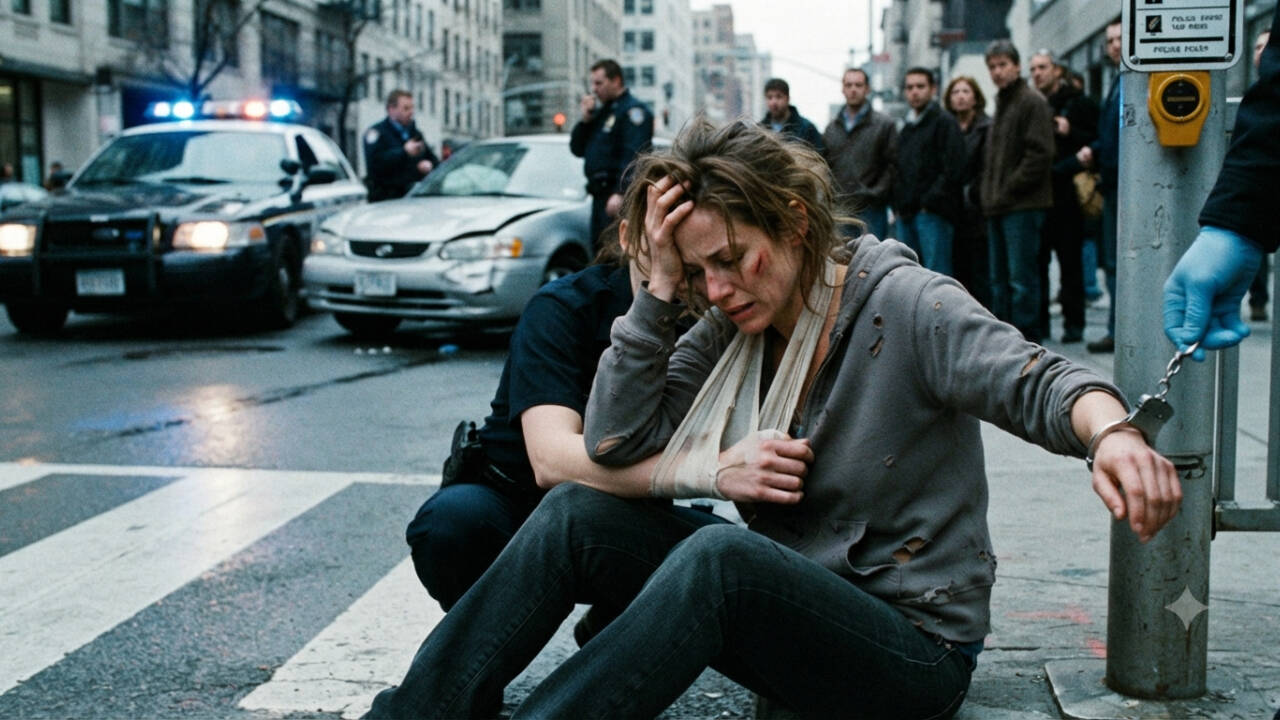
So when the woman behind the wheel could not obey rapid-fire verbal instructions, the escalation followed a script written decades before she ever turned her ignition key. She was removed from the car. Her arms—one of them already losing neural connection to her brain—were pulled behind her back. Cold steel clicked shut around her wrists.
Handcuffed. Detained. Treated not as a patient sliding toward permanent disability, but as a problem to be restrained.
Inside the Cruiser While the Clock Runs Out
I have spent enough time in hospital corridors and neurological step-down units to know the specific, hollow look in the eyes of stroke survivors who arrived an hour too late. They carry a grief that is difficult to explain to anyone whose brain has never betrayed them. It is the grief of knowing the person you were at 2:00 PM is gone by 4:30 PM, not because medicine lacked the tools to save you, but because nobody realized you were drowning on dry land.
Consider what happens physiologically during those lost minutes on the roadside.
While the trooper processes what he believes is an uncooperative motorist, blood pressure spikes in response to panic and physical restraint. The brain, starved of perfusion past the blockage, attempts to reroute blood through smaller collateral vessels. Every minute of delay expands the ischemic core—the zone of dead tissue—into the penumbra, the surrounding region of stunned, salvageable brain cells waiting desperately for rescue.
Every minute in handcuffs is a minute further from a CT scanner. Every minute spent debating whether a silent, disoriented woman is "refusing" a breathalyzer or field sobriety test is a minute stolen from her ability to walk unassisted, hold a fork, or speak her own name without stumbling over the syllables.
During the civil trial that followed, jurors were asked to confront that exact collision of timelines. They saw the dashcam footage. They heard the medical testimony detailing how the delay in recognizing a blatant medical emergency robbed the plaintiff of timely intervention and compounded her lifelong neurological deficits.
Juries are notoriously skeptical of large payouts against public entities—taxpayers, after all, sit in those jury boxes, knowing that state verdicts ultimately draw from public coffers. Yet after weighing the evidence, that New Jersey jury returned a verdict of $11.25 million.
They did not arrive at that number lightly. An eight-figure award in a civil rights and negligence case is a flare fired high into the night sky, a collective declaration by ordinary citizens that the gap between how the state reacted and how a human being deserved to be treated was unconscionable.
The State’s Legal Counterattack
Which brings us to the appeal, and the chilling logic of institutional self-defense.
When a government agency appeals a massive verdict like this, the arguments rarely hinge on denying that a tragedy occurred. Instead, the battle shifts to the cold, bloodless terrain of qualified immunity, statutory tort exemptions, and the precise legal definition of "objectively reasonable" conduct under the Fourth Amendment.
Let us be clear about what the state is asking the appellate judges to validate. New Jersey’s legal team is arguing, in essence, that the trooper acted within the bounds of his training and the chaotic uncertainty of a highway stop—that a police officer is not a board-certified neurologist, and cannot be held financially liable for mistaking the symptoms of a stroke for intoxication or non-compliance in the heat of the moment.
On paper, inside the quiet, wood-paneled chambers of an appellate court, that argument sounds deceptively tidy. We do not want paramedics arresting bank robbers, and we do not expect state troopers to carry portable MRI machines in their trunks.
Look closer, though, and the tidy logic begins to unravel.
The question before the jury was never whether the trooper could diagnose an occlusion of the middle cerebral artery on the side of the New Jersey Turnpike. The question was whether a reasonable human being—let alone a trained public servant sworn to protect life—should recognize basic signs of acute medical distress and summon emergency medical services before slapping metal restraints on an incapacitated woman.
By appealing the $11.25 million verdict, the state is drawing a hard line in the asphalt. It is asking the courts to rule that when law enforcement misreads a catastrophic medical emergency as criminal behavior, the citizen must absorb the entire physical, emotional, and financial ruin of that mistake alone.
Why This Happens Over and Over Again
If this New Jersey case were a freak anomaly—a once-in-a-generation convergence of bad luck—we could treat it as a tragic outlier and move on.
It is not an outlier. It is a pattern repeating itself across American roadways with disturbing regularity.
Over the past decade, civil rights dockets from California to Florida to New Jersey have filled with nearly identical stories. A diabetic driver whose blood sugar plummets into hypoglycemia, causing confusion and slurred speech, is dragged from a sedan and tased for failing to exit the vehicle. A man suffering a silent seizure behind the wheel is pinned to the pavement by multiple officers who interpret his involuntary muscle rigidity as "resisting arrest." A woman having a stroke is booked into a county jail cell rather than an emergency room, left lying on a concrete bench for hours until a nurse finally notices her pupils are uneven.
Why does this keep happening? Because modern policing has quietly become the default first responder for every crisis society fails to triage properly, without updating the mental operating system officers use when they step out of their cruisers.
Imagine a hypothetical scenario to see how deeply embedded this reflex is. Picture two identical cars stopped on the shoulder of Route 1 at twilight. Inside both cars sits a 54-year-old woman staring blankly ahead, unable to answer questions, her left arm resting limp in her lap.
If an ambulance arrives first, the responders immediately check her pulse, shine a light in her eyes, ask her to smile and raise both arms, and radio a "Stroke Alert" to the nearest hospital trauma bay within ninety seconds.
If a state patrol cruiser arrives first, the officer approaches with one hand near his duty belt, scanning for weapons, alcohol odor, or sudden movement. His training prioritizes control of the scene before assessment of the person. Once the mental frame locks onto non-compliant suspect, confirmation bias takes over. Slurred words confirm intoxication. Failure to exit the car confirms defiance. Confusion confirms evasion. By the time anyone realizes the driver is having a stroke, the golden hour of neurological rescue has evaporated.
The Invisible Cost of "Qualified" Mistakes
There is a phrase lawyers love to use in appellate briefs: the luxury of 20/20 hindsight. It is meant to remind judges that patrol officers make split-second decisions on dark highways without the calm clarity of a courtroom transcript.
That point deserves genuine respect. Policing highways is dangerous, unpredictable work. Troopers walk up to darkened windows every night never knowing whether they will find a tired commuter, a drunk driver, or someone reaching for a firearm. Dismissing the real hazards of traffic enforcement does no one any favors.
Yet respect for the difficulty of the job cannot become a blank check for abandoning common humanity.
Consider the invisible arithmetic hidden inside the $11.25 million figure that New Jersey is fighting so hard to erase. People hear a number like eleven million dollars and picture a lottery windfall. They do not picture the reality of severe post-stroke survival.
They do not picture the $15,000-a-month cost of specialized neurological rehabilitation, speech pathology, and occupational therapy that insurance routinely caps after a few dozen visits. They do not picture the retrofitting of a home so a person with hemiparesis can navigate a bathroom without fracturing a hip. They do not picture the lost decades of earning capacity, the crushing weight of cognitive fatigue that turns a ten-minute conversation into an exhausting marathon, or the quiet humiliation of needing help to button a shirt you used to fasten in the dark.
When a jury awards $11.25 million in a case like this, they are not handing out a prize. They are calculating the price tag of a stolen life and handing the invoice to the institution that helped break it.
If the appellate court grants New Jersey’s request to overturn or gut that verdict, the financial burden does not magically vanish into thin air. It simply shifts back onto the shoulders of the woman who was handcuffed while her brain was dying. The state keeps its budget intact, the legal precedent shields future mistakes behind layers of immunity, and the survivor is left to fund her own recovery from an injury aggravated by the very people sworn to keep her safe.
What Reform Actually Looks Like on the Shoulder of a Highway
The tragedy of this appeal is that it represents a massive missed opportunity to fix the root failure rather than litigating around it.
Every state police academy in the country spends hundreds of hours teaching recruits how to spot the subtle micro-expressions of deception, how to administer Standardized Field Sobriety Tests with courtroom precision, and how to execute tactical handcuffing techniques. How many hours do those same academies dedicate to distinguishing an acute ischemic stroke, a hypoglycemic crash, or a post-ictal seizure from alcohol impairment?
Often, it is less than a single afternoon block—a slide deck buried somewhere between basic first aid and defensive driving.
Yet the overlap between medical emergencies and suspected DUI is so well-documented in emergency medicine that ignoring it is a choice, not an inevitability. A simple protocol change—mandating immediate medical evaluation whenever a driver exhibits slurred speech or motor deficits without the clear odor of alcohol or positive preliminary screening, and training troopers to run a thirty-second FAST neurological check before applying restraints—could save lives and millions of taxpayer dollars simultaneously.
Instead of pouring state legal resources into convincing appellate judges that handcuffing a stroke victim was legally defensible, New Jersey could have treated that $11.25 million verdict as an urgent wake-up call. It could have rewritten its patrol protocols, retrained every trooper on the turnpike, and ensured that no other citizen ever lies cuffed in the back of a cruiser while precious neurons wink out one by one.
The Weight of the Steel
In the end, this legal battle is not really about tort law, or appellate standards of review, or the technical boundaries of sovereign immunity. It is about what happens in the quiet space between two human beings when one of them is completely helpless and the other holds all the power.
Think back to that woman sitting on the shoulder of the highway. Her brain was misfiring, desperately trying to send distress signals through severed neural pathways. Her body had locked her inside a cage of sudden paralysis and silence. She needed a hand on her shoulder, a voice saying stay with me, help is coming, and the urgent wail of an ambulance clearing a path to the nearest emergency room.
Instead, she felt her wrists pulled behind her back and heard the metallic ratchet of handcuffs tightening against her skin—the unmistakable sound of a state deciding that her suffering was a crime.