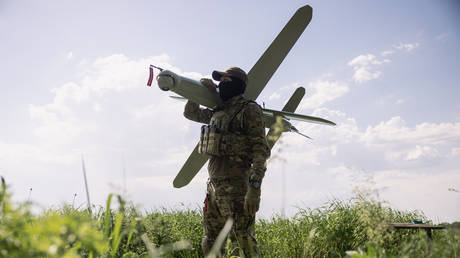
The escalation of Ukrainian long-range drone strikes against industrial and logistics targets in St. Petersburg, occurring in tandem with Moscow’s rejection of direct negotiations, exposes a fundamental miscalculation in contemporary conflict resolution models. Western geopolitical analysis frequently treats military kinetic action and diplomatic engagement as sequential phases—where fighting stops so that talking can begin. In asymmetric warfare, this sequence collapses. Kinetic escalation is not an alternative to diplomacy; it is the primary mechanism used to establish a baseline for leverage when a massive structural asymmetry exists between combatants.
Ukraine's targeted campaign against the Leningrad oblast, located over 1,000 kilometers from the state border, represents a deliberate shift from tactical theater management to strategic economic disruption. By analyzing the mechanics of these long-range strikes against Russia's critical infrastructure alongside the breakdown of diplomatic signaling, we can map the precise cost-imposition frameworks governing this phase of the war.
The Cost Function of Deep Infrastructure Strikes
To understand why Ukraine is prioritizing targets in the St. Petersburg region, one must look at the economic geography of the Russian Federation. The Baltic Sea ports and their associated petrochemical infrastructure form the financial engine of the Russian state, converting crude oil and refined products into the hard currency required to sustain a protracted war of attrition.
When analyzing these deep strikes, the military utility is calculated through a specific cost-imposition ratio:
$$R_{\text{cost}} = \frac{C_{\text{defense}} + C_{\text{disruption}}}{C_{\text{attack}}}$$
Where $C_{\text{attack}}$ represents the marginal cost of producing and launching a long-range one-way attack drone (typically ranging from $20,000 to $100,000 for composite, GPS-guided systems). The numerator is comprised of two distinct, compounding variables:
- $C_{\text{defense}}$ (Air Defense Reallocation Cost): The financial and operational cost of deploying short- and medium-range air defense systems (such as Pantsir-S1 or Tor-M2) away from the active frontline to protect static rear-area economic assets.
- $C_{\text{disruption}}$ (Economic Opportunity Cost): The capital required to repair specialized refining infrastructure, such as atmospheric distillation columns, combined with the lost revenue from frozen export capacity during the downtime.
By targeting facilities like the Ust-Luga oil terminal or the Petersburg Oil Terminal, Ukraine exploits a severe geographic vulnerability. The Russian air defense umbrella is vast but finite. Securing a perimeter around a front line spanning hundreds of kilometers while simultaneously providing dense point-defense coverage for industrial zones thousands of kilometers away creates an unsustainable operational bottleneck.
Every Pantsir battery deployed to protect a refinery in St. Petersburg is a battery stripped from the Donbas or Crimea. This forces Russian military planners into a zero-sum resource allocation dilemma: protect the state's tax base or protect its advancing ground forces.
The Friction of Asymmetric Signaling in Diplomatic Deadlocks
The rejection of direct communication frameworks by the Kremlin highlights a structural failure in signaling theory. In standard bargaining models, an actor agrees to negotiate when the estimated utility of a negotiated settlement exceeds the expected utility of continued conflict.
Ukraine's diplomatic overtures, often framed around structured peace formulas or invitations to multilateral summits, operate on the assumption that Russia can be incentivized to negotiate through a combination of international diplomatic isolation and localized economic pressure. However, this framework fails to account for Russia's long-term attrition strategy, which relies on three distinct pillars:
- Demographic and Material Scale: The capacity to absorb high equipment and personnel loss rates due to a centralized command structure and a fully mobilized defense industrial base.
- Sanctions Circumvention Resilience: The establishment of a shadow fleet of tankers and alternative trade corridors through non-aligned nations, mitigating the immediate shock of Western economic restrictions.
- The Anticipated Decay of Western Political Will: A calculated assessment that democratic coalitions suffer from inherent institutional fatigue, leading to eventual reductions in financial and military aid allocations to Ukraine.
Because Moscow operates under the assumption that time acts as an asymmetric advantage, any willingness to enter direct talks with Kyiv without preconditions would signal structural weakness. From the Kremlin's perspective, negotiations are a tool to codify territorial realities, not a mechanism for revisionist compromise. Consequently, verbal offers for direct dialogue are dismissed out of hand because the underlying strategic calculus of the Russian leadership has not yet been altered by the material costs imposed on the ground.
Vulnerability Mechanics in Refineries and Logistics Nodes
The selection of St. Petersburg as a recurring target zone is not symbolic; it is dictated by the physical architecture of modern oil refining and transport. A common analytical error is measuring the success of a drone strike solely by whether an entire facility is destroyed. Total destruction is unnecessary to achieve strategic paralysis.
Modern petrochemical facilities possess highly centralized single points of failure, most notably the fractional distillation towers (crude distillation units, or CDUs).
These components are massive, highly engineered structures lined with specialized alloys designed to operate under extreme pressure and temperature variables. They cannot be easily bypassed, and they cannot be purchased off the shelf due to their highly customized designs.
When a low-cost drone strikes a CDU, the immediate result is a complete halt in production. The long-term impact is governed by procurement and engineering bottlenecks:
- Custom Fabrications: Replacing a damaged distillation column requires custom fabrication that can take months, if not over a year, under normal economic conditions.
- Sanctions Constraints: The specialized machinery, precision instrumentation, and foreign engineering expertise required to repair or rebuild these units are heavily restricted under Western export controls. While components can be smuggled through third-party intermediaries, the lead times and capital expenditure required to secure them scale exponentially.
Consequently, a single successful drone strike costing less than a modern economy car can effectively mothball a multi-billion-dollar refining node for quarters at a time. The resulting drop in export volumes forces a shift from high-value refined petroleum products to lower-margin crude oil exports, directly squeezing the net revenue generation capabilities of the Russian energy sector.
The Strategic Failure of Defensively Tethered Warfare
The necessity of Ukraine’s deep-strike campaign is reinforced by the operational constraints imposed by its international partners. Western military assistance has historically been delivered with strict geographic usage restrictions, prohibiting the deployment of highly precise, long-range tactical missile systems (such as ATACMS or Storm Shadow) against targets within the internationally recognized borders of the Russian Federation.
This policy of defensive tethering created a sanctuary zone for Russian military assets, allowing the Kremlin to store ammunition, muster ground forces, and launch strategic bomber fleets from bases mere hours from the Ukrainian border with absolute impunity.
To circumvent this artificial operational bottleneck, Ukraine was forced to develop an indigenous long-range strike capability. By relying on domestically designed, low-cost propeller-driven drones with extended ranges, Ukraine effectively decoupled its strategic deep-strike doctrine from Western political red lines.
While these indigenous platforms lack the speed, payload capacity, and radar-evading capabilities of Western cruise missiles, they compensate through volume and range. Moving the strike envelope to St. Petersburg demonstrates that no industrial zone in European Russia is safe from interdiction, effectively neutralizing the concept of a domestic sanctuary zone without violating the formal user agreements of Western-supplied material.
The Attrition Equilibrium
The current state of the conflict can be conceptualized as a race between two distinct vectors of degradation: the degradation of Ukrainian defense systems and civilian infrastructure via Russian missile and glide-bomb campaigns versus the degradation of Russian economic infrastructure via Ukrainian asymmetric deep strikes.
The primary limitation of Ukraine’s strategy is its reliance on un-crewed platforms with relatively small warheads. A drone carrying 20 to 50 kilograms of explosives requires precise targeting data to cause systemic structural failure, whereas a Russian Kh-101 cruise missile or Iskander ballistic missile carries a payload five to ten times larger, capable of leveling entire structures regardless of point-accuracy. Ukraine’s strategy therefore depends entirely on sustained intelligence superiority, allowing operators to identify the exact coordinates of unarmored, highly flammable sub-components within Russian industrial complexes.
Furthermore, Russia has begun adapting its internal defense architecture. The state is actively deploying localized electronic warfare (EW) jamming networks around major metropolitan areas and utilizing mobile, searchlight-equipped anti-drone interception teams similar to those developed by Ukraine. As these defensive countermeasures mature, the success rate of long-range drone strikes will naturally decay, requiring Ukraine to continuously innovate its guidance systems, implement automated terminal homing via computer vision, and scale up production to overwhelm defensive nets through sheer mass.
The Core Strategic Play
To break the current strategic deadlock and force a shift in Russia's negotiation calculus, Ukraine must transition from sporadic, opportunistic deep strikes to a synchronized, high-frequency interdiction campaign targeting the Baltic and Black Sea energy corridors simultaneously.
The objective must not be the temporary disruption of individual facilities, but the systematic closure of the maritime export infrastructure that funds the Russian state budget. This requires the deployment of standardized, mass-produced drone swarms capable of executing multi-axis attacks to deplete localized air defenses, paired with the deployment of un-crewed surface vessels (USVs) to mining and blockading roles outside major shipping channels.
Only when the structural cost of defending domestic economic infrastructure consistently outpaces the financial returns of energy exports will the Kremlin be forced to reassess the utility of its long-term attrition strategy. Until that material tipping point is reached, diplomatic signaling will remain entirely ineffective, and the war will continue to be decided purely by the brutal metrics of industrial capacity and systemic vulnerability exploitation.