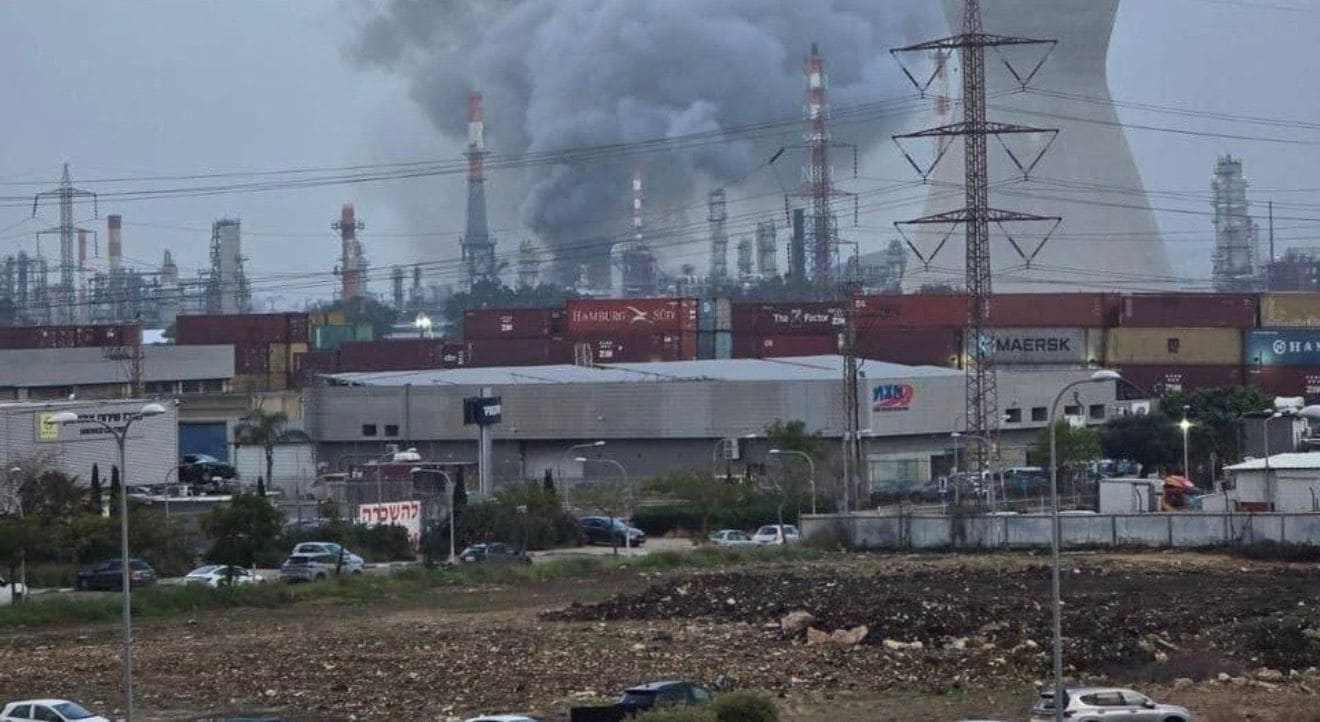
The targeting of the Haifa oil refinery by Iranian missile assets represents a transition from symbolic signaling to the kinetic disruption of critical energy infrastructure. This event must be analyzed through the lens of Energy Security Elasticity and Integrated Air Defense System (IADS) Saturation. When a precision-guided munition enters the terminal phase over a high-density industrial zone like Haifa, the objective is rarely the immediate destruction of the entire facility. Instead, the tactical goal is the creation of a Cascading Failure Loop—where the destruction of high-lead-time components (fractionating columns, heat exchangers, or hydrocrackers) results in a disproportionate period of operational downtime relative to the mass of explosives used.
The Haifa Refinery as a High-Value Bottleneck
The Bazan Group refinery in Haifa is not merely an industrial site; it is a critical node in Israel's domestic fuel supply chain. Its output capacity and proximity to the Mediterranean port make it a singular point of failure for the following three vectors:
- Refined Product Sovereignty: While crude oil can be imported, the specialized conversion of that crude into jet fuel (JP-8), diesel, and gasoline occurs here. Disruption forces a shift from importing raw materials to importing finished products, which carries a significantly higher "Landed Cost" and introduces maritime logistics vulnerabilities.
- Chemical Feedstock Integration: The refinery provides the aromatic and olefinic building blocks for the downstream petrochemical industry. A shutdown here halts the production of polymers and specialized chemicals essential for the domestic manufacturing sector.
- Strategic Reserves Management: Refineries are co-located with storage tank farms. An kinetic strike introduces the risk of "Boil-Over" or "Pool Fire" events that can consume months of strategic fuel reserves in hours.
The Mechanics of Terminal Phase Penetration
The success of a missile strike against a hardened, defended site like Haifa depends on the Intercept Probability Ratio. Modern missile defense, such as the Arrow-3 or David's Sling, operates on a "Look-Shoot-Look" doctrine. Iranian strategy has shifted toward Asymmetric Saturation, utilizing a mix of low-cost loitering munitions (drones) and high-velocity ballistic missiles.
The logic of this saturation is mathematical. If an interceptor battery has $N$ ready-to-fire missiles and the incoming swarm consists of $N+1$ projectiles, the final projectile has a near-100% probability of impact, assuming no electronic warfare interference. By using slow-moving drones to force the activation of radar systems and the expenditure of expensive interceptors, the attacker "clears the path" for high-precision ballistic missiles with Maneuverable Reentry Vehicles (MaRVs). These MaRVs can execute late-course corrections, making them significantly harder to track with traditional parabolic trajectory calculations.
Economic Attrition and the Insurance Premium Spike
Beyond the physical damage to steel and concrete, the strike triggers a Geopolitical Risk Multiplier in the global markets. Even if the refinery remains partially operational, the "War Risk Premium" for tankers entering the Port of Haifa increases immediately.
- Freight on Board (FOB) Volatility: Sellers may demand higher prices to compensate for the risk of their cargo being destroyed mid-loading.
- Protection and Indemnity (P&I) Clauses: Insurance clubs may restrict coverage or demand exorbitant surcharges for vessels docking in the Levant, effectively creating a "Soft Blockade."
- Operational Contingency Costs: The shift to the Port of Ashdod or the use of offshore ship-to-ship transfers increases the per-barrel cost of energy, which filters through the entire economy as inflationary pressure.
The Vulnerability of the Fractionation Process
To understand why a single missile can be "successful" without leveling a city block, one must examine the refinery's Critical Component Lead Times. A refinery is a series of interconnected pressure vessels. The most vulnerable points are:
- Atmospheric Distillation Units (ADUs): These are the massive towers that separate crude into components. They are custom-engineered and cannot be bought "off the shelf." Replacing a damaged ADU can take 12 to 24 months.
- Control Room Digital Infrastructure: Modern refineries are managed by Distributed Control Systems (DCS). A strike that causes a fire near the cabling or server hubs can "blind" the plant, necessitating a manual shutdown that takes days to execute safely and weeks to restart.
- Cooling Water Intake: Refineries require massive amounts of water to manage the thermal loads of the refining process. Damaging the pumping stations at the Haifa waterfront can force an emergency trip of the entire facility to prevent a catastrophic meltdown of the processing units.
Kinetic Impact vs. Psychological Deterrence
The strategic utility of the Haifa strike for Iran lies in the Deterrence Gap. By demonstrating the ability to strike a facility surrounded by some of the world’s most advanced air defenses, the attacker signals that the "Cost of Defense" is now higher than the "Cost of Offense."
A standard interceptor missile may cost between $1 million and $3 million, while a long-range drone or basic ballistic missile may cost as little as $50,000 to $500,000. This Negative Cost-Exchange Ratio means that the defender can be economically exhausted even if they intercept 90% of incoming threats. The 10% that get through provide the kinetic proof of concept required to devalue the opponent's security guarantees.
Strategic Infrastructure Hardening Requirements
Moving forward, the resilience of the Haifa industrial basin depends on shifting from Passive Protection (walls and bunkers) to Distributed Redundancy. The current centralized model of refining is a relic of 20th-century industrial planning.
The primary limitation of the current Israeli energy posture is the lack of a "Modular Refining" capability. Small-scale, containerized refining units, while less efficient than a massive central plant, provide a "Floor" for fuel production that cannot be knocked out by a single missile strike. Furthermore, the integration of Directed Energy Weapons (DEWs)—such as high-energy lasers—is the only path to correcting the negative cost-exchange ratio, as lasers provide a "near-infinite magazine" with a cost-per-shot measured in cents rather than millions of dollars.
The strike on Haifa confirms that the era of "Safe Rear Areas" has ended. Future industrial planning must treat the refinery not just as a profit center, but as a front-line combat zone where the ability to survive a hit is as important as the ability to produce fuel.
Strategic recommendation: Transition the Haifa energy complex toward a "Cold Standby" redundancy model by accelerating the development of the Eilat-Ashkelon pipeline bypass and investing in localized, micro-grid fuel synthesis to decouple military readiness from a single geographic coordinate.
Would you like me to analyze the specific missile flight profiles and radar cross-sections used in this engagement?