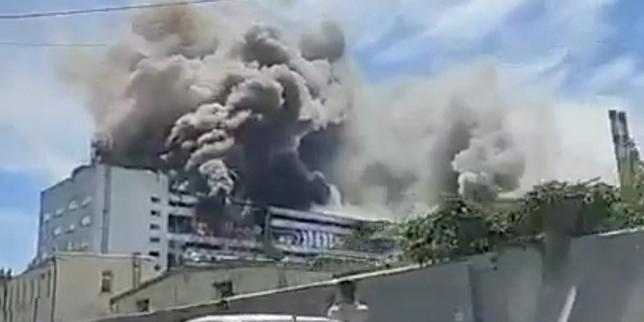
Ukrainian kinetic operations inside the internationally recognized borders of the Russian Federation represent a deliberate shift from localized tactical defense to systemic strategic attrition. The reported strike in the Voronezh region, resulting in localized infrastructure disruption and casualties, cannot be evaluated as an isolated tactical event. Instead, it must be analyzed through the lens of a highly structured operational framework designed to degrade logistics, force air defense reallocation, and alter the political calculus of the escalating conflict.
By evaluating these cross-border actions against hard military and economic variables, we can map the true cause-and-effect relationships driving this phase of the war. The standard media narrative focuses heavily on immediate casualty counts and localized damage; however, a rigorous strategic assessment reveals that the primary utility of these strikes lies in their systemic downstream effects on military theater sustainability.
The Tri-Axe Framework of Deep Strike Operations
To understand the operational intent behind targeting logistics hubs like Voronezh—located roughly 200 kilometers from the Ukrainian border—analysts must apply a clear three-part framework. These strikes target specific operational vulnerabilities within the Russian military apparatus.
1. Logistical Interdiction and Supply Chain Degradation
Voronezh serves as a critical node for the Southeastern Railway and major highway networks feeding troops and matériel into the Donbas and Kharkiv operational theaters. When deep strikes successfully disrupt these nodes, they introduce severe friction into the Russian military supply chain.
The mechanism of this friction operates as a compounding cost function:
- Direct destruction of transport assets or storage depots forces reliance on secondary, less efficient routes.
- Increased transit times lower the velocity of ammunition replenishment at the front lines.
- The requirement to offload material further from the active combat zone increases the vulnerability of the remaining logistical tail to tactical rocket artillery.
2. Air Defense Saturation and Asset Reallocation
The Russian Federation possesses a vast but finite inventory of advanced surface-to-air missile (SAM) systems, such as the S-400 and Pantsir-S1. Ukrainian planners utilize a combination of low-cost domestic uncrewed aerial vehicles (UAVs), decoy systems, and stand-off missiles to exploit a fundamental mathematical asymmetry in air defense physics.
An air defense network must defend a specific geometric area. By expanding the geographic scope of potential targets deep into regions like Voronezh, Kursk, and Belgorod, Ukraine forces Russian command to make a binary structural choice. They must either leave critical military infrastructure inside Russia vulnerable, or strip active air defense assets from the frontline theaters in Ukraine to protect domestic airspace. The removal of a single Pantsir system from the Donbas to protect a domestic oil refinery or command post creates an immediate localized window of vulnerability that Ukrainian tactical aviation and drone units can exploit.
3. Asymmetric Economic Cost Imbalance
The financial calculus of long-range drone strikes heavily favors the attacker. A long-range strike UAV manufactured domestically in Ukraine may carry a production cost ranging from $20,000 to $50,000. In contrast, the interceptor missiles fired by systems like the Tor or S-300 cost between $500,000 and $2,000,000 per unit.
Even when a strike is successfully intercepted by Russian air defense, the engagement often represents a net economic victory for the attacker, draining the defender's finite missile stockpiles and manufacturing capacity. When intercepts fail, the economic damage to industrial or military infrastructure multiplies this cost asymmetry exponentially.
Target Classification and Operational Intent
The selection of targets within the Voronezh oblast follows a clear hierarchy of strategic utility. While regional officials frequently attribute casualties and structural damage to falling debris or direct hits on civilian sectors, an examination of the target landscape reveals three primary objective categories.
Military Airfields and Aviation Infrastructure
The Baltimor airbase, situated directly on the outskirts of Voronezh, houses elements of the Russian Aerospace Forces (VKS), specifically Su-34 fighter-bombers. These aircraft are the primary vectors for launching guided glide bombs (KABs), which have caused devastating damage to Ukrainian defensive positions along the frontline.
Striking the infrastructure supporting these sorties—such as fuel farms, ammunition storage bunkers, and maintenance hangars—directly reduces the operational sortie rate of the VKS. Damaging a runway or support facility yields a compounding degradation of capability that prevents aircraft from launching, regardless of the availability of pilots or airframes.
Energy Infrastructure and Refineries
Voronezh contains critical electrical substations and petroleum storage facilities that power both civil society and military logistics networks. Targeting the energy grid forces the diversion of state resources into emergency repairs and disrupts industrial manufacturing.
Furthermore, the destruction of oil depots directly constrains the local availability of refined fuel products required for mechanized military units moving toward the southern and eastern fronts.
Command and Control Nodes
Temporary military headquarters, communication centers, and electronic warfare facilities are high-priority targets. Disrupting these nodes induces localized paralysis within the chain of command, delaying operational reaction times during active Ukrainian counter-operations or defensive adjustments.
The Physics of Attrition: Systemic Limitations and Risks
A rigorous analysis requires acknowledging the hard limits of cross-border strike strategies. While highly effective at creating operational friction, these operations face strict constraints that prevent them from acting as an independent, decisive factor in terminating the conflict.
The Problem of Scale and Mass
To achieve a structurally decisive effect, an attrition campaign requires a volume of fire capable of overwhelming defensive repair capacities. If Ukraine conducts strikes at a lower frequency, the Russian state can absorb the damage, repair localized infrastructure, and adapt its logistical routing before systemic collapse occurs. The rate of Ukrainian domestic drone production and the acquisition of Western stand-off munitions form the absolute ceiling of this strategy's effectiveness.
Escalation Dynamics and Political Constraints
The use of Western-supplied long-range weapons—such as ATACMS or Storm Shadow—inside recognized Russian territory remains bound by complex political redlines imposed by partner nations. This restriction forces Ukraine to rely predominantly on its own evolving domestic long-range drone portfolio. While these drones possess the necessary range, they carry significantly smaller payloads than military-grade cruise or ballistic missiles, limiting their structural destruction capabilities per successful impact.
The following matrix delineates the structural differences between these weapon classes as utilized in cross-border operations:
- Domestic Long-Range UAVs
- Payload Capacity: 20–50 kg
- Velocity: Subsonic (Low)
- Primary Vulnerability: Electronic warfare jamming, point-defense systems
- Strategic Utility: Air defense exhaustion, soft-target economic disruption
- Western-Supplied Ballistic/Cruise Missiles
- Payload Capacity: 200–450 kg
- Velocity: High Subsonic to Supersonic
- Primary Vulnerability: High-altitude area defense systems, political usage restrictions
- Strategic Utility: Hardened target destruction, deep command node elimination
Structural Forecast and Strategic Recommendations
The frequency and geographic depth of Ukrainian cross-border operations will likely expand in direct proportion to the volume of domestic manufacturing scaling. As Russia attempts to sustain offensive momentum along the eastern axis, its reliance on fixed logistical corridors through Voronezh and similar hubs becomes more acute, increasing the target value of these nodes.
To maximize the strategic return on investment for these cross-border operations, military planners must execute three distinct operational adjustments:
First, transition from single-vector drone strikes to multi-domain integrated attack packages. Synchronizing low-altitude drone swarms with high-speed anti-radiation missiles can systematically suppress regional air defense radars, maximizing the probability of survival for follow-on strike assets targeting heavy infrastructure.
Second, prioritize the interdiction of rolling stock and rail bottlenecks over highway networks. Roads are easily bypassed or repaired within hours, whereas the destruction of specialized rail bridges, switching stations, or electrical substations serving the railway network creates long-term systemic delays that cannot be mitigated quickly by manual labor.
Third, align the timing of deep strikes directly with localized tactical counter-offensives on the front lines. Executing deep logistics strikes weeks before a tactical operation allows the defender sufficient time to reconstitute supply lines. Compounding the friction by striking logistics nodes at the exact moment frontline units require urgent ammunition and fuel replenishment maximizes the operational impact, turning localized infrastructure damage into immediate tactical breakthroughs on the battlefield.