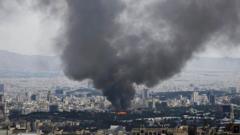
The October 2024 direct military engagement between Israel and Iran, characterized by high-precision strikes on Iranian military infrastructure, represents a terminal shift from shadow warfare to a measurable, state-level kinetic competition. Analyzing the global reaction requires moving beyond diplomatic rhetoric and into a structural assessment of three primary variables: the degradation of Iranian integrated air defense systems (IADS), the signaling of red-line shifts to the "Axis of Resistance," and the economic resilience of energy markets under the threat of Strait of Hormuz interdiction. The international response was not a monolithic "call for restraint" but a calibrated exercise in risk management, where states prioritized the containment of an escalatory spiral that threatened the global semiconductor and energy supply chains.
The Tri-Node Response Framework
Global reactions to the strikes are best understood through a tri-node framework that categorizes nations based on their strategic proximity to the conflict's fallout. Each node operates under a distinct cost-benefit analysis.
Node 1: The Western Security Architecture
For the United States and its European allies, the response focused on the Validation of Deterrence. The objective was to support a strike that was "proportionate" enough to satisfy Israeli security requirements while "limited" enough to prevent a total regional conflagration. The U.S. deployment of the THAAD (Terminal High Altitude Area Defense) system to Israel prior to the strikes functioned as a physical hedge against Iranian retaliation, shifting the burden of escalation onto Tehran.
The Western response prioritized the maintenance of the status quo in the global energy market. By steering Israeli targets away from oil production and nuclear facilities, the U.S. managed the "Political Risk Premium" in Brent Crude prices. European reactions, while formally emphasizing de-escalation, implicitly recognized the necessity of degrading Iran’s drone and missile manufacturing capabilities—the same infrastructure supplying Russian operations in the Ukraine theater.
Node 2: The Regional Realists
The Arab states, specifically the GCC (Gulf Cooperation Council) members, adopted a posture of Strategic Neutrality. Their official statements condemned the violation of Iranian sovereignty, a necessary diplomatic maneuver to insulate their own infrastructure from Iranian or proxy retaliation.
The underlying logic for Riyadh, Abu Dhabi, and Amman is the "Proxy Spillover Metric." These nations calculate that any strike which weakens the Iranian Revolutionary Guard Corps (IRGC) without triggering a full-scale regional war is a net positive for their long-term security. However, the proximity of their desalination plants and oil terminals to Iranian territory creates a "Fragility Constraint," forcing them to distance themselves publicly from Israeli-U.S. kinetic actions.
Node 3: The Revisionist Powers
Russia and China viewed the strikes through the lens of Multipolar Competitive Advantage. Russia’s condemnation was transactional; it relies on Iranian Shahed-136 loitering munitions. Any degradation of Iranian manufacturing directly impacts the Russian "Attrition Ratio" in Eastern Europe.
China’s response was governed by the "Energy Security Imperative." As the primary buyer of Iranian "teapot" oil exports, Beijing views Middle Eastern instability as a threat to its manufacturing cost base. Their diplomatic pressure was directed at the U.S., attempting to frame the escalation as a failure of Western hegemony rather than a regional security dilemma.
Technical Analysis of the Kinetic Engagement
The effectiveness of the strikes and the subsequent global reaction cannot be separated from the technical performance of the hardware involved. The Israeli Air Force (IAF) utilized a combination of long-range standoff munitions and stealth platforms to bypass the S-300 air defense systems provided by Russia to Iran.
The Degradation of the S-300 Shield
The strikes targeted "strategic depth" assets. By neutralizing the S-300 radar arrays, Israel created a "Vision Gap" in Iranian airspace. This is a critical variable because it changes the mathematical probability of success for future sorties. Global military analysts observed this as a proof-of-concept for the vulnerability of fourth-generation Russian defense systems against fifth-generation Western integration.
The Missile Manufacturing Bottleneck
A primary objective was the destruction of planetary mixers used in the production of solid fuel for medium-range ballistic missiles. Unlike standard infrastructure, these mixers are highly specialized, dual-use industrial components with long lead times for replacement. The destruction of these units imposes a Physical Latency on Iran’s ability to replenish its missile stockpiles. This technical setback reduces Iran’s "Volume of Fire" capability for at least 12 to 18 months, altering the regional balance of power.
The Cost Function of Global De-escalation
The international community’s insistence on "restraint" is a calculated response to the economic cost function of a closed Strait of Hormuz. Approximately 20% of the world’s liquefied natural gas (LNG) and oil passes through this chokepoint.
- The Insurance Variable: Following the strikes, maritime insurance premiums for the Persian Gulf did not see the catastrophic spike witnessed during the 1980s "Tanker War." This indicates that the market viewed the strikes as a "Calculated Exchange" rather than the start of an "Unbounded Conflict."
- The Inflation Hedge: Central banks, particularly in the Eurozone and the U.S., are operating in a high-sensitivity environment. An energy price shock would force a pivot in interest rate trajectories, risking a global recessionary event. The diplomatic pressure on Israel was, therefore, an economic necessity to protect the "Soft Landing" of the global economy.
Strategic Deficiencies in Conventional Reporting
Standard analysis often fails to account for the Information Gap between public condemnation and private intelligence sharing. While many nations publicly criticized the strikes, the "Silent Cooperation" in intelligence and airspace management tells a different story.
- Airspace Coordination: The transit of Israeli jets required a complex deconfliction matrix. The lack of active interception by regional neighbors suggests a tacit acceptance of the mission’s parameters.
- The Proxy Decoupling: A significant observation post-strike was the relative silence of the "Axis of Resistance." The degradation of Hezbollah’s command structure in the preceding weeks created a "Symmetry Deficit." Iran found itself unable to leverage its traditional proxy-based deterrence, forcing it to rely on its own conventional (and now degraded) air defenses.
The Red-Line Shift: A New Doctrine of Engagement
We are witnessing the emergence of a "Direct Kinetic Doctrine." For decades, the confrontation was managed via third parties. The 2024 exchange has established a new precedent: direct, state-to-state missile and air strikes are now the standard unit of escalation.
This shift introduces the Uncertainty Principle of Deterrence. Previously, both sides knew where the "Shadow" ended. Now, the threshold for a direct strike has been lowered. This creates a more volatile environment because the margin for error in signal interpretation has narrowed. A miscalculated radar lock or a stray interceptor could now trigger a full-scale air campaign.
The Strategic Playbook for the Next Quarter
For stakeholders in global energy and security, the focus must shift toward monitoring the Iranian Reconstruction Timeline. The speed at which Iran can source replacement components for its solid-fuel mixers and radar arrays will determine the next window of vulnerability.
Investors and strategists should prioritize the following metrics:
- Radar Signature Replenishment: Monitor if Russia replaces the destroyed S-300 units with more advanced S-400 systems, which would signal a deepening of the Moscow-Tehran military axis.
- Proximal De-risking: Watch for GCC countries accelerating their "Vision 2030" style economic diversifications to reduce their reliance on the Persian Gulf as a single-point-of-failure for exports.
- Cyber-Kinetic Integration: As conventional air defenses are tested, expect an uptick in "Below-the-Threshold" operations, specifically targeting industrial control systems (ICS) and maritime logistics software.
The strategic play is to treat the Middle East not as a zone of "Permanent Chaos," but as a theater of "High-Frequency Calibration." The October strikes proved that precise, high-tech intervention can temporarily suppress escalation, but it does so by shortening the fuse of the next engagement. The global response was a sigh of relief, not because peace was achieved, but because the current system of managed volatility held for one more cycle.
Would you like me to analyze the specific economic impact of these strikes on the global semiconductor supply chain in more detail?


