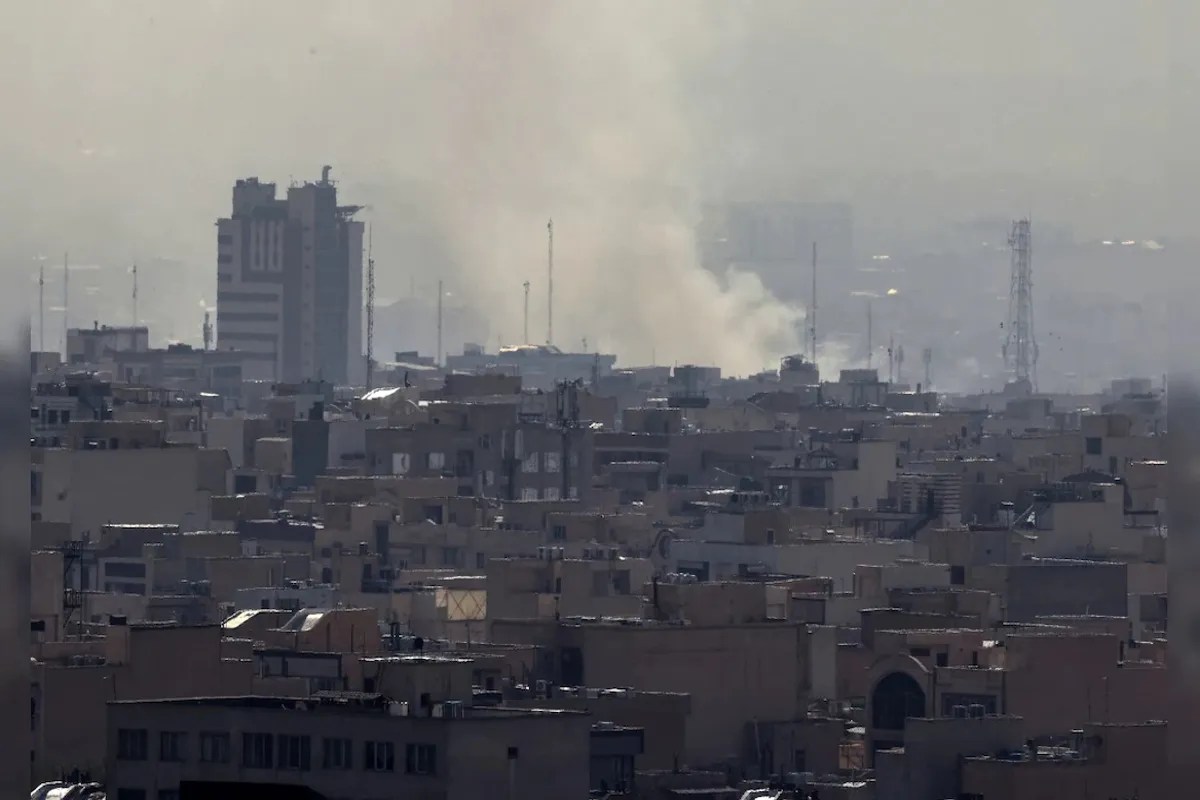
The recent surge in Iranian ballistic missile activity serves as a kinetic manifestation of a calculated geopolitical doctrine designed to exploit the gap between conventional military superiority and regional power projection. While traditional reporting focuses on the immediate destruction, a structural analysis reveals these strikes are not impulsive reactions. They are calibrated signals within a broader framework of strategic deterrence and domestic signaling.
The Architecture of Proportionality
Iran operates within a constraint-heavy environment. Lacking a modern air force, the Islamic Revolutionary Guard Corps (IRGC) has invested decades into a "Missile-First" strategy. This creates a specific cost-benefit calculus when responding to perceived threats from U.S. or Israeli interests. The logic of these strikes rests on three distinct pillars of escalation management.
Pillar One: Credible Threat Demonstration
To maintain deterrence, a state must prove it possesses both the capability and the will to strike. By targeting specific sites—ranging from purported intelligence hubs to military outposts—Iran seeks to validate the circular error probable (CEP) of its newer munitions. A strike that lands within 10 to 50 meters of a target is more than a tactical hit; it is a data point sent to satellite surveillance systems globally, signaling that high-value assets are no longer shielded by distance.
Pillar Two: Domestic Legitimacy and Logic
The IRGC must satisfy a hardline internal constituency that demands visible retribution for strikes against its commanders or nuclear infrastructure. The choice of target often correlates with the perceived "prestige" of the grievance. If an Iranian general is targeted, the response must involve a platform capable of reaching across borders to demonstrate that Iranian sovereignty extends beyond its geographic lines.
Pillar Three: Threshold Management
The primary strategic goal is to inflict enough damage to satisfy honor and signal capability without crossing the "red line" that would trigger a full-scale, regime-threatening invasion by a superior conventional power. This requires a delicate calibration of payload and target selection.
Technical Variables in the IRGC Arsenal
The effectiveness of these strikes is governed by the technical specifications of the delivery systems used. Understanding the mechanics of the flight path explains why certain targets are chosen over others.
- Solid vs. Liquid Propellants: Solid-fuel missiles, like the Fateh-110 family, offer rapid launch capabilities. These are prioritized for strikes requiring high responsiveness, as they do not need to be fueled on the pad, reducing the window for preemptive destruction by enemy aircraft.
- Terminal Guidance Systems: The transition from unguided rockets to precision-guided munitions (PGMs) has fundamentally altered the regional security equation. Modern Iranian variants utilize GPS/INS guidance with terminal seekers, allowing for the targeting of specific buildings rather than entire bases.
- Re-entry Vehicle Dynamics: The ability of a missile's warhead to maneuver during its terminal phase determines its success against sophisticated theater missile defense (TMD) systems. High-velocity impacts make interception mathematically difficult, even for systems with high hit-to-kill ratios.
The Economic Friction of Missile Defense
There is a profound imbalance in the economic cost of these engagements. This "Attrition Ratio" favors the aggressor in a prolonged conflict.
The cost of a single Iranian short-range ballistic missile (SRBM) is estimated to be a fraction of the cost of the interceptors used to down it. For every $100,000 to $500,000 missile launched, the defending party may spend $2 million to $5 million on interceptor missiles (such as the Patriot PAC-3 or Arrow-3). This creates a structural bottleneck for the defender. Over time, a high-volume "saturation attack" can deplete an interceptor stockpile faster than industrial bases can replenish them, regardless of the defender's GDP.
The Interceptor Depletion Logic
When Iran launches a "salvo," they are testing the defender's battery management. If a battery has 16 ready-to-fire interceptors and Iran launches 20 missiles, the laws of physics dictate that four will strike. This simple math forces the defender to prioritize targets, essentially deciding which assets are "expendable."
Regional Geopolitical Spillover and Proxy Integration
Iranian missile strikes do not occur in a vacuum. They are integrated into a multi-theater strategy involving "The Axis of Resistance." This network functions as a force multiplier, allowing Iran to distribute the risk of retaliation.
- Intelligence Sharing: Proxies provide ground-level Battle Damage Assessment (BDA). This feedback loop allows the IRGC to refine its targeting parameters for subsequent waves.
- Decoy Strategy: In many scenarios, less sophisticated proxy rockets are fired simultaneously with Iranian high-precision missiles. The cheaper rockets serve as "chaff," forcing defense systems to engage low-value threats while the high-value Iranian PGMs navigate through the gaps.
- Geographic Encirclement: By positioning launch capabilities in Lebanon, Syria, Iraq, and Yemen, Iran forces its adversaries to maintain 360-degree situational awareness, which is significantly more resource-intensive than defending a single border.
The Intelligence Gap and Attribution Complexity
A critical component of these operations is the "gray zone" of attribution. While Iran often claims responsibility for high-profile strikes to project strength, smaller-scale or more sensitive operations are often left shrouded in ambiguity. This creates a "decision paralysis" for the targeted nation.
If a missile originates from a third-party country using Iranian technology, does the victim strike the launch site or the source of production? This ambiguity is a feature, not a bug, of the Iranian strategy. It stretches the legal and political definitions of "act of war," making a unified international response difficult to coordinate.
The Risk of Miscalculation and Kinetic Overspill
The greatest threat to regional stability is not a planned war, but a technical or intelligence failure during a "calibrated" strike.
The Error Function of Escalation:
$E = f(I, T, P)$
Where:
- $E$ is the unintended escalation.
- $I$ is the Intelligence error (striking a target with higher-than-expected casualties).
- $T$ is Technical failure (a missile veering off course into a civilian center).
- $P$ is Political misreading (misjudging the adversary's threshold for total war).
This equation highlights why these strikes are inherently volatile. Even a "successful" hit from Iran's perspective might be viewed as an existential threat by the recipient, triggering a disproportionate response that collapses the carefully managed escalation ladder.
Constraints on Iranian Projection
Despite the technical advancements, the IRGC faces significant limitations that prevent them from achieving total dominance.
The first constraint is the Detection Window. Space-based infrared sensors can detect the heat signature of a missile launch almost instantly. This gives defenders several minutes to warn personnel and prep defenses. As long as the "early warning" advantage remains with the U.S. and its allies, the element of surprise is largely neutralized.
The second constraint is Supply Chain Vulnerability. Precision components, specifically high-end microelectronics and specialized resins for carbon-fiber casings, are often subject to international sanctions. While smuggling networks are robust, they create a "production ceiling." Iran cannot produce these high-end munitions at the same scale that a major industrial power could, making every missile fired a significant loss of inventory.
Tactical Implications for the Near-Term
Military planners must shift focus from "absolute defense" to "resilient infrastructure." Since stopping every missile is statistically improbable in a high-volume scenario, the emphasis is moving toward:
- Redundancy: Creating distributed command and control nodes so that no single missile can decapitate a response.
- Hardening: Increasing the structural integrity of high-value targets to withstand the impact of 500kg warheads.
- Rapid Recovery: Developing the engineering capability to repair runways and communication lines within hours of a strike.
The shift in Middle Eastern warfare is moving away from the era of "Air Superiority" and into the era of "Missile Persistence." Iran has demonstrated that it no longer needs a pilot in the sky to exert its will across the region. The strategic play for opposing forces is no longer just about building a better shield, but about re-calculating the entire cost of the game.
The most effective counter-strategy involves targeting the manufacturing and logistics nodes rather than the individual missiles. Disrupting the "kill chain" at the point of assembly is the only way to break the math of interceptor depletion. This requires a shift from defensive posture to proactive technical disruption, focusing on the specialized machinery and engineers required to maintain a precision-guided arsenal.