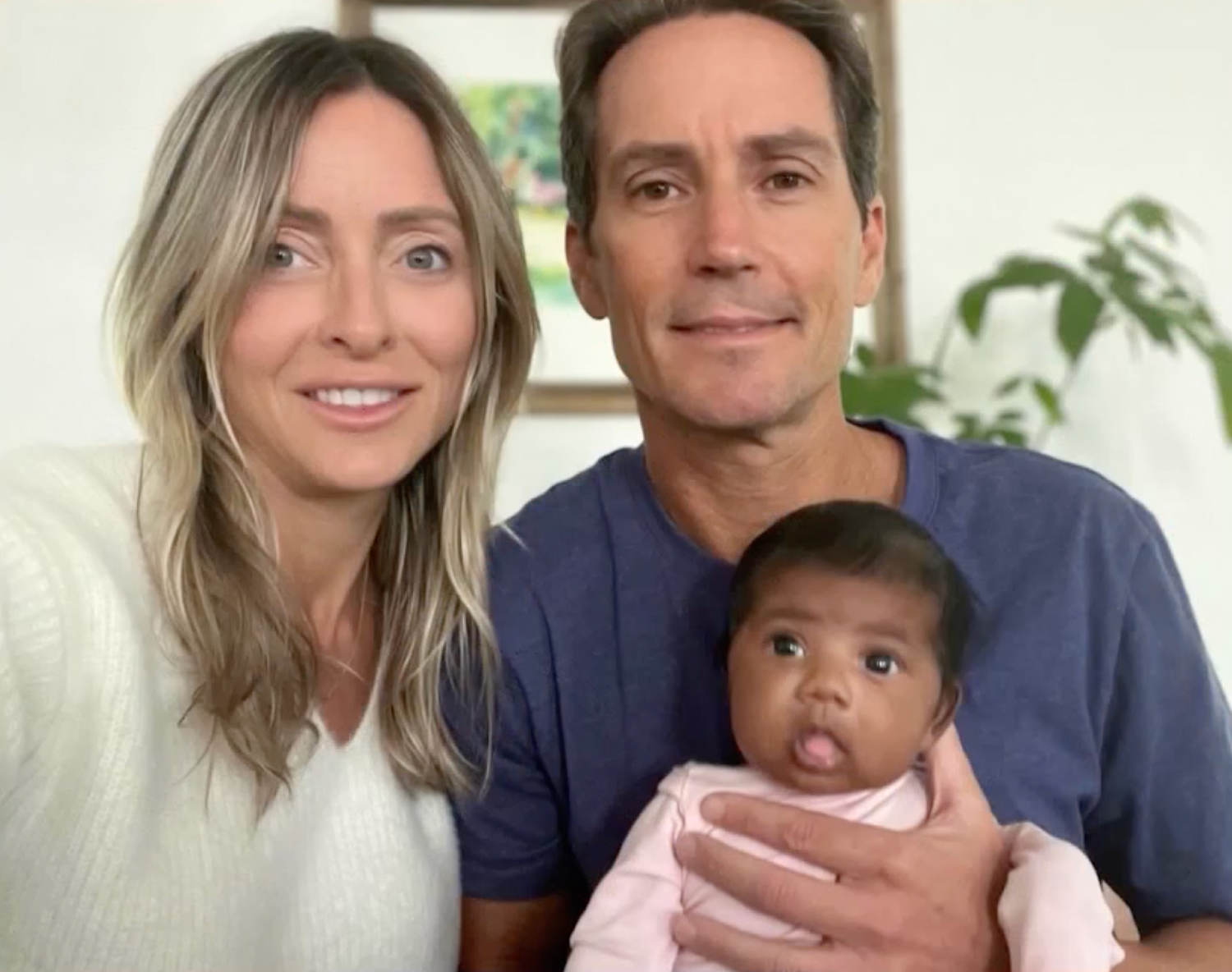
The delivery room in December is supposed to be the end of a long, calculated journey. For Tiffany Score and Steven Mills, that journey had a meticulous itinerary, mapped out in the sterile, high-stakes world of reproductive medicine. Three viable embryos. Their own genetic material. A long-awaited pregnancy through the Fertility Center of Orlando.
When their daughter, Shea, drew her first breath, the world shifted in a way no medical journal could predict.
Tiffany looked at the newborn. Then she looked at Steven. Both parents are white. The beautiful, healthy baby girl resting on Tiffany’s chest possessed deep South Asian features. In that quiet, terrifying moment of realization, the clinical precision of the past nine months dissolved into an impossible psychological fog.
A DNA test confirmed the unthinkable. Shea was not genetically theirs. Not even half. The clinic had implanted the wrong embryo.
We live in an era where science can engineer the beginning of human life, but our legal systems and our hearts are still operating on analog software. When the machinery of modern medicine breaks down so fundamentally, it forces a question that strikes at the very marrow of humanity: What actually makes a parent?
Consider what happens next in a situation that feels entirely science fiction but is devastatingly real.
You do not stop loving a child you carried for nine months just because a laboratory technician mislabeled a vial. Tiffany and Steven were completely obsessed with the smiles, the giggles, the dreams of future ponytails and beach trips. The emotional bond didn't evaporate; it grew stronger every hour. Yet, they faced a haunting, dual-front moral crisis. Somewhere out there, a South Asian couple was completely unaware that their biological daughter had been born to a stranger. And somewhere else—perhaps in a liquid nitrogen tank, or perhaps inside another woman's body—Tiffany and Steven's own embryos were missing.
The legal battle that followed wasn't driven by a desire for a payday. It was driven by a desperate need for truth.
The couple filed a lawsuit, demanding answers. They forced the clinic to audit its records, eventually narrowing the search down to a single egg-retrieval group from March 2025. They found her. Patient 004.
Imagine receiving that phone call. You went to a clinic, perhaps you failed to conceive, or perhaps you are still waiting, only to find out your biological child exists, is six months old, and is living with another family. The biological parents were reported to be utterly devastated, caught in a sudden vortex of grief and shock.
Florida law does not have a roadmap for this. In the eyes of the state, embryos are not legal persons, and precedents for accidental switch-births in the IVF era are incredibly sparse. The legal system wants to treat this like a contract dispute or a property error. But you cannot repossess a soul. You cannot issue a product recall on a baby’s smile.
This week, a quiet resolution emerged from the chaos of the Orange County Circuit Court. The two families, bound by an accidental knot of shared tragedy, bypassed the rigid cruelty of a standard courtroom battle. They reached a private, mutually devised custody agreement.
Tiffany and Steven will keep permanent legal custody of Shea. They will raise the girl they brought into the world. The genetic parents, choosing to protect their privacy, agreed. It is a profound act of grace born from an unimaginable nightmare.
But the real problem lies elsewhere, buried in the dark corners of an industry that remains shockingly under-regulated.
The Fertility Center of Orlando has since closed its doors permanently, leaving a wake of lawsuits and shattered trust. While Shea’s immediate future is secure, the mystery of Tiffany and Steven's own biological material remains unsolved. Their remaining embryos have been moved to a new facility, awaiting rigorous DNA testing to ensure no further trickery occurred. They still do not know if a child of their own blood is being raised by an unsuspecting family somewhere else in the country. They fear they may never know.
Science gave us the miracle of assisted reproduction, but it left us to navigate the emotional wreckage when human hands stumble. We are left looking at a crib where love and biology have fought a silent war—and where, against all odds, love managed to claim the territory.