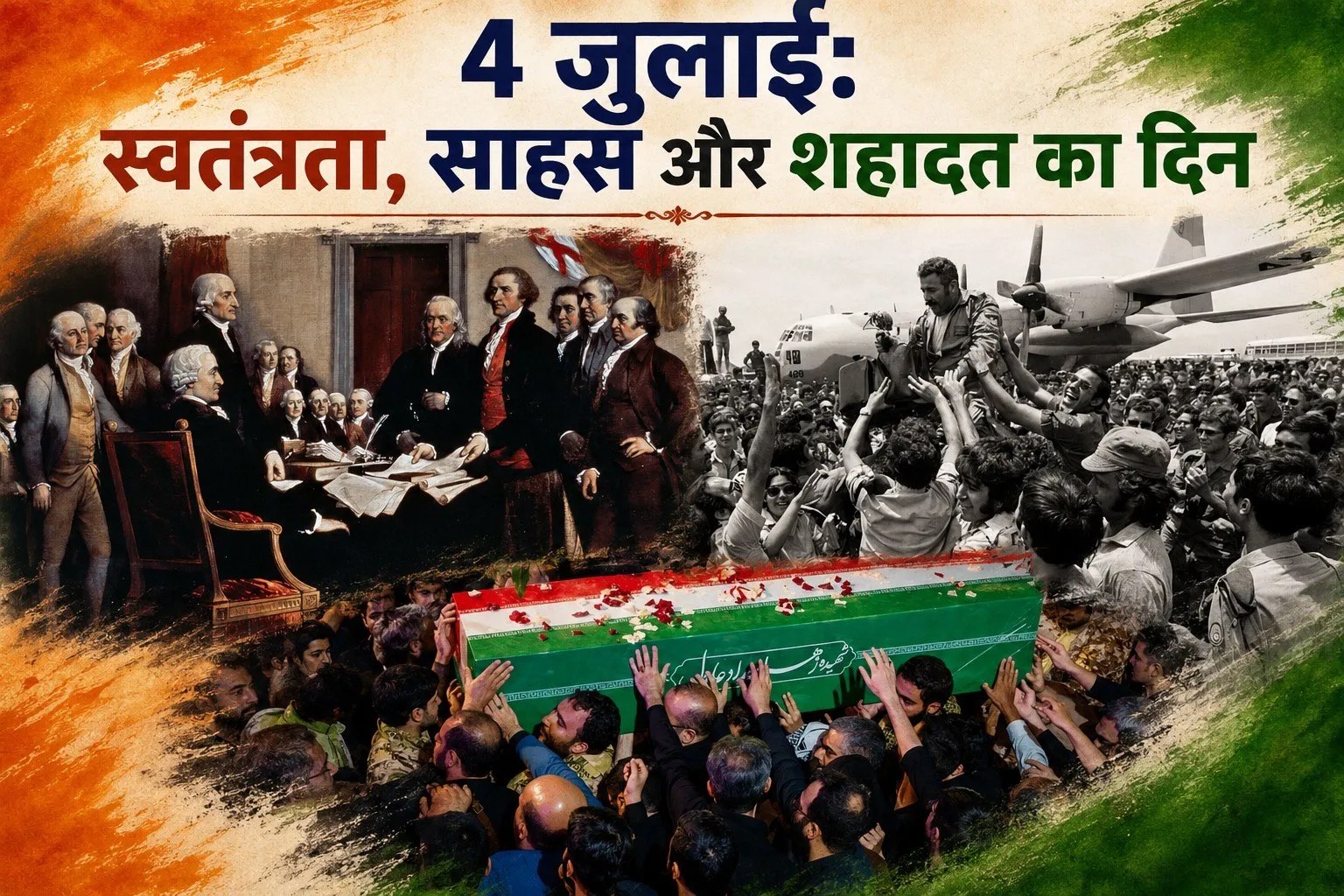
History has a brutal way of repeating its patterns through dates that seem entirely accidental. Every year on the fourth of July, the American public celebrates the birth of a nation built on anti-imperial rebellion. Yet, viewed through a wider lens, this specific date acts as an anchor for two other geopolitical milestones that define our modern world order. Fifty years ago, Israel executed a daring military raid that permanently changed the rules of international counter-terrorism. Today, Iran finds itself at the center of a volatile Middle Eastern matrix, facing the exact same structural pressures that forced America and Israel to reshape global security mechanics decades earlier. What looks like a bizarre historical coincidence is actually a lesson in how revolutionary states behave when pushed to the edge.
Geopolitical shifts do not happen in a vacuum. The alignment of these milestones across 250 years reveals a deeper truth about power, sovereignty, and the inevitable friction between established empires and rising revisionist states.
The Birth of a Revolutionary Superpower and the Mechanics of Liberty
In the summer of 1776, thirteen disparate colonies took a gamble that defied the established rules of global governance. The declaration signed in Philadelphia was more than a localized tax revolt. It was an ideological flashpoint that challenged the supreme maritime empire of the era.
The early American state survived because it understood asymmetric warfare. The Continental Army could not match the British Navy in an open theater, so it relied on extended supply lines, local intelligence, and ideological fervor to wear down a superior enemy. This foundational blueprint matters because it established a precedent. When a political entity believes its existential survival is at stake, it discards traditional diplomatic norms.
The legacy of 1776 created a superpower that eventually became the custodian of the international order. However, the irony of history is that the strategies used by the weak to defeat the strong eventually get turned against the original victors. The very methods used by early America—guerilla tactics, reliance on ideological alliances, and proxy engagement—are the exact tools now deployed by modern adversaries seeking to dismantle the current global hierarchy.
The Entebbe Paradigm and the Redefinition of Sovereign Might
Exactly two centuries after the American experiment began, another nation faced an existential crisis on the identical calendar date. On July 4, 1976, Israeli commandos landed at Entebbe Airport in Uganda, thousands of miles from their home borders, to rescue over a hundred hostages held by hijackers.
Operation Thunderbolt was a watershed moment for modern military intelligence. It proved that state sovereignty is fluid when citizens are placed in jeopardy abroad. The success of the raid did not just salvage Israeli pride; it established a doctrine of preemption that western nations have relied upon ever since.
The mechanics of the Entebbe operation required an unprecedented alignment of intelligence gathering, tactical deception, and political willpower. The decision-makers in Tel Aviv knew that failure meant total humiliation and the potential collapse of their defense posture. By executing a flawless tactical strike deep within hostile territory, Israel sent a clear message to the international community that geographic distance would no longer guarantee safety for non-state actors or the regimes that sponsored them.
This event reshaped the security architecture of the Middle East. It solidified the strategic alliance between Washington and Tel Aviv, binding their defense doctrines together under a shared philosophy of decisive intervention. The operational success at Entebbe created a template for modern counter-terrorism, but it also sowed the seeds of a deep-seated resentment across the region, setting up a direct confrontation with a new revolutionary force that was about to emerge.
The Iranian Crucible and the Shadow War of the Modern Era
As the Western world looked back at the legacies of 1776 and 1976, the geopolitical chessboard shifted toward Tehran. The modern Iranian state operates under a revolutionary mindset that mirrors the intensity of early America, yet its strategic objectives are diametrically opposed to Western hegemony.
Tehran has spent decades building a sophisticated proxy network across the Levant and the Arabian Peninsula. This network operates on the same principles of asymmetric defiance that allowed smaller forces to defeat empires in the past. By utilizing unconventional warfare, drone technology, and regional alliances, Iran has managed to project power far beyond its borders despite crushing economic sanctions and diplomatic isolation.
The current standoff in the region is not merely a localized conflict over territory or maritime trade routes. It is a fundamental clash of strategic doctrines. On one side stands the established order, built on the principles of maritime freedom and state alliances traceably linked back to post-World War II agreements. On the other side sits a revolutionary regime that views the status quo as an existential threat to its survival.
The tension has reached a critical boiling point. Tactical strikes, cyber warfare, and sabotage have replaced traditional diplomacy. Every move made by Tehran is calculated to test the limits of Western resolve without triggering a full-scale conventional war. This delicate balance of terror requires an immense amount of strategic discipline from all actors involved, as a single miscalculation could ignite a conflagration that alters global energy markets and security dynamics for a generation.
The Dangerous Illusion of Historical Coincidence
It is easy for casual observers to dismiss the connection between 1776, 1976, and the current crisis as mere trivia. That is a mistake. The alignment of these dates highlights a cyclical rhythm in global politics where the revolutionaries of one era become the guardians of the next, only to be challenged by a new wave of actors using the exact same playbook of defiance.
The United States, Israel, and Iran are locked in an intricate dance where each player's actions are dictated by their historical trauma and foundational myths. Washington fights to preserve a global system it built. Tel Aviv operates under the constant pressure of existential defense. Tehran seeks to overturn an international hierarchy it perceives as inherently hostile.
Understanding this dynamic requires looking past the daily headlines and focusing on the structural drivers of state behavior. Power is never static. The mechanisms used to secure independence or execute daring rescues are the very same instruments that regimes use today to challenge the prevailing global equilibrium. The calendar may offer strange synchronicities, but the underlying physics of empire, rebellion, and statecraft remain completely unchanged.