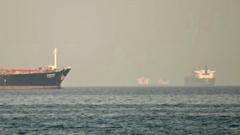
The global energy market just got a violent wake-up call. Two massive oil tankers were hit by explosions near the Strait of Hormuz, the world’s most sensitive maritime chokepoint. If you think this is just a local skirmish in the Middle East, you’re wrong. It’s a direct hit on the global economy.
When ships burn in these waters, the math is simple. Supply lines tighten. Insurance premiums for every vessel in the region skyrocket. Traders panic. Within minutes of the news breaking, crude oil prices jumped nearly 4%. That’s not a rounding error. It’s the sound of every logistics chain on the planet getting more expensive.
The Strait of Hormuz isn't just a waterway. It’s a jugular vein. About 20% of the world’s total oil consumption passes through this narrow stretch between Oman and Iran. We’re talking about roughly 21 million barrels of crude, condensate, and petroleum products every single day. If that flow stops, the global economy doesn't just slow down. It breaks.
The Reality of the Attacks and Who Suffers First
The two vessels involved, the Front Altair and the Kokuka Courageous, weren't just carrying fuel. They were carrying a message. One ship was loaded with naphtha, a flammable hydrocarbon, while the other carried methanol. Both were targeted in a way that suggests a deliberate attempt to cause maximum disruption without necessarily starting a full-scale war.
Initial reports from the U.S. Fifth Fleet, based in Bahrain, confirmed they received distress calls early in the morning. The crews had to abandon ship. Imagine being a merchant sailor and suddenly facing a hull breach and fire in one of the most geopolitically charged zones on earth. It’s terrifying.
The immediate fallout hits the shipping industry. No one wants to sail into a shooting gallery. When a tanker is attacked, the "War Risk" insurance premiums don't just go up—they multiply. Ship owners then pass those costs directly to the companies buying the oil. Eventually, you see it at the pump. You see it in the price of your plane ticket. You see it in the cost of shipping a container from Shanghai to New York.
Why This Chokepoint is So Hard to Replace
People often ask why we don't just pipe the oil around the problem. It’s a fair question, but the scale makes it impossible. While Saudi Arabia and the United Arab Emirates have pipelines that can bypass the Strait, their capacity is limited.
Most of the oil from Iraq, Kuwait, and Qatar has nowhere else to go. It has to pass through a gap that's only 21 miles wide at its narrowest point. Even worse, the actual shipping lanes—the deep-water paths these giants must take—are only two miles wide in each direction. It’s a bottleneck designed for disaster.
If the Strait were ever actually closed, there isn't enough spare pipeline capacity in the entire world to make up the difference. We’d be looking at a global shortage of nearly 15 million barrels per day. The resulting price spike wouldn't be 4%. It would be catastrophic.
The Geopolitical Chess Board
You can't talk about these attacks without talking about the tension between the U.S. and Iran. The U.S. has been tightening the screws with "maximum pressure" sanctions, aiming to bring Iranian oil exports to zero. Iran, in response, has signaled that if they can't sell their oil, nobody else in the region will be able to either.
It's a high-stakes game of chicken. The U.S. blames Iran, pointing to "limpet mines" used in previous attacks. Iran denies involvement, often suggesting these are "false flag" operations meant to justify further aggression. Honestly, the "who did it" almost matters less than the "what happens now." The mere threat of instability is enough to keep the markets on edge.
What Happens to Your Wallet Next
Energy analysts usually look at "risk premiums." This is the extra amount added to the price of a barrel of oil because of the possibility of supply disruption. Before these attacks, that premium was relatively low because global supply was decent and demand was lukewarm.
That's over.
- Gasoline Prices: Expect an immediate, albeit small, creep upward. If the attacks continue or escalate, that small creep becomes a jump.
- Global Inflation: Everything requires energy to produce and move. If oil stays high, the cost of food and consumer goods follows.
- Stock Market Volatility: Energy stocks might rally, but the broader market hates uncertainty. Airlines and shipping companies will take a beating.
The International Energy Agency (IEA) and OPEC are both watching this with gritted teeth. We’ve seen this movie before. In the 1980s, during the "Tanker War" phase of the Iran-Iraq conflict, over 500 vessels were attacked. Back then, it took a massive international naval effort to keep the lanes open. We’re moving toward that reality again.
How to Protect Yourself from Energy Spikes
You can't stop a torpedo or a mine in the Middle East, but you can hedge against the chaos it causes. If you're running a business that relies on logistics, now's the time to look at fuel surcharges or locking in contracts.
For the average person, it's about awareness. Don't wait for the price at the local station to hit a five-year high before you start thinking about fuel efficiency or your travel budget. Geopolitical shifts happen fast. One day it's a headline about a ship you've never heard of, and the next day your commute costs 20% more.
Keep a close eye on the U.S. State Department and the International Maritime Organization (IMO) briefings. Their tone will tell you more than any politician's tweet. If they start talking about "escorted convoys," you know the situation is grave.
The Strait of Hormuz is the world's most dangerous commute. Right now, it's on fire. Watch the "Brent Crude" ticker on any financial news site. If it stays above $70 or $80 a barrel, the pressure on the global economy will become unbearable.
Check your local gas price tracking apps tonight. Use them to find the lowest price in your area and fill up before the weekend adjustment hits. If you're an investor, look at energy ETFs (Exchange Traded Funds) as a potential hedge, but be careful—volatility works both ways. The situation is fluid, and in the Strait of Hormuz, things can go from tense to explosive in the blink of an eye.