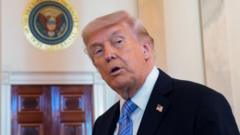
The maritime corridor that dictates the global price of a gallon of gasoline has just become the world’s most expensive waiting room. On Tuesday, President Donald Trump announced a temporary suspension of Project Freedom, the high-stakes military operation designed to escort neutral commercial vessels through the blockaded Strait of Hormuz. The pause comes at a moment when the global economy is already white-knuckled, watching 1,550 ships and 22,500 mariners sit idle in the Arabian Gulf. While the White House frames this as a diplomatic breathing room requested by Pakistan and other regional mediators, the reality on the water is far more volatile than a Truth Social post suggests.
The operation was supposed to be the hammer that broke Iran’s grip on the waterway. Instead, it has morphed into a delicate dance of "strategic patience" that leaves trillions of dollars in energy infrastructure and cargo at the mercy of a "Final Agreement" that has yet to be inked. For the seasoned observer of Middle Eastern geopolitics, this pause is not just a ceasefire. It is a calculated gamble on a diplomatic solution that, if it fails, could trigger a naval confrontation the likes of which we have not seen since the Tanker Wars of the 1980s. For another perspective, consider: this related article.
The Mechanical Reality of Project Freedom
To understand why this pause is so significant, one must understand the sheer scale of the operation being mothballed. Project Freedom is not a simple coast guard patrol. It is a coordinated strike-and-shield maneuver involving roughly 15,000 U.S. service members and a "red, white, and blue dome" of protection over the strait.
The Pentagon’s strategy relied on a layered defense: Further insight on the subject has been provided by NBC News.
- Aegis-equipped Destroyers: Providing a kinetic umbrella against cruise missiles and one-way drones.
- Air Superiority: Over 100 fighter jets and reconnaissance aircraft providing 24/7 surveillance to spot Iranian fast-attack boats.
- Bunker Buster Precedence: The operation followed a March 2026 campaign where 5,000-pound bunker busters were used to neutralize Iranian anti-ship missile sites.
The pause halts the momentum of these escorts just as they were proving their concept. Two U.S.-flagged vessels recently transited the strait under this protective blanket, providing a glimmer of hope to insurers and shipping conglomerates. By stopping now, the U.S. risks losing the "confidence interval" it worked so hard to build with commercial carriers. If the ships don’t move, the oil doesn't flow. If the oil doesn't flow, the economic pressure shifts from Tehran back to Washington and its allies.
Why Pakistan is the Middleman
The mention of Pakistan in the President’s announcement is no coincidence. Islamabad has been walking a tightrope between its proximity to Iran and its reliance on U.S. security guarantees. Pakistani mediators were instrumental in the April 8 ceasefire, and they are currently the primary conduit for the 14-point framework aimed at turning a shaky truce into a durable peace.
However, the "tremendous military success" cited as a reason for the pause is a double-edged sword. While the U.S. claims to have annihilated a significant portion of the Iranian navy—including 158 vessels and nearly all mine-layers—Tehran’s asymmetric capabilities remain. They don't need a formal navy to sink a tanker. They only need a few well-placed mines or a swarm of low-cost drones. The pause is effectively a test of Iran’s willingness to trade its primary leverage—the ability to choke the world's energy supply—for a lifting of the naval blockade that remains "in full force and effect."
The Insurer’s Nightmare
While the military analyzes coordinates, the business world is analyzing risk premiums. The shipping industry operates on thin margins and heavy insurance. Every day a ship sits at anchor in the Arabian Gulf, it burns through capital. Food supplies for crews are dwindling. Essential maintenance is being deferred.
The pause creates a vacuum of certainty. Lloyd’s of London and other major underwriters are currently looking at a "Project Freedom" that is on again, off again. This creates a "gray zone" where the cost of shipping oil through the strait might actually exceed the value of the cargo itself. If the "short period of time" promised by the administration stretches into weeks, we will see a permanent rerouting of global energy traffic, likely bypassing the Gulf entirely in favor of pipelines that are already at maximum capacity.
The Hardware at the Heart of the Conflict
The technical sophistication of this blockade is unprecedented. We aren't just talking about ships and guns. We are talking about an integrated electronic warfare environment.
| System Type | Role in Project Freedom | Status During Pause |
|---|---|---|
| MQ-4C Triton | High-altitude, long-endurance maritime surveillance | Active (Monitoring) |
| Arleigh Burke-class | Ballistic missile defense and escort | Staging (Standby) |
| P-8A Poseidon | Anti-submarine and anti-surface warfare | Active (Patrol) |
| Electronic Jamming | Neutralizing drone control signals | Restricted |
The U.S. military is currently using high-fidelity data to track every movement in the strait, but the "pause" means they cannot proactively neutralize threats unless fired upon. This "defensive crouch" is a dangerous position for a naval force. It grants the adversary the initiative to reposition assets, replant mines, or reorganize their remaining fast-attack fleets under the cover of diplomatic talks.
The Shadow of 250 Years
Domestically, the timing of this conflict is awkward. The administration is currently knee-deep in "Freedom 250" festivities, celebrating the quarter-millennial anniversary of American independence. The imagery of "Freedom Trucks" and mobile museums traveling the 48 states stands in stark contrast to the grim reality of sailors trapped in a combat zone 7,000 miles away.
There is a political necessity to resolve the Hormuz crisis before the height of the July 4th celebrations. A protracted naval war—or a spike in gas prices caused by a failed "Project Freedom"—would cast a long shadow over the national celebrations. The pause is as much about domestic optics as it is about international diplomacy.
The Fragility of the "Final Agreement"
The core premise of the pause is the "Great Progress" made toward a Final Agreement. Skeptics point to the failure of the Islamabad talks just weeks ago. Iran’s previous 14-point proposal was dismissed by the White House as "not acceptable." What has changed?
One possibility is that the naval blockade is finally starting to starve the Iranian economy of its remaining lifelines. With the U.S. controlling maritime traffic and the Strait of Hormuz effectively closed to Iranian exports, Tehran’s leverage is high in theory but low in practice. They can stop others from using the strait, but they cannot use it themselves. This creates a stalemate where the first side to blink loses.
The "short period" specified for the pause is the ultimate variable. In the world of high-stakes maritime strategy, a pause is rarely just a pause. It is a recalibration. U.S. Central Command is likely using this time to rotate crews and refit vessels that have been on high alert since the March strikes.
If the agreement isn't signed within the next 72 to 96 hours, expect Project Freedom to resume with a level of force that makes the previous campaign look like a rehearsal. The "red, white, and blue dome" isn't just a metaphor. It's a promise of total kinetic dominance that the administration is clearly itching to fulfill if the diplomats fail to deliver. The ships are waiting. The world is watching. The price of oil is holding its breath.