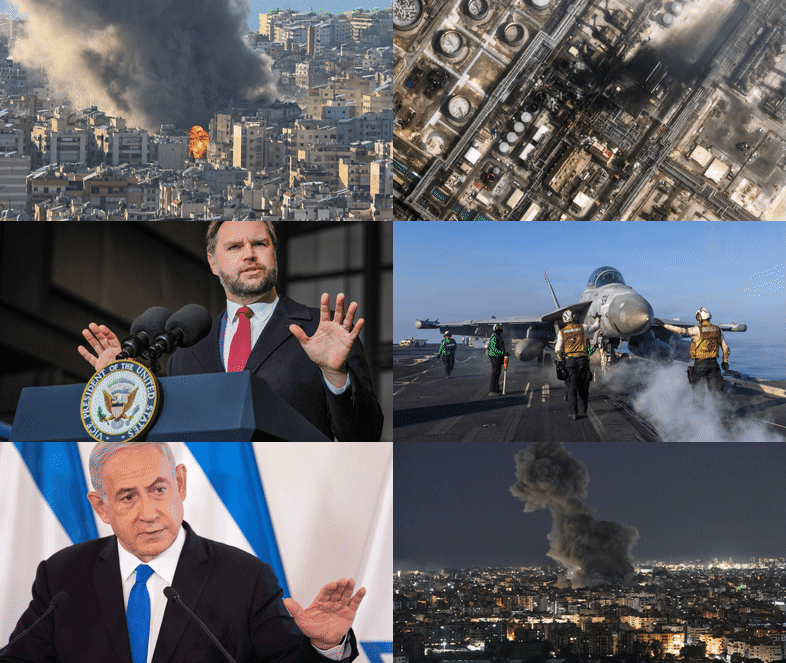
The Myth of the Global Chokepoint
Panic is a commodity. Right now, the mainstream media is selling it by the bucketload. They want you to believe that a kinetic conflict between the US and Iran, specifically one involving the closure of the Strait of Hormuz, is the trapdoor to a global economic depression. They point to the 30% of global oil tanker traffic passing through that 21-mile-wide strip of water and scream "catastrophe."
They are wrong.
The "Strait of Hormuz threat" has become the security equivalent of a security blanket—an old, ragged story we tell ourselves because we’re comfortable with the fear. I’ve watched energy traders hedge against this "black swan" for fifteen years. Most of them are burning money on a ghost. Closing the Strait is not a strategic masterstroke for Tehran; it is a suicide note that the global market has already factored into its resilience.
If Iran sinks a VLCC (Very Large Crude Carrier) today, the world doesn't stop. It pivots.
The Crude Reality of 2026
The "lazy consensus" assumes we are still living in 1979. In that era, a disruption in the Middle East meant gas lines in Maryland. Today, the energy map is unrecognizable.
- The American Shield: The US is no longer a desperate supplicant at the altar of Gulf oil. As the world’s leading producer, American shale acts as a massive, automated shock absorber. Every time the "war drums" beat, the rig count in the Permian Basin has a reason to climb.
- Spare Capacity is a Weapon: Saudi Arabia and the UAE haven't been sitting idle. The East-West Pipeline (Petroline) in Saudi Arabia can move five million barrels a day to the Red Sea, bypassing Hormuz entirely. The UAE’s Habshan-Fujairah pipeline can shunt another 1.5 million barrels directly to the Gulf of Oman.
- The China Factor: Iran’s biggest customer is China. If Tehran shuts the door, they aren't just starving the West—they are cutting the throat of their only remaining superpower lifeline. Beijing doesn't do "revolutionary solidarity" when it affects their industrial output.
The idea that Iran can "hold the world hostage" ignores the fact that the hostage-taker is tied to the same radiator as the victim.
Why a Price Spike is a Correction, Not a Crisis
Mainstream outlets report on "skyrocketing" oil prices as if they are an unmitigated evil. This is a narrow, consumer-centric delusion. From a macro-industrial perspective, the oil market has been starved of CAPEX (Capital Expenditure) for years due to aggressive ESG pivoting and "green" mandates.
We need higher prices to signal the next phase of extraction technology.
A conflict-driven spike to $120 or $150 a barrel isn't the end of the world. It is a violent, necessary market signal that forces efficiency and accelerates the transition to nuclear and high-density renewables. The "worldwide pressure" mentioned in the headlines is actually the friction required to move the gears of a stalled global energy policy.
The Math of War vs. The Math of Markets
Let's look at the actual mechanics. Shipping insurance (War Risk Premiums) will jump. Freight rates will double. But the physical molecules of oil don't vanish. They reroute.
Imagine a scenario where the Strait is physically blocked by sea mines. The US Fifth Fleet, contrary to the "quagmire" narrative, is built specifically for mine countermeasures. The delay is measured in weeks, not years. In the interim, global Strategic Petroleum Reserves (SPR) are at levels designed specifically for this exact, predictable contingency.
The "death toll" is a human tragedy, yes. But to equate tactical military exchanges with a global economic collapse is a failure of logic. It conflates kinetic violence with systemic failure. They are not the same.
The Iran Miscalculation
The media portrays Iran as a rational actor playing a 4D chess game of regional dominance. This gives them too much credit. Tehran’s threats are a symptom of internal fragility, not external strength.
When Trump or any US administration warns of further strikes, they aren't poking a sleeping giant. They are poking a regime that is terrified of its own population and an economy that is already hyper-inflated into oblivion. Iran’s "escalation" is a desperate attempt to gain leverage for a seat at a table that no longer exists.
The "further strikes" being discussed aren't the start of World War III. They are a continuation of a decades-long containment strategy that has already succeeded. The "status quo" isn't being disrupted; it's being enforced.
Stop Asking if Oil Will Hit $200
The question itself is flawed. You should be asking who profits when the fear-mongering reaches its peak.
- Defense Contractors? Obviously.
- Short-sellers? Naturally.
- The "Clean Tech" Lobby? Absolutely.
The reality is that a conflict in the Gulf is a localized military event with a temporary inflationary shadow. It is not a systemic reset.
I’ve seen this movie before. In 2019, when the Abqaiq–Khurais attack knocked out 5% of global oil production in a single morning, the "experts" predicted a multi-year recession. Oil prices spiked, then retraced within weeks. The market has grown a thick skin.
The Brutal Truth About "Global Pressures"
The pressure isn't coming from Iran. The pressure is coming from the realization that the West’s energy policy is built on a foundation of sand. We rely on "just-in-time" delivery for a commodity that requires "just-in-case" security.
If you want to survive the coming volatility, stop reading live updates about troop movements. Start looking at the inventory builds in Cushing, Oklahoma. Start looking at the dry-bulk shipping indices.
The "conflict" is a distraction. The real story is the total decoupling of energy prices from Middle Eastern geography. We are moving toward a world where a bomb in the Gulf matters less than a software update in a Texas fracking field.
The Strait of Hormuz is a bottleneck only if you refuse to walk around the bottle.
Build your portfolio for a world where the Middle East is a footnote, not the lead paragraph. The era of oil-based geopolitics is dying, and these "live updates" are just the death rattle.
Stop flinching every time a drone flies over a tanker. The tankers will keep moving. The oil will keep flowing. The only thing that will truly "rise" is the bank balance of those who didn't swallow the panic.
Go long on reality. Short the drama.
Would you like me to analyze the specific impact of the UAE's bypass pipelines on the 2026 Brent Crude futures?


