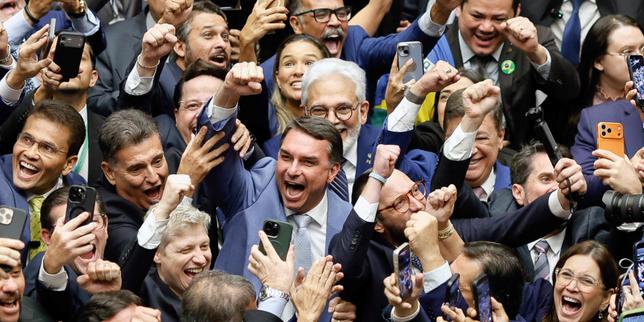
The humidity in Brasília doesn’t just sit on your skin; it weighs on your lungs, thick with the scent of red earth and the metallic tang of impending rain. Inside the Palácio do Planalto, the air conditioning hums a frantic, mechanical prayer against the swelter. Luiz Inácio Lula da Silva, a man who has spent more time in the trenches of power than perhaps any living leader, knows that the weather outside is the least of his concerns. The real storm is brewing in the Praça dos Três Poderes, and it isn't carrying rain. It’s carrying the cold, hard reality of a shifting tide.
Six months. For a more detailed analysis into similar topics, we suggest: this related article.
In the lifespan of a presidency, half a year is a heartbeat. In the context of the upcoming elections, it is an eternity. For Lula, the clock isn’t ticking; it’s pounding. Two major political blows have recently struck his administration, and they weren’t delivered by the ghost of his predecessor or a sudden economic collapse. They were delivered by the very institution he once thought he could charm into submission: the Brazilian Congress.
The Architect of Walls
Consider the plight of a hypothetical shopkeeper in São Paulo named Roberto. Roberto doesn't care about the intricacies of legislative vetoes. He cares about the price of beans and whether the streetlights stay on. To Roberto, Lula represents a promise of stability—a return to the "golden years" of the early 2000s. But the stability Roberto craves is being dismantled brick by brick in the halls of power. For broader information on this issue, in-depth coverage can also be found on Al Jazeera.
The first blow landed on the issue of the "Marco Temporal." It sounds like a dry, bureaucratic term, the kind of phrase that makes eyes glaze over at a dinner party. In reality, it is a battle for the soul of the Amazon and the ancestral rights of the people who have lived there since before the Portuguese ever saw a horizon. The Supreme Court had previously ruled in favor of Indigenous rights, rejecting a cut-off date for land claims. Lula, positioning himself as the global guardian of the rainforest, stood firmly with them.
Then, the Legislature pushed back. Hard.
By overturning Lula’s veto on the Marco Temporal, Congress didn't just pass a law; they sent a message. They told the President that his international prestige as an environmental savior stops at the border of their political interests. For the Indigenous leader watching from a village in Pará, this isn't a policy debate. It’s a threat to the ground beneath their feet. For Lula, it’s a public stripping of his authority. The "Architect of Walls" in Congress—the powerful agribusiness lobby—just built a fortification he cannot climb.
The Price of a Veto
The second blow was more intimate, more visceral. It concerned the budget. Specifically, the "emendas parlamentares"—the legislative amendments that allow lawmakers to funnel money into their own districts. To the uninitiated, this looks like pork-barrel politics. To a Congressman, it is the oxygen they breathe.
Lula tried to choke that supply. He attempted to claw back control over how billions of reais are spent, hoping to direct them toward national social programs rather than local vanity projects. He failed. Congress overrode his veto, reclaiming their right to the purse strings.
This isn't just about money. It’s about the "Centrão," that amorphous, ideologically fluid bloc of parties that holds the balance of power in Brazil. They are the kingmakers who do not care for crowns, only for the treasury. When they broke with Lula on the budget, they weren't just protecting their projects. They were demonstrating that the President is a guest in his own house.
The Human Toll of Deadlock
We often talk about "reversals" and "setbacks" as if they are scores in a game. They aren't. They are the friction that slows down a country’s pulse. When the executive and legislative branches go to war, the casualties are the policies that never get implemented and the reforms that die in committee.
Imagine a classroom in the Northeast. The roof leaks. The books are a decade old. The funding for that repair was tied up in a legislative amendment that just became a bargaining chip in a feud over a veto. The teacher doesn't know about the Marco Temporal or the intricacies of the budget override. She only knows that the money didn't arrive. This is the invisible stake of the political drama in Brasília. Every time Lula loses a battle, the friction increases. The gears of government grind a little louder, a little slower, and eventually, they begin to smoke.
Lula is a man built on the power of the word. He is a communicator, a negotiator, a weaver of alliances. But words lose their potency when they are ignored. The charm that once convinced world leaders to embrace Brazil as a rising superpower is currently hitting a wall of pragmatism and resentment back home.
The Shadow of the Sunday
The upcoming municipal elections in October are the "Sunday" toward which this entire storm is moving. While they are local contests, they serve as the ultimate litmus test for Lula’s survival. If his candidates fail, he enters the final two years of his term as a "lame duck" before the water has even reached his knees.
The opposition knows this. They aren't just voting against his bills; they are campaigning against his relevance. Every defeat in the capital is a video clip for a rival’s social media feed in a small town in Minas Gerais. Every veto override is a headline that whispers: He is losing his grip.
Lula’s struggle is a mirror of the global political climate—a charismatic leader attempting to bridge a chasm in a country that is fundamentally divided. Brazil is not one nation right now; it is a collection of interests, some of which are diametrically opposed to the President’s vision of a social-democratic utopia. The agribusiness giants see him as a threat to growth. The conservative base sees him as a relic of a corrupt past. The Centrão sees him as a source of revenue that needs to be managed.
The Weight of the Beard
There is a weariness that comes with this level of combat. You can see it in the way the President carries himself. The iconic beard is whiter now. The voice, while still gravelly and commanding, sometimes falters when the questions get too sharp. He is fighting a war on two fronts: one against his political enemies, and one against the ticking clock of his own legacy.
He wants to be remembered as the man who saved the Amazon and fed the poor. But to do that, he needs a Congress that will at least let him speak. Instead, he has a Congress that is learning how to rule without him. They have realized that the presidency is not the only seat of power in the land of the Southern Cross.
As the sun sets over the Planalto, casting long, distorted shadows across the pavement, the shopkeeper in São Paulo closes his gate. He isn't thinking about the vetoes. He isn't thinking about the Marco Temporal. He is thinking about tomorrow.
Lula is also thinking about tomorrow. But for the first time in a long time, the man who mastered the art of the possible is finding himself trapped in a reality defined by the impossible. The storm is no longer "impending." It is here. The rain has started to fall, and the umbrella of the presidency is leaking.
The question is no longer whether Lula can win the next battle. The question is whether he can survive the peace that follows his defeats. The six months leading to the election won't just decide the fate of mayors and councillors; they will decide if the man who rose from poverty to lead a nation has finally met a mountain he cannot move.
The red earth turns to mud. The metal tang of the rain stays in the mouth. In the silence of the palace, the hum of the air conditioner sounds a lot like a countdown.