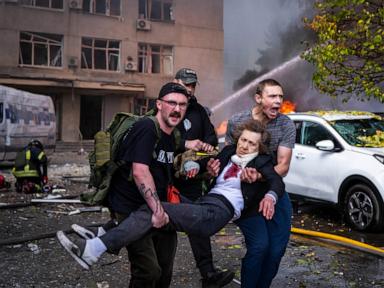
Every single time the air raid sirens wail across the Dnipro, a predictable ritual unfolds in global newsrooms. Editors scramble for the most harrowing photo available. They want the billowing black smoke. They want the shattered glass of a residential courtyard. They want the tear-streaked face of a civilian standing amid debris. It is designed to shock, to horrify, and to demand immediate emotional compliance from the reader.
The lazy consensus in modern conflict reporting is that visceral imagery equals deep understanding. The prevailing belief is that if you flood social media feeds and front pages with enough high-resolution misery, the world will grasp the gravity of what is happening on the ground in Kyiv.
This is a dangerous delusion.
The relentless focus on trauma porn and apocalyptic aesthetics does not educate the public; it flattens a complex, grinding war of attrition into a passive spectator sport. It turns human suffering into a digital metric, reducing strategic realities to a grim aesthetic. While photojournalists hunt for the most dramatic explosion plume, they completely miss the actual mechanics of how a major European metropolis survives under continuous aerial bombardment.
We need to stop consuming war like a real-time thriller.
The Trap of Performative Outrage
Let us look at the structural failure of standard crisis photography. When news outlets publish a gallery of fires and injuries, they present a snapshot of destruction divorced from context. You see the broken concrete, but you do not see the redundant supply chains that cleared that rubble in under two hours. You see the shattered windowpane, but you miss the municipal workers who had already patched the municipal heating grid before the smoke cleared.
This framing creates a binary trap for the audience. You are either paralyzed by performative despair or numbed by overexposure. When every single strike is packaged as an existential Hollywood-style cataclysm, the human brain eventually hits a wall. Compassion fatigue sets in. People scroll past the tenth burning apartment building of the week because the media has trained them to treat foreign war zones as a recurring television series.
I have watched organizations spend millions of dollars analyzing viewer engagement metrics on conflict coverage, measuring heart rates and click-through rates on catastrophe imagery. It is a grotesque ecosystem. The incentives are entirely backward. The worse the damage looks in a static photograph, the higher the algorithmic reward.
Yet, looking only at the fire blinds you to the fireproof infrastructure underneath.
The Boring Reality of Urban Resilience
If you want to understand what is actually happening in Kyiv right now, ignore the smoke and look at the logistics. The real story of this conflict is not found in the dramatic frames of burning vehicles. It is found in the unglamorous, highly technical engineering feats happening in the dark.
Take power grid decentralization. Mainstream coverage loves to focus on the moments the lights go out. What they routinely fail to report is the massive, quiet shift toward modular micro-grids, subterranean substations, and automated load-balancing systems that make targeted missile strikes increasingly inefficient over time. When a ballistic missile hits a transformer, the traditional narrative screams about darkness. The operational reality is a race against time where engineers reroute power through backup loops designed precisely for this scenario.
War is math disguised as chaos. Every attack has a cost-benefit ratio for the aggressor, and every defense has an economic and logistical toll. When media outlets reduce this multi-billion-dollar kinetic chess match down to emotional mugshots of fear, they rob the citizens of Kyiv of their actual agency. They portray them solely as helpless victims waiting for the next blast, completely ignoring the rigorous civil defense infrastructure, the tech-driven air raid notification apps, and the sophisticated drone-interception tracking networks built by local software engineers.
The victims are real. The injuries are real. The lives lost are irreversible tragedies. But reducing a nation of millions navigating an existential crisis into a permanent reel of burning wreckage is a profound journalistic failure. It strips away their resilience and replaces it with a manufactured narrative of perpetual helplessness.
The Desensitization Loop
We must confront the psychological fallout of this voyeuristic news cycle. When media consumers are fed a steady diet of raw terror without structural analysis, two things happen.
First, panic replaces strategy. Decision-makers in allied capitals often react to the visceral shock of social media videos rather than cool, calculated military or logistical assessments. Public pressure driven by shock photography leads to erratic policy shifts, short-term panic buying of defense assets, and knee-jerk diplomatic posturing that solves nothing.
Second, it breeds a cynical detachment. When the imagery becomes too loud, too frequent, and too graphically intense, the average reader builds an emotional firewall. They swipe away from the horror because they feel entirely powerless to change it. The media has created a boy-who-cried-wolf scenario with human empathy. By dialing the dial to maximum panic every single day, they have ensured that people eventually tune out entirely.
Rewriting the Narrative
If media organizations actually respected their audience, they would ditch the lazy reliance on sensationalist disaster porn. They would start treating their readers like adults capable of understanding systemic complexity.
That means shifting the focus from the momentary flash of the explosion to the long-term mechanics of endurance. It means reporting on how supply chains adapt when bridges are compromised. It means analyzing how medical triage systems have decentralized to handle sudden surges in casualties without collapsing. It means looking at the economic adaptations, the software innovations in civil defense, and the quiet determination of everyday people who refuse to let urban life grind to a complete halt.
Stop looking at Kyiv through the narrow, exploitative lens of a disaster tourism brochure. The city is not a tragic movie set designed to elicit your afternoon pity. It is a living, breathing laboratory of modern urban survival, operating under extreme pressure, adapting faster than its adversaries can destroy it.
The next time you see a headline screaming about fires and fear, ask yourself what the story is deliberately leaving out. Usually, it is the part that actually matters.